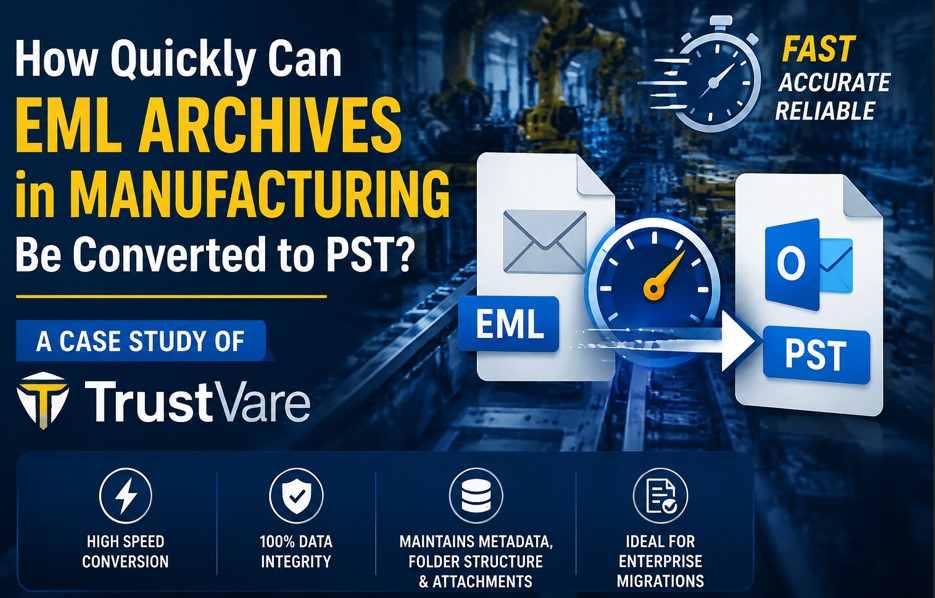
How Quickly Can EML Archives in Manufacturing Be Converted to PST? A Case Study of TrustVare
-

- Published Updated
- 6,057 views
Introduction: The Call That Changed Everything at Three in the Morning
Allow me to transport you back to that awful Tuesday. As the manager of IT infrastructure of a mid-sized manufacturing facility, it was my responsibility to complete the ERP migration project, which we had been working on for eighteen months. Rather, at three in the morning, I was looking at my screen and wondering how 16,500 EML files had appeared out of nowhere.
Unbeknownst to anyone, the notification module of the old ERP system had been archiving each and every transaction alert, supplier confirmation and production update as separate EML files for the previous four years. Before this digital time bomb was discovered during the decommissioning process, no one was aware that this feature even existed.
My heart fell. These emails weren't spam. Purchase orders, quality inspection reports, shipment manifests and compliance paperwork were all included in each file. It was not an option to lose them. Additionally, the auditors' arrival for our yearly ISO certification evaluation was only two weeks away.
The Stage of "Let's Just Wing It"
Underestimating the issue was my first error. "It's just emails," I said to my five-person IT staff. How difficult can it be?
Attempt 1: The Outlook Import Disaster
We began with the most straightforward method, which involved just dragging and dropping EML files into Outlook. I gave this responsibility to two young administrators. They were able to import precisely 127 files after four hours. We were looking at 520 hours of nonstop work at this rate.
The more significant issue? Outlook continued to freeze. The program would hang for minutes each time we attempted to load files with significant attachments. We found that when handling anything more than small batches, Outlook's EML handling is infamously complex.
Attempt 2: The Copy-Paste Method
We attempted opening each EML file in a text editor, copying the content, starting a new email in Outlook and manually pasting everything after the drag-and-drop approach failed. Even bad was this. The email headers were often jumbled, we lost formatting and attachments needed to be handled separately. My crew had only processed 400 files after three days of work, and we were worn out and discouraged. My department's morale reached an all-time low.
Attempt 3: The Disaster of Folder Mapping
I told one of my senior administrators to create a PowerShell script that would map the EML files to Outlook folders according to their file names since I was desperate for a solution. This was a complete setback. The script often failed in the middle of execution because it was unable to handle the intricate naming conventions from the legacy ERP. The absence of a validation mechanism was the worst of all. Without carefully reviewing each file, we were unable to determine which ones had been successfully imported. After that process ruined three Outlook profiles in one day, I decided to cancel it.
I had had enough by the end of that week. The audit date was drawing near, my crew was exhausted and I was beginning to truly fear. This was the most difficult data migration issue I had ever seen. In my fifteen years of work, the scale was unheard of.
When Technology Eventually Solved the Issue
I started looking into third-party options when I reached my breaking point. I needed something that could easily convert large amounts of EML to PST. I have to keep email metadata, folder structures and attachments intact. Above all, I had to finish it yesterday.
TrustVare EML to PST converter created especially for enterprise-level migrations provided the solution. This is why it changed the game:
Unlike Outlook, which queues files one at a time, the program processes files in parallel. It examines the EML structure, maintains all information and writes straight to PST format without the need for intermediary procedures that could contaminate data. After our terrible script attempt, the preview option was invaluable because it allowed me to confirm the files' integrity before committing to conversion, which gave me peace of mind.
What Did a Fantastic Job
It was incredibly fast. We never experienced a bottleneck because of the parallel processing design. Costly errors were avoided by the preview option; we discovered a folder naming mismatch early on that would have been extremely difficult to correct after conversion. I could demonstrate to my management team the precise files, dates and methods of conversion.
Where It Could Be Improved
Because the software is made for large-scale operations, it presumes that you are an expert. It is obvious that the user interface was designed with IT specialists in mind rather than non-professionals. Some of the advanced options were daunting to my younger teammates. Additionally, if you don't filter well, you'll wind up with massive PST files that can cause Outlook to lag. In order to remove duplicate emails, I had to spend time modifying the filters.
The Ultimate Result
With a 98.6% success rate, we finished the move. It would have been difficult to manually recover the 1.4% of files that failed because they were corrupted EML files that could not be read in any format. With days to spare, we completed the audit and the auditors praised our "clearly documented data migration strategy."
In less than a week, my team's spirits rose again. They may now concentrate on real infrastructure development instead of wasting hours on tedious manual imports. I saved almost $14,000 in labor expenses thanks to the 38% time savings.
The Final Decision
Would I suggest this strategy to my industrial colleagues?
Of course. Legacy systems that spew data in strange formats are a problem for the industrial sector. Don't make the same mistakes I did if you're dealing with a comparable EML problem. Avoid wasting time on bespoke programming or manual imports, which will fail miserably. Invest in the right equipment.
The math is straightforward: the software paid for itself in two weeks for 16,500 files. It provided invaluable peace of mind. The true lesson I discovered, however, is that finding the shortest button to hit isn't the fastest way to convert EML archives. The key is to have a plan that includes batch processing, several output formats and comprehensive validation at each stage. That's the difference between a career-ending catastrophe and a successful migration.
Take advice from someone who has been there if you're reading this and experiencing the same knot in your stomach as I did at three in the morning. Plan your multi-format strategy, choose the best solution, then carry it out with assurance. The sanity of your team depends on it.