Employee Recognition Programs: Why They Matter and What Actually Works
-

- Published Updated
- 50 views
Only 1 in 3 US workers strongly agree they were recognized for good work in the past seven days, according to Gallup. That is most of the workforce going a full week without hearing their work landed. This is a summary of our full guide, Employee Recognition Programs: Why They Actually Matter, covering what an employee recognition program is, the retention and burnout research behind it, the four types of employee recognition, how to build one and the tools teams use.
What is an employee recognition program?
An employee recognition program is a structured, repeatable system for acknowledging good work, built around published criteria, a set cadence and a mix of channels, rather than praise that only happens when a manager happens to remember. That structure is the entire difference between a program and a vague company value nobody can point to. It defines who gets recognized, for what, how often and through which channel, whether that is a public shoutout, a spot bonus, a formal award or extra time off, so appreciation does not depend on one manager's memory.
Where recognition comes from matters as much as whether it happens. Gallup's survey found the most memorable recognition came from a direct manager 28% of the time, a senior leader or CEO 24% of the time and peers just 9% of the time. If your program leans hard on peer-to-peer recognition tools while skipping manager training, you are optimizing the smallest slice of what actually moves people.
Why do employee recognition programs matter for retention?
Unrecognized employees quit at a measurably higher rate, and the research now tracks that gap across years, not just a single engagement survey. Employees who received high-quality recognition in 2022 were 45% less likely to have left their job by 2024, based on a longitudinal study of roughly 3,400 employees from Workhuman and Gallup. That two-year window rules out much of the noise a single-quarter survey would carry.
The same research found employees who strongly agree they receive adequate recognition are 37% less likely to be actively job hunting. Women who feel adequately recognized are 63% less likely to report burnout, and recognized Black and Hispanic employees are 7 times more likely to report a real sense of belonging at work.
Does giving recognition help the person doing it too?
Yes. Giving recognition in the past 30 days is linked to 57% lower odds of burnout and 24% lower odds of probable anxiety in the person giving it, according to O.C. Tanner's 2025 Global Culture Report. A manager who builds a recognition habit is protecting their own wellbeing, not just their team's.
What are the different types of employee recognition?
Most working employee recognition programs layer four types of appreciation instead of relying on just one. Picking a single type is the most common reason a program feels thin within a few months.
- Spot recognition: a quick, specific shoutout tied to one piece of work, given within days of it happening, not months later.
- Formal awards: a best performer award or a quarterly ceremony, with selection criteria published in advance so it does not read as favoritism.
- Peer-to-peer recognition: a Slack integration, a nomination form or a shared doc where colleagues flag each other's work directly.
- Milestone rewards: tied to tenure, project completion or a service anniversary, kept separate from performance-based recognition so people do not confuse showing up with standing out.
How do you build an employee recognition program that works?
You build a working program by publishing clear criteria for who gets recognized and why, running it on a fixed cadence instead of ad hoc timing, and combining manager-led recognition with peer-to-peer channels. Skip any of those three and participation drops off within a quarter.
- Write the criteria first. Decide what actually earns recognition before you pick a tool or a budget.
- Set a cadence and stick to it. Weekly beats quarterly. A five-minute recognition slot at the start of a team meeting costs nothing.
- Mix manager and peer channels. Manager recognition carries the most weight, but a peer channel catches wins a manager never sees.
- Cross-check against real activity data to catch who is overdue, not just who is underperforming.
- Review participation monthly. A spike at launch and a flatline by month three means the program failed.
Which tools do companies use?
Points-based platforms like Bonusly and Nectar let employees give each other points tied to company values. Motivosity, Achievers and Workhuman run similar models at larger scale, and Blueboard offers experience-based rewards. Small companies do not need any of that to start: a public Slack channel for peer shoutouts, a five-minute recognition slot in the weekly meeting and a small manager-approved spot bonus budget of $20 to $50 a month often outperforms an enterprise platform a small team never adopts. Consistency, not budget, is the real constraint.
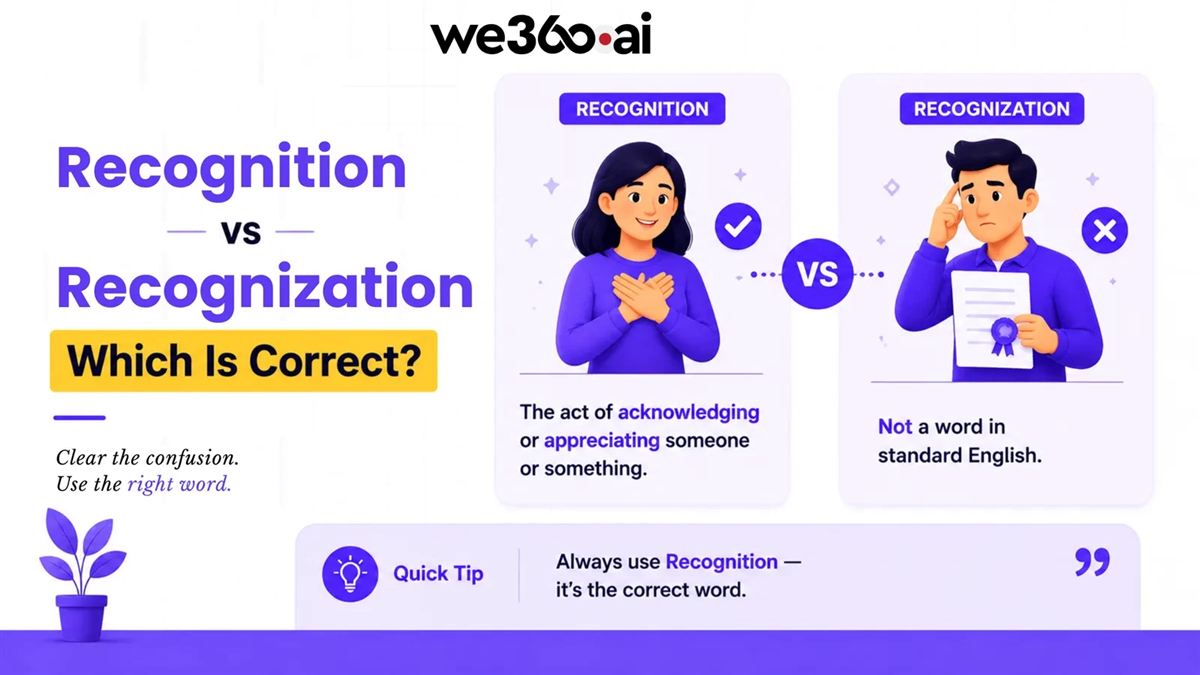
Is it "recognition" or "recognization"?
It is recognition. "Recognization" is not listed as a standard word in Merriam-Webster, Oxford or Cambridge, and search engines autocorrect it anyway. In Indian English, both "recognise" and "recognize" are correct; "recognization" is neither.
Why the loudest employee is not always the best performer
Recognition run on gut feel rewards visibility, not contribution: the person who looks busiest or communicates the most can get the credit while strong contributors stay unseen. We360.ai uses workforce data to show who is actually carrying the team, so recognition and promotion decisions rest on evidence instead of perception. It is used by 120K+ users across 10K+ companies in 21+ countries, and G2 has voted it the highest-rated employee monitoring software in the world (4.7 rating).
If you are running recognition on gut feel and a shared spreadsheet, start a free trial of We360.ai and pull an activity report before your next round of shoutouts. It surfaces the people quietly carrying a team and flags rising attrition risk before someone hands in notice.