Enterprise Blockchain Development: What Businesses Need to Consider Before Scaling
-

- August 27th, 2026
- 1,954 views

Blockchain technology has evolved considerably beyond its early association with cryptocurrency. Today, businesses are exploring blockchain for applications involving supply chains, financial services, digital assets, identity, payments, asset tracking, and multi-party data sharing.
However, building a blockchain proof of concept is very different from deploying a system that can support real business operations.
Enterprise blockchain development requires organizations to consider architecture, security, interoperability, governance, scalability, and integration with existing technology. A successful implementation is not simply about selecting a blockchain network and writing smart contracts. It is about determining where distributed technology can provide measurable value and designing the surrounding system accordingly.
Start With a Business Problem
The first step in an enterprise blockchain project should be identifying the business problem.
Blockchain can be useful when several parties need to share trusted information, verify transactions, automate predefined processes, or maintain a common record without relying entirely on a single centralized authority.
Potential use cases include:
Supply-chain traceability
Digital asset management
Cross-organization transaction processing
Document and credential verification
Payment and settlement workflows
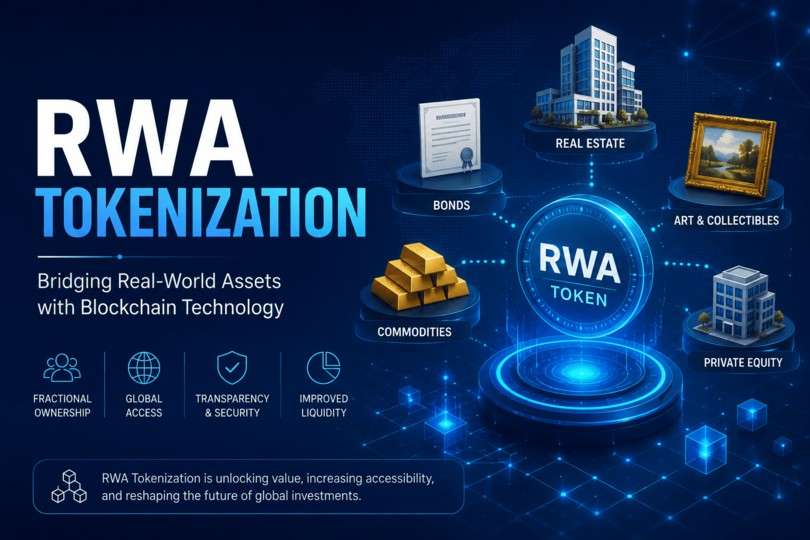
Asset tokenization
Automated business agreements
Shared records between business partners
If a conventional database can solve the problem more efficiently, blockchain may not be necessary. A clear business case should therefore come before technology selection.
Choosing the Right Blockchain Architecture
Enterprise requirements can differ significantly from those of public blockchain applications.
Some organizations may need a public network because transparency and open participation are important. Others may require a permissioned environment where participants are known and access can be controlled.
Consortium and hybrid architectures can also be appropriate when several organizations need to collaborate while maintaining defined governance and access rules.
The architecture should be evaluated according to factors such as:
Data privacy
Transaction volume
Performance requirements
Participant permissions
Governance
Compliance
Interoperability
Infrastructure requirements
Long-term scalability
There is no single blockchain architecture that works for every enterprise. Selecting the technology according to the business requirements is more important than following industry trends.
Integration With Existing Systems
One of the biggest challenges in enterprise blockchain projects is integration.
Large organizations rarely operate on a single application. They may already have ERP systems, CRM platforms, payment gateways, databases, cloud infrastructure, identity systems, analytics tools, and internal APIs.
A blockchain application must often communicate with several of these systems.
For example, a supply-chain application might need information from an ERP platform, while a financial application may need to interact with payment infrastructure and identity verification services.
This means businesses should define integration requirements early.
Important questions include:
Which systems will provide information to the blockchain?
Which applications will consume blockchain data?
What APIs are required?
Which data should remain off-chain?
How will user identities be verified?
How will failures and exceptions be handled?
Well-designed enterprise blockchain solutions should fit into the organization's existing technology environment instead of becoming an isolated system.
Smart Contracts Need Careful Planning
Smart contracts can automate business rules and execute predefined actions when certain conditions are satisfied.
For example, a smart contract could trigger a transaction after a delivery milestone is verified or automate a settlement process after predefined conditions are met.
However, smart contracts should not be treated simply as pieces of code that replace traditional business logic.
Before implementing one, organizations should determine:
What conditions trigger execution?
Who can initiate the transaction?
What happens when an expected condition fails?
Can business rules change later?
How are permissions controlled?
How will the contract be tested?
What security review is required?
Because smart contracts can control assets or business-critical transactions, testing and security assessment should be incorporated into the development process.
Security Must Be Designed Across Multiple Layers
Blockchain provides specific security properties, but an enterprise blockchain application can still contain vulnerabilities.
The complete system may include smart contracts, APIs, wallets, identity services, cloud infrastructure, databases, front-end applications, and third-party integrations.
Security planning should therefore cover the entire technology stack.
Organizations should consider:
Identity and Access
Users and organizations should receive only the permissions required for their roles.
Key Management
Private keys and other cryptographic credentials need appropriate protection, storage, recovery, and access controls.
Smart Contract Security
Contracts should undergo thorough testing and, where appropriate, independent security reviews.
API Security
External interfaces need authentication, authorization, monitoring, and appropriate protections against abuse.
Infrastructure Security
Blockchain nodes and supporting infrastructure need to be secured, monitored, updated, and backed up according to operational requirements.
Decide What Data Belongs On-Chain
Putting every piece of business information directly on a blockchain is rarely the best architecture.
Enterprises may need to consider privacy, storage requirements, performance, compliance, and data retention before deciding what should be recorded on-chain.
In some systems, the blockchain may store transaction records, proofs, ownership information, or other information that benefits from shared verification, while larger or sensitive datasets remain in conventional databases or secure off-chain storage.
This approach can allow organizations to use blockchain where it provides the greatest value without unnecessarily changing their entire data architecture.
Plan for Scalability From the Beginning
A successful pilot does not automatically mean that a blockchain application is ready for enterprise deployment.
As adoption increases, the system may need to support more users, transactions, organizations, integrations, and data.
Scalability planning should therefore include more than transaction speed.
Businesses should also evaluate:
Infrastructure capacity
Number of network participants
Integration load
Data growth
Monitoring requirements
Upgrade processes
Security operations
Future business requirements
Testing should reflect realistic production scenarios rather than relying solely on theoretical network performance.
Enterprise Blockchain Requires Long-Term Thinking
Blockchain development does not end when an application goes live.
Production systems require monitoring, security updates, performance optimization, infrastructure management, smart contract maintenance, and integration changes.
Business requirements may also evolve over time. A system designed for a small group of participants may eventually need to support additional partners, customers, or geographic markets.
For this reason, organizations should evaluate development partners not only on their ability to build a prototype but also on their ability to design an architecture that can evolve.
Final Thoughts
Enterprise blockchain development is increasingly becoming a practical technology discipline rather than an experimental exercise.
The organizations most likely to benefit are those that begin with a specific business problem and then evaluate whether blockchain provides a meaningful advantage.
Architecture, integration, security, governance, smart contracts, data management, and scalability all need to be considered before moving from a proof of concept to production.
The objective should not be to put an entire business on a blockchain.
Instead, organizations should identify the processes where blockchain can improve trust, coordination, automation, traceability, or digital ownership—and then build a secure and scalable system around those requirements.
That business-first approach provides a stronger foundation for developing enterprise blockchain systems that can deliver practical value over the long term.