ERP for Solar Industry: Optimizing Solar Manufacturing & Business Operations
-

- September 17th, 2026
- 1,970 views
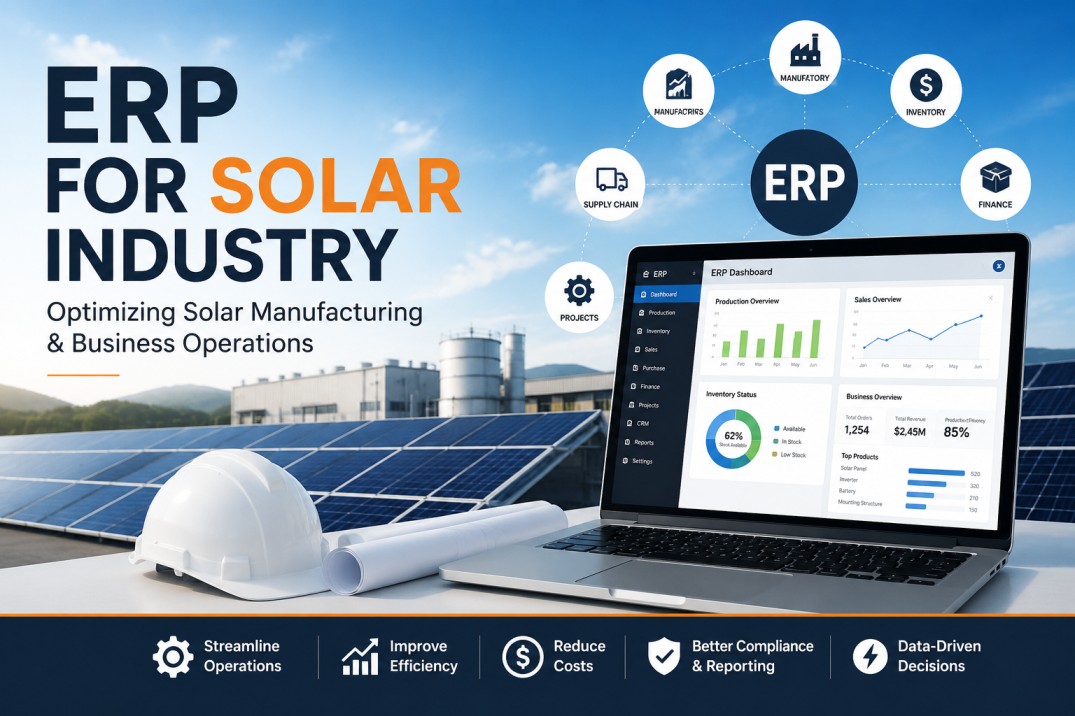
The solar energy industry is growing rapidly, but expansion also brings greater operational complexity. Solar manufacturers, EPC companies, distributors, and installation businesses must coordinate procurement, inventory, production, projects, sales, finance, quality control, and customer service.
Managing these activities through spreadsheets and disconnected software can lead to delays, duplicate data, inventory problems, and limited visibility.
This is where ERP for Solar Industry businesses can make a significant difference.
An Enterprise Resource Planning system connects different business functions through a centralized platform. Instead of managing production, purchasing, inventory, finance, and sales separately, solar companies can bring these processes together and create a more streamlined operational workflow.
What Is ERP for Solar Industry?
ERP for Solar Industry refers to an integrated business management system designed to support the specific operational requirements of solar energy companies.
Depending on the organization, a solar ERP platform can manage:
Solar panel manufacturing
Production planning
Raw material procurement
Inventory management
Warehouse operations
Quality control
Project management
Sales and CRM
Accounting and finance
Installation management
Vendor management
Maintenance and service
Business reporting
The purpose is not simply to digitize individual tasks. It is to connect them so that information can move efficiently between departments.
For example, when a solar company receives a new order, the ERP can connect the order with inventory requirements, procurement, production planning, delivery, and invoicing.
Why Solar Companies Need ERP Software
Solar businesses often operate across multiple departments and locations. As order volumes increase, manually coordinating these processes becomes difficult.
Common operational challenges include:
Inaccurate inventory information
Production delays
Manual data entry
Procurement inefficiencies
Difficulty tracking projects
Poor cost visibility
Delayed reporting
Communication gaps
Duplicate records
Limited management visibility
An ERP system creates a centralized source of operational information, helping teams work from consistent and up-to-date data.
How ERP Optimizes Solar Manufacturing
Solar panel manufacturing involves multiple stages and materials. An ERP system can help businesses coordinate these activities more efficiently.
A typical manufacturing workflow may include:
Procurement → Raw Materials → Production Planning → Manufacturing → Quality Control → Finished Goods → Warehouse → Dispatch
Connecting these stages allows manufacturers to track materials and production more effectively.
Production Planning
Production planning helps manufacturers determine what needs to be produced, when production should happen, and what resources are required.
An ERP platform can help coordinate:
Production schedules
Material requirements
Available resources
Manufacturing capacity
Work orders
Production progress
Better planning can help reduce production bottlenecks and improve resource utilization.
Bill of Materials Management
Solar panels contain multiple components, and different products may have different specifications.
ERP software can maintain Bills of Materials (BOMs) that define the components required for manufacturing a particular product.
These may include:
Solar cells
Glass
Encapsulants
Backsheets
Frames
Junction boxes
Connectors
Adhesives
Maintaining structured BOMs helps production teams work with consistent product specifications.
Raw Material and Inventory Management
Inventory is a major consideration for solar manufacturers.
Too little stock can interrupt production, while excessive inventory can increase storage expenses and tie up working capital.
An ERP system can provide visibility into:
Current stock
Reserved inventory
Incoming materials
Material consumption
Reorder levels
Warehouse locations
Batch information
Finished goods
This helps purchasing and production teams make decisions based on current requirements.
Streamlining Procurement
Procurement teams need to manage suppliers, purchase orders, prices, deliveries, and material requirements.
With an integrated ERP system, procurement can be connected directly to inventory and production planning.
For example, when material levels fall below a predefined threshold, the system can generate an alert for the procurement team.
This reduces reliance on manual inventory checks and helps businesses avoid unnecessary purchasing delays.
Supplier Management
Solar companies often depend on multiple suppliers for materials and equipment.
An ERP platform can maintain centralized supplier records and provide information about:
Purchase history
Pricing
Delivery performance
Order status
Quality issues
Payment records
Over time, this information can help businesses evaluate suppliers and make more informed procurement decisions.
Quality Management for Solar Manufacturing
Quality control is essential throughout solar panel production.
ERP software can support structured quality-management processes from incoming materials through finished products.
Businesses can track:
Incoming material inspections
Production-stage inspections
Finished-product testing
Defects
Batch information
Non-conformance
Quality reports
Batch Traceability
Batch tracking can make it easier to identify where a particular material or finished product originated.
If a quality issue is discovered, businesses can use ERP records to investigate relevant batches, suppliers, production stages, and inventory movements.
ERP for Solar EPC Companies
ERP is also useful for solar Engineering, Procurement, and Construction (EPC) companies.
An EPC project can involve:
Site surveys
Engineering
Procurement
Equipment
Installation
Workforce management
Vendor coordination
Project expenses
Customer billing
Maintenance
A centralized ERP platform can bring these activities together.
Project managers can monitor budgets, procurement, resources, timelines, and project progress from a unified system.
Warehouse Management
Solar companies may need to manage large quantities of panels, equipment, components, and installation materials.
Warehouse management functionality can help organize:
Goods receiving
Stock transfers
Warehouse locations
Barcode management
Batch tracking
Picking and packing
Dispatch
Inventory adjustments
Improved warehouse visibility can reduce stock discrepancies and make order fulfillment more efficient.
Financial Management
Manufacturing and project operations have a direct relationship with financial performance.
An ERP platform can connect operational activity with financial management.
Common financial functions include:
Accounts payable
Accounts receivable
Sales invoices
Purchase invoices
Expense management
Tax management
Budgeting
Cash-flow tracking
Profitability analysis
Financial reporting
This allows management teams to better understand how operational decisions affect business performance.
CRM and Sales Management
Solar companies also need to manage leads, customers, quotations, orders, and follow-ups.
CRM functionality within an ERP system can help teams manage:
Leads
Customer profiles
Quotations
Sales orders
Follow-ups
Communication
Customer service
Order status
When sales and inventory information are connected, sales representatives can have better visibility into product availability and order progress.
Real-Time Business Reporting
One of the key benefits of ERP is centralized reporting.
Management teams can use dashboards to monitor:
Inventory levels
Production status
Sales
Procurement
Project progress
Expenses
Revenue
Outstanding payments
Operational performance
Instead of waiting for separate departments to compile reports, decision-makers can access information through a centralized platform.
Key ERP Modules for Solar Companies
The modules required will depend on the organization's business model.
ERP Module |
Purpose |
Production Management |
Plan and monitor manufacturing |
Inventory Management |
Track raw materials and finished products |
Procurement |
Manage purchasing and suppliers |
Quality Management |
Monitor inspections and defects |
Warehouse Management |
Manage storage and movement |
CRM |
Manage customers and sales |
Finance |
Handle accounting and financial operations |
Project Management |
Manage solar EPC projects |
HR Management |
Manage employees and workforce |
Analytics |
Monitor business performance |
A manufacturer may prioritize production and inventory, while an EPC company may place greater emphasis on project management and procurement.
Benefits of ERP for Solar Industry Businesses
Improved Operational Efficiency
ERP automation can reduce repetitive administrative tasks and streamline workflows between departments.
Better Inventory Control
Businesses can gain better visibility into available, reserved, incoming, and consumed inventory.
More Effective Production Planning
Production schedules can be aligned with orders, available materials, and manufacturing capacity.
Reduced Data Errors
Centralized information reduces the need to enter the same data into multiple systems.
Better Cost Visibility
Companies can monitor purchasing expenses, production costs, inventory values, and project budgets more effectively.
Faster Decision-Making
Real-time dashboards give management teams faster access to important business information.
Improved Customer Service
Sales and customer-service teams can access order and project information more quickly.
Automation in Solar ERP
Modern ERP systems can automate many repetitive workflows.
Examples include:
Inventory alerts
Purchase approvals
Reorder notifications
Invoice generation
Production workflows
Order updates
Approval processes
Financial entries
Performance reports
Automation allows employees to spend less time on repetitive administrative work and more time on strategic activities.
Cloud ERP vs. On-Premise ERP
Solar companies can choose between cloud-based and on-premise deployment depending on their requirements.
Cloud ERP
Cloud ERP is hosted on remote infrastructure and accessed through the internet.
Potential advantages include:
Easier remote access
Lower infrastructure requirements
Faster deployment
Scalable resources
Simplified updates
On-Premise ERP
On-premise ERP is hosted and maintained within the organization's own infrastructure.
It can provide greater control over the environment but may require additional IT resources for maintenance, security, and upgrades.
The best option depends on the company's budget, infrastructure, security requirements, workforce, and operational model.
How Much Does Solar ERP Development Cost?
The cost of developing an ERP for a solar business depends on the size and complexity of the system.
Factors that influence cost include:
Number of ERP modules
Manufacturing requirements
Number of users
Number of locations
Custom workflows
Third-party integrations
Mobile applications
Reporting requirements
Cloud infrastructure
Security requirements
Custom UI/UX
Ongoing maintenance
A small ERP implementation with basic inventory, sales, and finance functionality will generally require less investment than a large platform connecting manufacturing, EPC projects, warehouses, CRM, finance, analytics, and multiple locations.
Businesses should therefore define their requirements before requesting development estimates.
How to Implement ERP Successfully
ERP implementation should be approached as a business transformation project.
1. Analyze Existing Processes
Identify how procurement, manufacturing, inventory, sales, finance, and project management currently work.
2. Identify Bottlenecks
Determine where manual work, delays, duplicate data, or communication gaps occur.
3. Define ERP Requirements
Select the modules and workflows that are actually needed.
4. Prepare Data
Clean and organize customer, supplier, inventory, product, and financial information before migration.
5. Configure the System
Customize workflows and permissions according to different departments and user roles.
6. Train Employees
Employees should understand how the new platform affects their daily responsibilities.
7. Test Before Launch
Run realistic business scenarios to identify technical or workflow issues.
8. Monitor After Implementation
Track adoption, performance, errors, and employee feedback after launch.
Challenges of ERP Implementation
ERP implementation can provide significant benefits, but businesses should also prepare for potential challenges.
Employee Resistance
Employees accustomed to existing processes may need time to adapt.
Data Migration
Poor-quality or inconsistent historical data can complicate migration.
Excessive Customization
Too much customization can make future upgrades more complicated.
Training Requirements
Without adequate training, employees may not use the system effectively.
Integration Issues
ERP may need to integrate with accounting software, CRM systems, payment gateways, manufacturing equipment, logistics platforms, or other business tools.
How to Choose an ERP Development Partner
When selecting an ERP development company, solar businesses should evaluate:
Industry experience
ERP development expertise
Customization capabilities
Integration experience
Security practices
Scalability
UI/UX capabilities
Support and maintenance
Development methodology
Previous projects
The development partner should understand both the technology and the operational requirements of the solar business.
How Triple Minds Can Support Digital Business Solutions
Triple Minds works on digital solutions designed to help businesses improve operational efficiency and customer experiences.
For companies exploring ERP development, the focus should be on creating software around actual business workflows rather than forcing existing processes into a rigid system.
A customized ERP solution can be designed around areas such as:
Inventory
Procurement
Manufacturing
CRM
Project management
Finance
Reporting
Automation
The system can then evolve as the solar company expands its operations.
ERP and the Future of Solar Business Operations
The solar industry is moving toward increasingly connected and data-driven operations.
As businesses expand their manufacturing capacity, project portfolios, distribution networks, and customer bases, the need for centralized operational systems will become more important.
ERP can provide the foundation for this transformation by connecting:
Procurement → Inventory → Manufacturing → Quality → Projects → Sales → Finance → Reporting
Instead of viewing these functions as isolated departments, ERP creates an interconnected business environment.
Final Thoughts
The growing solar market presents significant opportunities, but companies need efficient systems to manage increasingly complex operations.
ERP for Solar Industry businesses can connect manufacturing, procurement, inventory, quality control, warehouse operations, project management, sales, and finance within one centralized platform.
For manufacturers, ERP can improve production planning, material management, quality tracking, and inventory visibility. For EPC companies, it can provide better control over projects, resources, procurement, and costs.
The key is to build or implement an ERP system around the company's actual requirements.
With the right technology, workflows, and implementation strategy, solar businesses can reduce operational inefficiencies, improve visibility, automate repetitive processes, and create a stronger foundation for long-term growth.
Frequently Asked Questions
What is ERP for the solar industry?
ERP for the solar industry is an integrated software system that helps solar businesses manage functions such as manufacturing, procurement, inventory, projects, sales, finance, quality, and reporting from a centralized platform.
What are the main benefits of solar ERP?
Key benefits include improved inventory management, better production planning, centralized data, workflow automation, cost visibility, faster reporting, and improved coordination between departments.
Can ERP be customized for solar panel manufacturing?
Yes. An ERP platform can be customized around manufacturing workflows, Bills of Materials, inventory, procurement, quality control, warehouse management, and other requirements.
Is ERP useful for solar EPC companies?
Yes. ERP can help EPC companies manage projects, procurement, equipment, resources, expenses, customers, billing, and project reporting.
How much does solar ERP development cost?
Development costs vary based on the number of modules, users, integrations, customization requirements, platform support, infrastructure, and overall project complexity. A detailed requirement analysis is recommended before estimating the final cost.