Exhibition Stand Builders Company in Germany: Trends & Planning Guide
-

- Published Updated
- 1,763 views
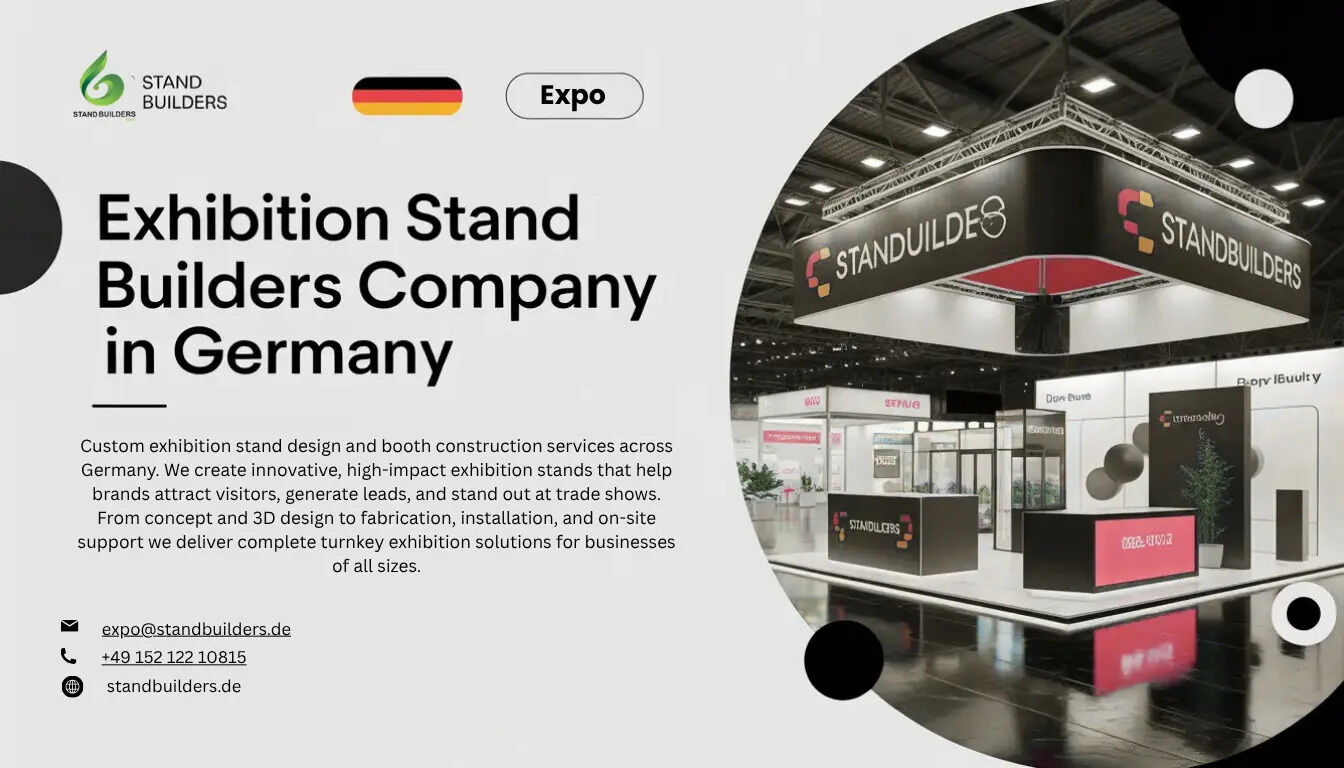
Germany still occupies a significant place in the international exhibition industry, and its main trade fair cities draw in companies from a wide range of sectors such as manufacturing, automotive, healthcare, technology, construction, energy, logistics, and many others. When businesses take part in these exhibitions, their exhibition stand usually becomes the central point of their marketing and communication strategy.
Success in taking part is seldom based merely on appearance. People attending expect to find useful information, easy access to interaction, demonstrations that are relevant, and a pleasant atmosphere in which professional discussions can take place. At the same time, exhibitors have to deal with their budgets, the technical regulations, transportation, the installation timetable, and the need to consider sustainability.
That is why a Exhibition Stand Builders in Germany can be seen as belonging to the broader exhibition planning process, and by understanding the existing methods of design and preparation businesses will be able to make more informed decisions before deciding on a specific stand concept.
Germany's Role in the Exhibition Industry
Germany hosts a large number of well-established trade fairs every year, and exhibition centres in Frankfurt, Düsseldorf, Munich, Cologne, Hannover, and Berlin draw in both domestic and international participants.
A great deal of attention is given to particular professional sectors, so that visitors generally seek out practical information rather than general entertainment. For example, a potential buyer might wish to compare different suppliers, whereas a technical specialist could be interested in product specifications or live demonstrations.
A exhibition stand which is to be effective should therefore make sure that relevant information is accessible and at the same time provide an environment in which professional discussions can occur.
Planning the Exhibition Before Designing the Stand
A design process functions more efficiently if it begins with well-defined objectives.
A company might wish to launch a product, improve its relationships with current customers, obtain qualified leads, show off its technology, or move into a new market; different approaches are needed depending on the objective.
For instance, a company that is launching complex industrial equipment will need a large demonstration area, whereas a consulting firm will get more benefit from having comfortable meeting rooms.
Research into the audience is just as important; by understanding the profiles of visitors, the professional roles they hold, their expectations, and the questions they usually ask, it is possible to decide which information should be given the most visual emphasis.
Emerging Exhibition Stand Design Trends
Sustainable Exhibition Concepts
Sustainability has become a consideration of greater relevance to businesses that take part in exhibitions. The use of reusable structures, recyclable materials, energy-efficient lighting, modular components and responsible choice of materials can help to cut down on waste that is not needed.
Reusable stand components can also be very useful for companies that take part in a number of events. Rather than having to build a completely new booth for each exhibition, they can reuse or reconfigure the adaptable parts.
It should therefore be seen as both an environmental and an operational issue.
Technology With a Purpose
Digital screens, interactive displays, augmented reality, virtual demonstrations, and touch-based product presentations are all capable of improving the exhibition experience.
Technology is particularly useful in cases where it is difficult to transport or physically demonstrate a product. For example, a digital simulation can enable visitors to come to an understanding of a complicated industrial process without it being necessary to install the whole system at the exhibition.
What matters most is relevance; technology should aim to improve communication not just add to visual complexity.
Open and Flexible Layouts
In Germany modern exhibition stand design usually includes open layouts so that visitors can reach the stand from various directions.
Flexible spaces can also be put to various uses. For example, a demonstration area can be turned into a presentation space, and an informal seating area can be used for brief business discussions.
Understanding Stand Construction Options
Custom-Built Exhibition Stands
Custom stands offer a great deal of freedom when it comes to architecture, materials, lighting, graphics, and the design of the visitor areas.
They are useful in the case where a company needs a unique environment or has specific requirements regarding the presentation of its products; on the other hand, custom construction generally requires more detailed planning and coordination.
Modular Exhibition Stands
Modular systems are based on components which can be adapted. They are especially useful for companies that take part in a number of exhibitions since the dimensions and layouts of the booths may have to change.
Modular structures also enable a uniform visual identity to be maintained across various events while at the same time allowing some elements to be altered.
The choice that is suitable will depend on the company's aims, how often the events take place, the amount of floor space available, and the budget.
Understanding the Complete Exhibition Budget
Planning the budget for an exhibition should go beyond the cost of construction.
Businesses might have to take into account the cost of stand production, flooring, graphics, furniture, lighting, electrical services, technology, transportation, installation, dismantling, storage, venue charges, staffing, travel, accommodation, and promotional materials.
The price that an Exhibition Stand Contractor in Germany charges will depend on the size of the project, the degree of customisation, the materials used, the technical requirements and the range of services provided.
A balanced budget can help avoid a usual issue, which is allocating a large amount of money to the structure while not providing enough resources for the activities that really support visitor engagement.
Logistics and Local Requirements
The building of the stand itself is only one stage in the process of preparing for an exhibition.
It is necessary to get the materials to the venue, the installation has to take place within the given time windows, and the technical requirements might have to be approved before the event.
International exhibitors may also need to work with different suppliers in other countries. Delays in shipping or missing technical documents can cause extra stress during setup.
Sometimes companies think about using exhibition stand builders in Germany since a clear understanding of the local exhibition procedures can make coordination easier.
Common Exhibition Mistakes
A frequent error is to create a stand without taking the visitor's journey into account; although the booth might appear impressive it can still be hard to navigate.
A further problem is an overabundance of information. Having too many graphics, product descriptions, screens, or messages can cause the area to appear visually confusing.
A lack of storage can lead to yet another issue. Things such as boxes, brochures, technical equipment, and the staff's personal belongings should normally be kept out of sight.
Businesses should also refrain from ignoring the needs of their staff. They need enough space in which to move about, talk to visitors, get access to materials, and take breaks without disrupting the visitor experience.
When Businesses Consider Professional Stand Support
Firms that have their own design and events teams might take care of some parts of the preparation for an exhibition. But in the case of bigger or more technically complicated projects, special coordination is needed.
In Germany the builders can provide support in areas including concept development, technical planning, construction, graphics, transportation, installation and dismantling.
When companies are holding exhibitions in different countries throughout Europe, European exhibition stand builders should also be taken into account if a uniform approach is needed across various venues.
The amount of professional involvement that is appropriate will vary according to the complexity of the project, the organisation's internal resources, the timeline, and the budget.
How to Make the Stand More Visitor-Friendly
A visitor shouldn't find it difficult to understand the purpose of a stand.
Branding must be clearly visible from the aisle, the main messages have to be simple and to the point, the product displays should be placed at viewing positions that are comfortable and staff should have sufficient space to interact with visitors without causing a crowd.
Meeting areas should be easy to find yet should not obstruct the main visitor route.
The numerous small decisions together contribute to making the exhibition environment more functional and welcoming.
Conclusion
To exhibit in Germany it is necessary to achieve a balance between creativity, practicality, and preparation; companies must understand the exhibition audience, set clear objectives, select an appropriate stand format, manage the entire budget, and take into account the technical and logistical requirements.
Things like modular construction, the use of sustainable materials, open plans, and purposeful technology offer some useful possibilities, but one should not accept any of them just because they are in vogue. Each and every design choice must help achieve the company's aims and improve the visitor experience.
For international businesses which are not familiar with German exhibition procedures, it makes sense to consider employing a company that specialises in the construction of Exhibition Stand Builders Company in Germany if local co-ordination, technical knowledge and installation assistance are required. Finally, it is careful planning and making informed decisions that result in the exhibition space becoming a practical setting for communication and for professional interaction.
FAQs
What are the present-day trends in the design of exhibition stands in Germany?
Businesses might consider a number of approaches such as the use of sustainable materials, reusable structures, open layouts, modular systems, interactive technology, and spaces that are geared towards visitors.
Are sustainable exhibition stands more useful?
Reusable and modular components have the potential to decrease waste and offer flexibility when it comes to various events. Whether or not they are practical will depend on the exhibition schedule and the design requirements.
In what way can technology be used to improve an exhibition stand?
Technology can be used to carry out product demonstrations, give interactive presentations, provide virtual simulations, and facilitate the sharing of information as long as it helps the visitors to understand the subject matter.
What ought the budget for an exhibition to include?
Businesses ought to take into account the costs associated with construction, graphics, furniture, lighting, technology, transportation, installation, dismantling, venue services, staffing, travel, accommodation, and other expenses connected with the event.
What value is there in local exhibition knowledge?
Local knowledge will enable businesses to get a clear understanding of the venue's procedures, the installation timetable, the technical requirements, the logistics, and other practical matters relating to exhibiting in Germany.