Exhibition Stand Construction Company in Frankfurt Germany
-

- Published Updated
- 3,983 views
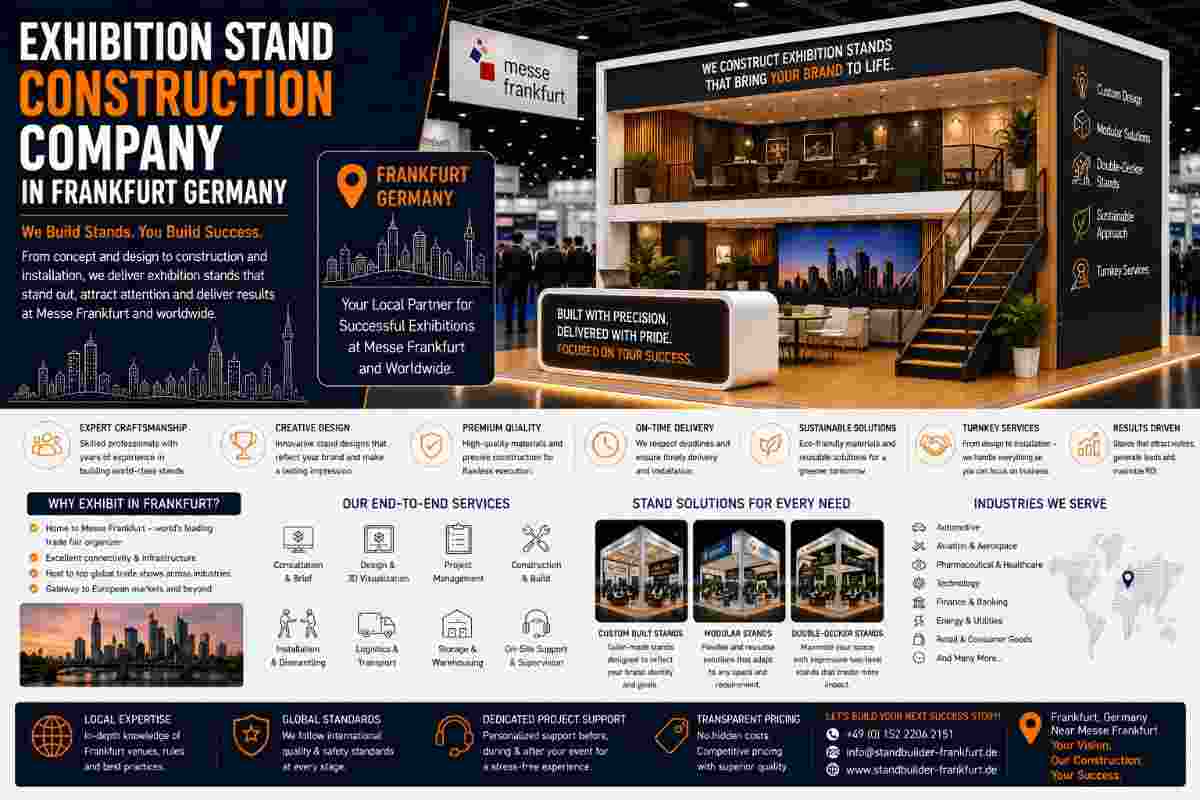
Most exhibitors only see the finished result — a stand fully assembled and ready before doors open at Messe Frankfurt. What actually happens between signing a contract and that final walkthrough is a longer, more technical process than most exhibition stand builders Frankfurt clients expect. Here's what a genuine exhibition stand construction company in Frankfurt Germany actually does at each stage, with realistic timelines for planning your own project.
Step 1: Discovery and Brief (Typically 1–2 Weeks)
Before any design work begins, an exhibition stand builder in Frankfurt needs a clear picture of your goals, audience, budget, and the specific trade fair you're attending. This stage usually includes a review of your assigned hall and stand dimensions, since technical requirements can vary meaningfully across Messe Frankfurt's 10 to 11 exhibition halls. Skipping detail here tends to cause revisions later, so a thorough brief upfront actually saves time overall.
Step 2: Concept Design and 3D Visualization (2–3 Weeks)
Once the brief is confirmed, designers develop initial layouts and 3D renders showing how the stand will look, how visitors will move through it, and where key branding elements will sit. A genuine exhibition stand design Frankfurt team typically runs a parallel structural feasibility check at this stage — confirming that ambitious elements like raised platforms or hanging signage are realistic before the client falls in love with a concept that can't be built as drawn.
Step 3: Engineering and Compliance Review (2–4 Weeks)
This is the least visible but arguably most important stage. German venues require formal structural sign-off, known as Statik, for stands above certain heights or with suspended elements. Engineers calculate load limits and prepare documentation for venue approval, while materials are checked against DIN fire-classification standards. An exhibition stand contractor Frankfurt exhibitors trust manages this step directly — rather than outsourcing it — which lets the same team handling design immediately adjust drawings if something doesn't clear review.
Quick Answer: How Long Does Exhibition Stand Construction Take in Frankfurt?
Q: How long does exhibition stand construction take at Messe Frankfurt?
A: Fabrication typically takes four to eight weeks depending on complexity, following two to four weeks of design and engineering review. On-site assembly is usually completed within Messe Frankfurt's tight build-up window, often just a few days immediately before the show opens.
Step 4: Material Sourcing and Fabrication (4–8 Weeks)
With approved drawings in hand, construction begins — often at a dedicated production facility rather than on-site. An experienced exhibition stand company Frankfurt exhibitors work with selects materials for durability, budget, and increasingly, sustainability, with recyclable framing and certified timber becoming standard requests. This stage runs in parallel with logistics planning, since transport needs to be scheduled well before fabrication finishes.
Step 5: Logistics and Transport Scheduling (Ongoing, Finalized 2–3 Weeks Before the Show)
Getting a completed stand from the workshop to Messe Frankfurt involves more coordination than exhibitors often expect. Delivery has to align precisely with the venue's assigned build-up window, and given Frankfurt's central city location, this also means navigating urban traffic patterns and access restrictions that a venue on the outskirts wouldn't require. Missing this window, even by a few hours, can create serious scheduling conflicts with other exhibitors sharing the same loading docks.
Step 6: On-Site Installation and Inspection (2–4 Days)
This is the phase most people picture when they think of "construction" — crews assembling the physical stand inside the hall. A completed structure typically goes through a final technical inspection covering electrical safety, structural stability, and fire compliance before the venue signs off on it being ready for visitors. Any issues discovered here, ideally caught earlier in engineering review, need to be resolved quickly given the tight timeline.
Step 7: Live Show Technical Support (Duration of the Event)
Once the show opens, construction work isn't necessarily finished. Lighting issues, loose panels, or last-minute layout adjustments can come up during multi-day shows like Automechanika or Ambiente. A trade show booth builder Frankfurt exhibitors keep on call throughout the event can resolve these quickly, while exhibitors without this support may be left waiting for a return visit.
Step 8: Dismantling and Storage (1–2 Days, Plus Ongoing Storage if Applicable)
After the show closes, the stand is disassembled according to the venue's teardown schedule. For exhibitors planning to attend future events, reusable modular components can be stored and prepared for reconfiguration at the next show rather than rebuilt entirely from scratch.
Why the Timeline Matters More Than Exhibitors Expect
Adding up these stages, projects with an exhibition booth builder Frankfurt exhibitors hire often span two to four months from initial brief to final installation, depending on the complexity of the design. First-time exhibitors frequently underestimate this, assuming construction can be compressed into a few weeks close to the show date. In reality, rushing engineering review or fabrication increases the risk of last-minute compliance issues — exactly the kind of problem that's far harder to fix once you're inside the venue's tight build-up window.
Where Blueprint Exhibits Fits Into This Process
Understanding each stage above makes it clear why having one accountable team matters — and Blueprint Exhibits manages this entire process under a single roof, functioning as a complete exhibition stand construction company Frankfurt Germany exhibitors can rely on:
- In-house design and 3D visualization developed alongside early structural feasibility checks
- Direct engineering review and Statik/fire-safety compliance management for Messe Frankfurt's halls
- Fabrication using durable, increasingly sustainable materials at a dedicated production facility
- Logistics coordination built around the venue's specific build-up window and urban access requirements
- On-site installation with a dedicated project manager present throughout
- Live technical support available for the full duration of the event
- Post-show dismantling, transport, and storage for reusable components
Managing every stage internally is what keeps this process moving efficiently instead of stalling at handoffs between separate vendors.
Conclusion
Exhibition stand construction in Frankfurt is a multi-stage process spanning design, engineering, fabrication, logistics, installation, live support, and dismantling — not a single event that happens in the final days before a show. Understanding realistic timelines for each stage helps exhibitors plan further ahead and avoid the compressed, high-risk schedules that cause most last-minute problems. Starting the process early, with one accountable team managing every step, remains the most reliable way to protect your show date.
Frequently Asked Questions
Q1. Can the construction timeline be compressed if I'm short on time?
Ans. Some stages can run in parallel, but engineering review and fabrication generally can't be rushed without increasing the risk of compliance issues or quality problems.
Q2. What is Statik certification and why does it add time to the process?
Ans. Statik is the structural engineering sign-off required for stands above certain heights or with suspended elements, and it must be completed before fabrication begins.
Q3. How far in advance should I start the construction process for Frankfurt?
Ans. Ideally two to four months before your show date, accounting for design, engineering, fabrication, and logistics scheduling.
Q4. What happens if my stand fails inspection during on-site installation?
Ans. Issues are addressed on-site where possible, but significant problems can cause delays — which is why catching structural issues during the earlier engineering review stage is critical.