Extendable Dining Tables : One Table, That Fits Every Occasion
-

- May 30th, 2026
- 6,261 views
Most of us do not need a big dining table every single day. Tuesday night dinner for two does not need the same table as Christmas with the whole family. But buying two separate tables is not exactly practical either. That is the problem an extendable dining table solves so neatly, and once you own one, it is genuinely hard to imagine going back.
If you are weighing up whether an extendable dining table is right for your home, here is everything you actually need to know before making the decision.
So what exactly is an extendable dining table?
An extendable dining table at its core is a dining table built with a mechanism that allows it to grow larger when you need it to. In its compact form it works perfectly for everyday use. Pull it apart, slide in a leaf or unfold a hidden extension, and suddenly you have a table that can comfortably seat twice as many people. Some designs extend from one end, others from the middle, and some fold out from the top. The result is always the same, a table that adapts to your life rather than the other way around.
Why more people are choosing extendable over fixed
The honest answer is space. Most homes do not have a dedicated dining room with unlimited floor space. Living rooms double as dining areas. Open-plan kitchens need furniture that earns its place every single day, not just on special occasions. A fixed large table in a smaller room constantly reminds you of how much space it takes up. An extendable table sits quietly in its compact form all week and steps up effortlessly when the weekend calls for it.
And beyond the practical side, there is a financial argument too. One well-chosen extendable table does the job of two separate ones, which makes it genuinely better value over the long run even if the upfront cost is slightly higher than a basic fixed table.
The extension types worth knowing about
♦ Butterfly leaf: A hidden leaf folds out from the center, which is smooth, quick, and has no separate pieces to store.
♦ Drop-in leaf: A removable panel slides into the middle, making it simple, flexible, and very common in solid wood tables.
♦ Draw leaf: Both ends pull outward to reveal built-in leaves underneath, elegant and effortless to operate.
♦ Folding top: One or both sides fold down when not in use, perfect for very compact spaces and occasional dining.
◊ Quick tip before choosing an extension type: If you extend the table regularly, go for a butterfly or draw-leaf mechanism. Both operate in seconds without any separate pieces to find, store, or lose. Drop-in leaves are great for occasional use but require storage space for the leaf panels.
Materials and what they mean day to day
1. Solid wood: It is still the most popular choice for extendable dining tables and with good reason. Oak and walnut handle daily use well, age beautifully, and feel substantial in a way that nothing else quite replicates. The extension mechanisms in solid wood tables also tend to be more reliable over years of repeated use.
2. Glass-top: Extendable tables look genuinely stunning and work well in modern and contemporary interiors. Just be aware that the extension mechanisms can be slightly more complex to operate, and the glass surface needs regular cleaning to stay looking its best.
3. Engineered wood options: It gives you a clean modern look at a much more accessible price. They work well for most households — just understand they will not handle heavy daily use quite as well as solid wood over the long term.
Styles that work in real dining rooms
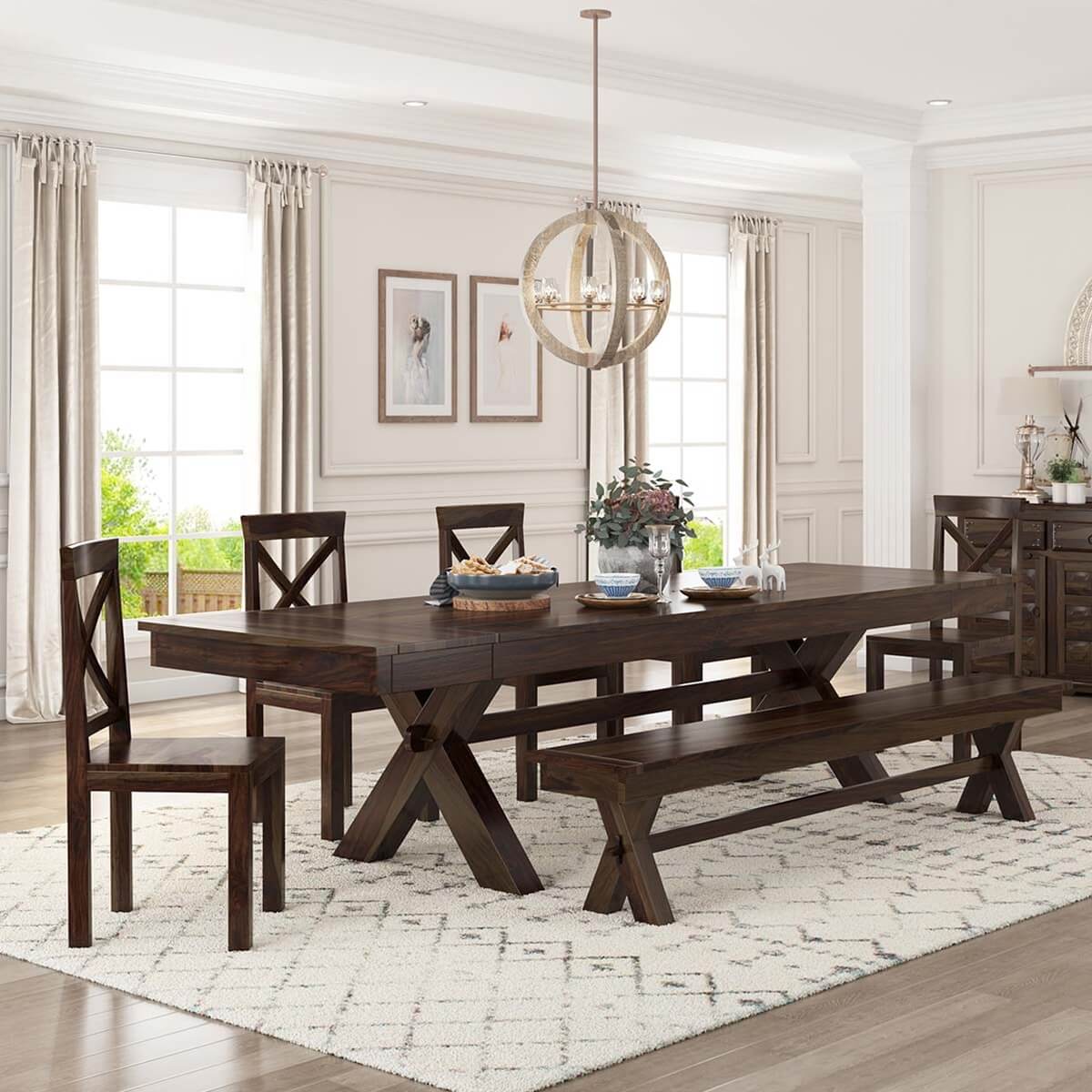
The good news about extendable dining tables is that they are no longer just a practical choice, they come in genuinely beautiful designs across every style direction. Whether you prefer farmhouse warmth or sleek modern design, most dining room table sets come in extendable versions today, giving you style and flexibility in one purchase.
→ Scandinavian: Light wood, tapered legs, clean lines. Compact and stylish in its everyday form.
→ Farmhouse: Solid and generous. Extends into a genuinely impressive centerpiece for big gatherings.
→ Modern: Bold base, mixed materials, seamless extension. Looks expensive at every size.
→ Industrial: Metal frame with wood top. Sturdy, characterful, and ages remarkably well.
What to check before buying
Measure your room in both states, compact and fully extended. You need at least 90 centimeters between the table edge and the nearest wall even when fully extended; otherwise, pulling chairs out becomes a daily frustration. Check how the extension mechanism operates—ideally test it in a showroom if you can, because some are genuinely smoother than others. Look at where the leaf panels store when not in use, since some drop-in leaf designs come without any built-in storage solution. And always check the seam where the extension meets the main table surface, since a visible gap or level difference between the two surfaces is a sign of lower build quality.
Quick FAQs
Q. How much does an extendable dining table typically extend by?
A. Most extendable tables add between 40 and 60 centimeters per extension leaf, typically allowing a 4-seater table to comfortably accommodate 6 to 8 people when fully extended.
Q. Are extendable dining tables as sturdy as fixed ones?
A. A well-built extendable table is just as sturdy as a fixed one. The key is build quality—solid wood frames with well-engineered mechanisms are every bit as stable as their non-extending counterparts.
Q. Which extension mechanism is the easiest to use?
A. Butterfly leaf mechanisms are generally considered the easiest and quickest to operate since the leaf is built into the table and requires no separate storage or handling whatsoever.
Q. Do extendable tables work in small dining rooms?
A. They are actually ideal for smaller rooms. Keep the table in its compact form day to day and only extend it when genuinely needed, giving you maximum flexibility without permanently sacrificing floor space.
Final Thoughts
An extendable dining table is one of those purchases that quietly makes daily life better in ways you do not fully appreciate until you own one. It gives you flexibility without compromise, handles every occasion without effort, and fits into real homes rather than demanding you redesign your space around it. Get the size right, pick a mechanism that suits how often you will use it, and choose a style that genuinely feels like yours. Do that and you will have a table that works as hard as you do—every single day.