Flutter vs React Native: Which Is Better for Mobile App Development in 2026?
-

- September 27th, 2026
- 1,901 views
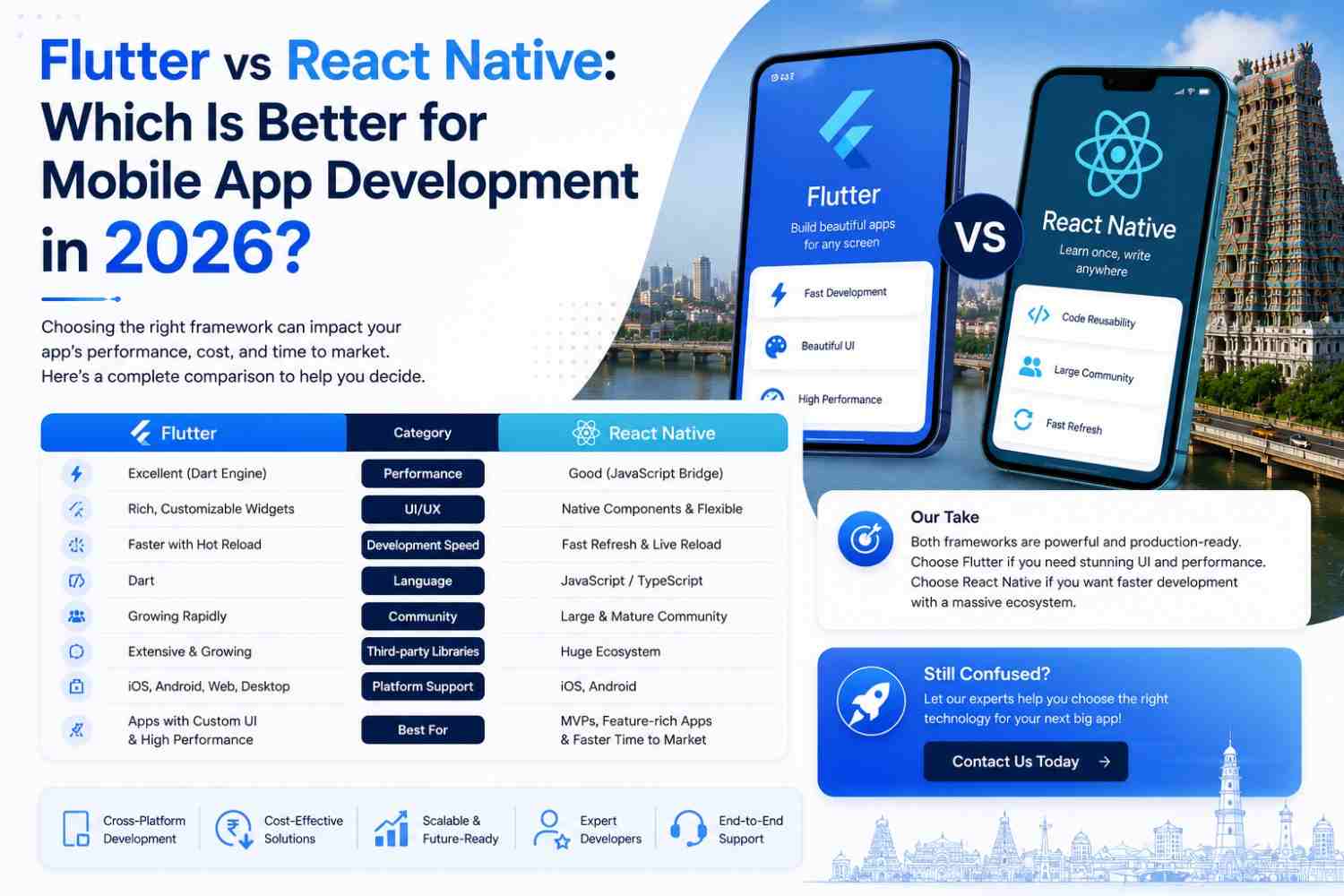
Choosing the right technology is one of the most important decisions when building a mobile application. With businesses looking for faster development, better performance, and applications that work smoothly across Android and iOS, cross-platform frameworks have become increasingly popular. Among the leading options, Flutter vs React Native remains one of the most discussed comparisons in mobile app development.
Both Flutter and React Native allow developers to create applications for multiple platforms using a shared codebase. They can reduce development time, simplify maintenance, and help businesses launch applications faster than building separate native applications from scratch. However, they use different technologies and approaches, which makes each framework better suited to certain types of projects.
In 2026, both Flutter and React Native are mature technologies with active development and strong communities. Flutter continues to improve its rendering engine, multiplatform capabilities, and developer experience, while React Native continues to strengthen its architecture, native integration, and React ecosystem.
So, which one should you choose? The answer depends on your business requirements, application complexity, development team, budget, performance expectations, and long-term product plans.
What Is Flutter?
Flutter is an open-source application development framework created by Google. It uses the Dart programming language and enables developers to build applications for Android, iOS, web, desktop, and other supported platforms using a shared codebase.
One of Flutter's biggest advantages is its widget-based architecture. Developers can use Flutter's extensive collection of widgets to create highly customized interfaces and maintain a consistent visual experience across different platforms.
Flutter also uses its own rendering approach, which provides developers with greater control over how the interface appears and behaves. This makes the framework particularly attractive for applications that require custom designs, smooth animations, interactive interfaces, and strong visual consistency.
For businesses, Flutter can be a practical option when the goal is to develop an application for Android and iOS without maintaining completely separate development teams for each platform.
What Is React Native?
React Native is an open-source mobile application development framework based on React. It was originally developed by Facebook, now Meta, and allows developers to build Android and iOS applications using JavaScript or TypeScript.
React Native is particularly popular among businesses that already use React or JavaScript technologies. Developers familiar with React can use many of their existing skills when working on mobile applications.
One of React Native's major strengths is its connection to the wider JavaScript ecosystem. Businesses can access a large developer community, numerous libraries, development tools, and integrations.
React Native also provides mechanisms for integrating native Android, iOS, and other platform-specific functionality when an application requires capabilities beyond the standard cross-platform layer.
Flutter vs React Native: The Main Difference
The biggest difference between Flutter and React Native is how they approach application development.
Flutter uses Dart and its own widget and rendering system. This gives developers significant control over the application's interface and visual behavior.
React Native uses JavaScript or TypeScript and follows the React development model. It is designed to work closely with native platform functionality while allowing developers to share application logic across platforms.
This fundamental difference affects UI development, performance, developer experience, native integration, and the overall architecture of an application.
Neither framework is automatically better for every project. The right choice depends on what your application needs to achieve.
Flutter vs React Native for Performance
Performance is one of the first factors businesses consider when selecting a mobile app development framework.
Flutter is designed to provide smooth rendering and consistent performance across supported platforms. Its rendering architecture gives developers considerable control over the user interface, which can be especially useful for applications with animations, custom graphics, and highly interactive screens.
React Native has also evolved significantly over the years. Improvements to its architecture and native integration have made it capable of supporting demanding production applications. Developers can also use native code when specific platform functionality requires it.
For standard applications such as eCommerce platforms, booking applications, business applications, food delivery apps, and marketplace platforms, both Flutter and React Native can provide excellent performance when the application is properly designed and optimized.
For applications where highly customized graphics and consistent rendering are critical, Flutter can be an attractive option. For applications that depend heavily on existing React infrastructure and native platform capabilities, React Native can be equally effective.
Therefore, performance should not be evaluated only by comparing frameworks. Application architecture, code quality, API performance, database design, image optimization, caching, and backend infrastructure can have a significant impact on the final user experience.
Flutter vs React Native for UI and User Experience
User experience plays a major role in the success of a mobile application. A technically powerful application can still fail if users find it difficult or unpleasant to use.
Flutter is known for its strong UI customization capabilities. Its widget-based approach allows developers to create highly customized interfaces while maintaining a consistent appearance across Android and iOS.
This makes Flutter particularly useful for brands that want a unique visual identity rather than relying heavily on standard platform components.
React Native follows a different approach by using React components and connecting them with native platform capabilities. Developers can create attractive and responsive interfaces, but applications with extremely customized designs may require additional UI work and platform-specific adjustments.
If your application requires a highly customized interface, complex animations, and consistent visual behavior across platforms, Flutter can be a strong choice.
If your application follows conventional mobile design patterns and your team already has React experience, React Native can provide an efficient development experience.
Flutter vs React Native: Development Speed
One of the main reasons businesses choose cross-platform development is to reduce development time.
With Flutter, developers can share a significant portion of the code between Android and iOS. Flutter's Hot Reload capability also allows developers to quickly view changes during development, which can speed up the design and development process.
React Native also allows developers to reuse application logic across Android and iOS. Developers who already understand React can often become productive quickly because they are working with a familiar programming model.
The actual development speed depends on the complexity of the application. A simple business application can be developed relatively quickly with either framework, while an advanced application involving real-time communication, multiple user roles, payment systems, location services, complex APIs, and third-party integrations will naturally require more development time.
In this area, neither framework has a universal advantage. The experience of the development team and the quality of the project architecture are often more important than the framework itself.
Flutter vs React Native: Programming Language
Flutter uses Dart, while React Native uses JavaScript or TypeScript.
Dart was designed to work closely with Flutter and provides a structured development environment. Developers who are new to both technologies will need to learn Dart before becoming comfortable with Flutter.
React Native benefits from the popularity of JavaScript and TypeScript. Businesses that already have JavaScript, TypeScript, or React developers may find React Native easier to adopt.
This makes React Native particularly attractive to startups and businesses with existing web development teams.
However, learning Dart is not necessarily a disadvantage. Flutter provides a closely integrated framework and language experience, which can make development predictable once the team becomes familiar with the technology.
Flutter vs React Native: Native Features and Integrations
Modern applications often require access to native device functionality. Applications may need camera access, GPS, Bluetooth, biometric authentication, push notifications, payment systems, background services, sensors, file storage, and other device capabilities.
Both Flutter and React Native can integrate with native Android and iOS functionality.
Flutter provides plugins and platform integration mechanisms that allow developers to communicate with native code when required.
React Native also provides native integration capabilities, allowing developers to connect JavaScript or TypeScript applications with native Android and iOS implementations.
For most common business requirements, both frameworks can handle native integrations effectively. However, highly specialized features may still require experienced native Android or iOS developers regardless of which cross-platform framework is selected.
Flutter vs React Native: Ecosystem and Community
React Native has a major advantage in terms of its connection to the JavaScript ecosystem. JavaScript is widely used across web development, backend development, and application development, giving React Native access to a large developer community.
Flutter has its own growing ecosystem built around Dart and Flutter packages. The framework has developed into a mature technology with a large global community and extensive documentation.
Both ecosystems provide libraries and tools for authentication, payments, maps, analytics, notifications, databases, state management, and other common requirements.
For businesses with an existing React or JavaScript team, React Native's ecosystem can be particularly convenient. For teams looking for an integrated cross-platform framework with strong UI capabilities, Flutter can be an excellent alternative.
Flutter vs React Native for Startups
Startups often need to launch an MVP quickly while keeping development costs under control.
Both Flutter and React Native can be suitable for startup applications because they allow businesses to share development work across Android and iOS.
Flutter can be particularly useful when the startup wants a visually distinctive product and expects to expand to additional platforms in the future.
React Native can be an excellent option when the startup already has React developers or plans to maintain a strong JavaScript technology stack.
The best approach is to choose the framework based on the product roadmap rather than simply selecting the technology that appears most popular.
Flutter vs React Native for E-Commerce Apps
E-commerce applications require product catalogs, search, filters, shopping carts, customer accounts, payment gateways, order management, notifications, and secure backend integrations.
Flutter is well suited to e-commerce applications because developers can create customized interfaces and maintain a consistent shopping experience across Android and iOS.
React Native is also a strong choice for e-commerce platforms, particularly when the business already has a React-based web platform or JavaScript development team.
For a new e-commerce business, either framework can work effectively. The final decision should be based on design requirements, existing infrastructure, developer expertise, integrations, and scalability expectations.
Flutter vs React Native for Food Delivery Apps
Food delivery applications typically involve multiple applications or user interfaces, including customer apps, restaurant panels, delivery partner applications, and administrative dashboards.
These applications may require real-time order tracking, GPS functionality, online payments, push notifications, restaurant management, delivery assignment, and live status updates.
Flutter can provide a consistent interface across multiple applications while allowing developers to build customized experiences.
React Native can also handle these requirements and is particularly useful for businesses with existing JavaScript or React infrastructure.
For complex food delivery platforms, the framework is only one part of the technology decision. Backend architecture, real-time communication, location services, database performance, and cloud infrastructure are equally important.
Flutter vs React Native for Healthcare Apps
Healthcare applications require careful attention to privacy, security, usability, and reliability.
Applications may include appointment booking, doctor discovery, telemedicine, patient management, digital records, notifications, and payment functionality.
Both Flutter and React Native can be used to develop healthcare applications. However, businesses operating in regulated healthcare environments must consider security architecture, data protection, authentication, encryption, hosting, compliance requirements, and integration with existing healthcare systems.
The choice between Flutter and React Native should therefore be based on the complete technical and compliance requirements rather than the framework alone.
Flutter vs React Native: Cost of Development in 2026
The cost of developing a mobile application depends on much more than the framework.
A basic application with a limited number of screens and simple functionality can require a relatively smaller budget, while a complex application with advanced features, backend systems, APIs, payment gateways, real-time functionality, multiple user roles, and third-party integrations will require a significantly larger investment.
In general, businesses planning a cross-platform mobile application in 2026 may consider an initial development range of around ₹1 lakh to ₹8 lakh or more, depending on the application's complexity and requirements.
Flutter and React Native can both help reduce duplicated development work because the same development team can build functionality for multiple platforms from a shared codebase.
However, choosing Flutter or React Native should not be based solely on development cost. A framework that fits the project properly can reduce maintenance problems and make future development easier.
Flutter vs React Native: Which Is Easier to Learn?
React Native may be easier for developers who already know JavaScript, TypeScript, or React.
Flutter requires developers to learn Dart, but the framework provides a highly integrated development environment once the team becomes familiar with the language.
For businesses hiring a new development team, the availability and experience of developers in the selected technology should be considered.
A highly experienced Flutter development team can often deliver better results than an inexperienced React Native team, and the same is true in the opposite direction.
Therefore, developer expertise should be considered alongside framework capabilities.
Flutter vs React Native: Which Is Better for Your Business?
If your business wants a highly customized interface, strong visual consistency, smooth animations, and a modern cross-platform development experience, Flutter can be an excellent choice.
If your business already has a React or JavaScript development team and wants to build mobile applications using familiar technologies, React Native can be a highly practical choice.
Flutter is also attractive when a company expects to expand its application beyond mobile and wants a technology that supports a broader multiplatform strategy.
React Native can be particularly valuable when an organization already has a strong React ecosystem and wants to connect mobile development with its existing technology stack.
Why Businesses Choose Cross-Platform App Development in 2026
Businesses are increasingly looking for ways to reduce development complexity while delivering applications across multiple platforms.
Building separate native Android and iOS applications can require different development teams, separate codebases, additional testing, and higher maintenance requirements.
Cross-platform frameworks such as Flutter and React Native allow businesses to share a significant amount of application code. This can simplify development and make it easier to release new features across multiple platforms.
For startups, small businesses, and growing companies, this approach can be especially useful when launching an MVP or entering the market quickly.
Flutter vs React Native: Final Verdict
So, Flutter vs React Native — which is better in 2026?
There is no single answer that applies to every business.
Flutter is an excellent option for companies that prioritize custom UI, visual consistency, animations, cross-platform development, and a unified development experience.
React Native is an excellent option for companies that already use React, JavaScript, or TypeScript and want to leverage their existing development expertise and the broader JavaScript ecosystem.
Both technologies can be used to build scalable applications for startups, e-commerce businesses, healthcare companies, financial services, food delivery platforms, marketplaces, logistics businesses, and enterprises.
The best framework is ultimately the one that matches your application's requirements, development team's expertise, budget, integrations, performance expectations, and long-term business goals.
Build Your Mobile App with the Right Technology
Choosing between Flutter and React Native is only the beginning of the mobile app development journey. A successful application also requires effective UI/UX design, scalable backend architecture, secure APIs, quality testing, cloud infrastructure, and ongoing maintenance.
Team Tweaks Technologies is a leading Mobile App Development Company in Chennai helps businesses plan and develop modern mobile applications based on their specific requirements. Whether you are considering Flutter, React Native, Android, or iOS development, the right technology can be selected based on your business model, target audience, application features, and future growth plans.
If you are planning to build a mobile application in 2026, choosing the right development approach at the beginning can help you create a scalable product while reducing unnecessary development and maintenance challenges.
Want to Know More? Reach out to Our Experts Today!
Visit Our Website For More Info: https://www.teamtweaks.com/
Call: +91 9894110087
Email: [email protected]