From Idea to App Store: What Mobile App Development Actually Involves
-

- Published Updated
- 1,724 views
Most failed apps don't fail because the code was bad. They fail because nobody made the hard decisions early enough — which platform to build for, what the MVP should actually include, how the app would be maintained six months after launch. By the time those questions surface, the budget is already spent and the product is halfway built in the wrong direction.
Understanding what mobile app development genuinely involves, beyond "hiring someone to build the app," is the difference between a product that launches on schedule and one that quietly stalls in development limbo. Here's what the process actually looks like when it's done properly.
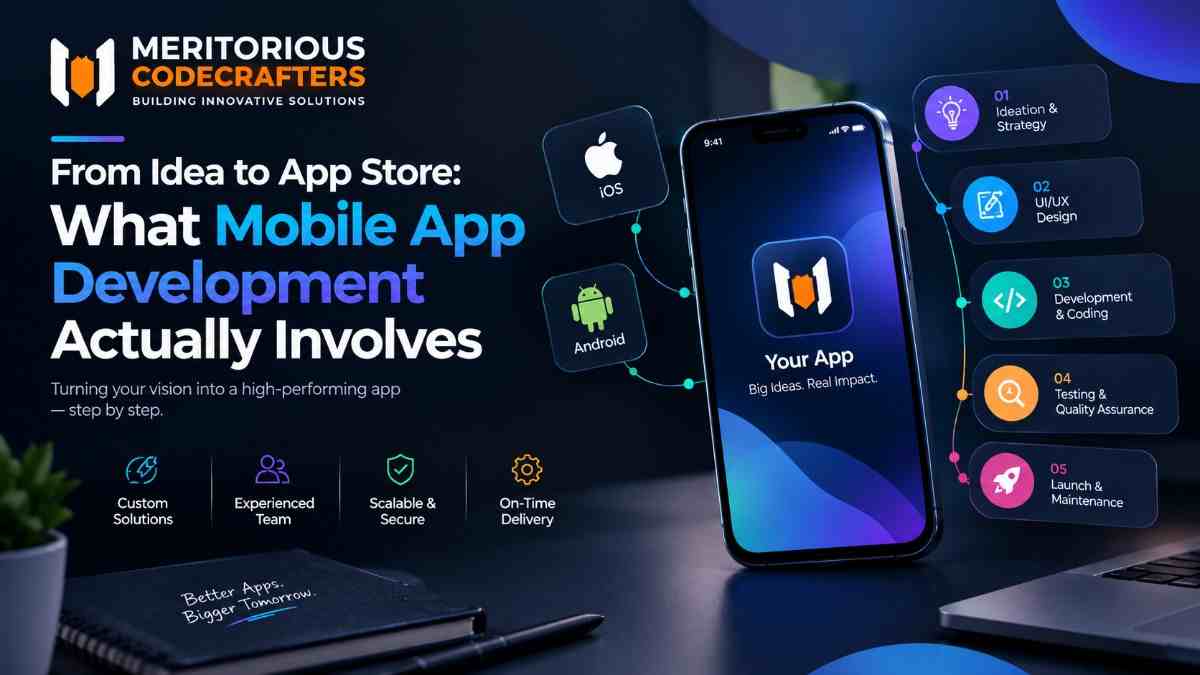
Stage 1: Deciding What You're Actually Building
Before anyone writes code, the scope has to be narrowed to something shippable. This is where most projects go sideways — a feature list that started reasonable balloons into something that takes nine months instead of three, and by launch the market has moved.
A good development partner pushes back here rather than simply agreeing to everything. The questions worth settling before development starts:
- What is the single core problem this app solves, and what's the minimum feature set that solves it?
- Which platform matters most to the target users, and does the product need both from day one?
- What needs to exist on the backend — an API, a database, third-party integrations, an admin panel?
- How will success be measured post-launch, and what analytics need to be built in to measure it?
Getting these answered in writing before the first sprint saves far more money than any hourly rate negotiation ever will.
Stage 2: Design Comes Before Development, Not Alongside It
One of the most common and expensive mistakes is treating design as something that happens in parallel with coding, or worse, after it. Building screens before the user flow is settled means rebuilding them later — and rework in code costs several times more than rework in a design file.
Proper UI/UX Design Services at this stage cover wireframes, user flows, and interactive prototypes that stakeholders can actually click through before a developer is booked. It's also where platform conventions get decided — an app that follows Apple's Human Interface Guidelines on iOS and Material Design on Android feels native on both, while one generic design applied to both tends to feel slightly wrong everywhere.
Stage 3: Choosing Native or Cross-Platform
This is the single most consequential technical decision in the project, and it shouldn't be made based on which approach is cheapest.
Native development means separate codebases built in the platform's own language — Swift for iOS, Kotlin for Android. It's the right call when the app depends on deep hardware integration, heavy camera or AR work, real-time processing, or immediate access to new OS features. For iOS-first products in that category, businesses typically Hire Swift Developers with genuine SwiftUI production experience rather than generalist mobile engineers, since Apple's frameworks carry their own learning curve.
Cross-platform development uses a single codebase that compiles to both platforms. For the majority of business apps — marketplaces, booking platforms, internal tools, content apps — this is the more efficient path, cutting both development cost and long-term maintenance roughly in half. Teams building this way generally Hire Flutter Developers to get native-feeling performance from one Dart codebase shipping to both app stores simultaneously.
The honest answer is that most apps don't need native, and the ones that do usually know it early — an AR fitness app or a camera-first social product has requirements that make the decision obvious. When it isn't obvious, cross-platform is usually the pragmatic choice.
Stage 4: Building the Backend and Web Layer Alongside It
An app is rarely a standalone product. Behind almost every mobile app sits an API, a database, authentication, and often an admin dashboard someone on the business side needs to actually operate the thing.
Running the mobile build and the backend as separate projects with separate vendors is a reliable source of delay — mismatched API contracts, unclear ownership when something breaks, slower iteration on any feature touching both. Development partners who handle both under one roof avoid most of that friction.
The same applies to any companion web platform. Many products launch with a mobile app and a web dashboard together, which is why teams often Hire React Developers for the web frontend while the mobile build runs in parallel — one design language, one API, two coordinated frontends rather than three disconnected projects.
Stage 5: App Store Submission Is Its Own Discipline
Plenty of technically finished apps sit in review limbo for weeks because nobody on the team had submitted to the App Store before. Apple's review guidelines are specific and enforced inconsistently enough that experience genuinely matters — privacy policy requirements, data collection disclosures, subscription implementation rules, and design standards all get flagged regularly.
Teams with real iOS App Development Services experience budget time for this properly and build compliance into the development process rather than discovering requirements during a rejected submission. Google Play is more forgiving but has its own policies around permissions and data handling that catch first-timers out.
Stage 6: The Part Nobody Budgets For
Launch isn't the finish line. Apple and Google both ship major OS updates annually, and apps that don't keep pace start breaking — deprecated APIs, changed permission models, new device form factors. Add ongoing bug fixes, security patches, and feature iteration based on actual user behavior, and post-launch maintenance typically runs 15-20% of the original build cost per year.
Businesses that skip this line item in their planning tend to find out about it when the app stops working on the latest iOS release and there's no team left under contract to fix it.
What This Means for Choosing a Partner
The practical takeaway is that "mobile app development" is not one skill — it's product strategy, design, native or cross-platform engineering, backend work, store compliance, and long-term maintenance. Vendors who only do one piece well leave the business to coordinate the rest.
For companies weighing their options, working with a partner offering end-to-end mobile app development services generally produces a smoother path from idea to launch than assembling specialists for each stage — not because any single stage is harder that way, but because the handoffs between them are where most projects actually lose time.