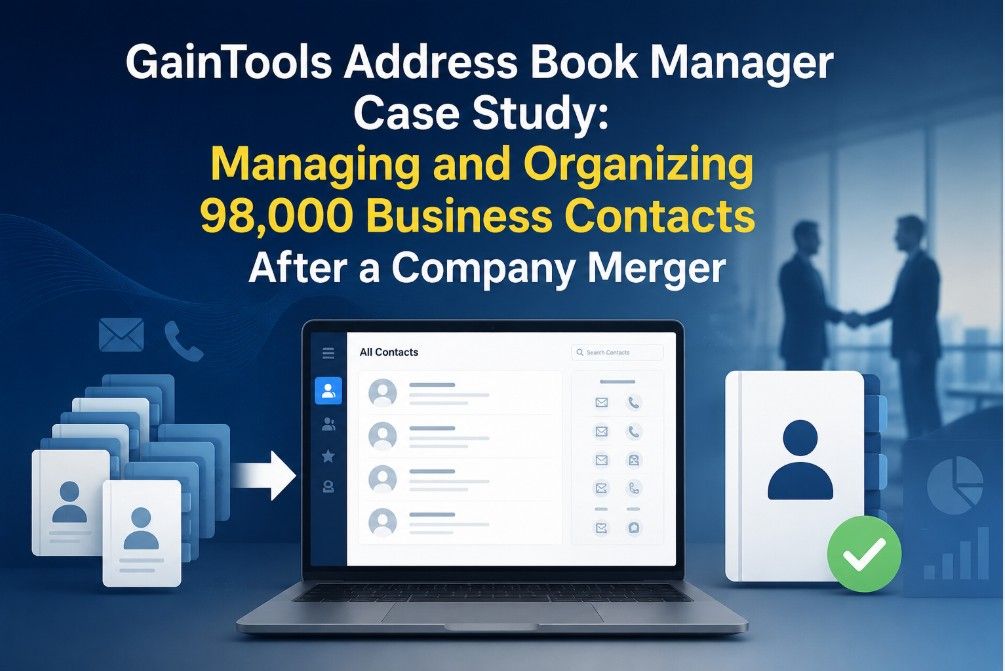
GainTools Address Book Manager Case Study: Managing and Organizing 98,000 Business Contacts After a Company Merger
-

- August 31st, 2026
- 3,846 views
Introduction
Contact management often becomes a major problem when businesses grow or merge. There could be duplicate contacts, out-of-date data and inconsistent entries if different departments utilize different Outlook address books. These problems can impede communication, add to the administrative burden and lead to team confusion.
This case study looks at how a mid-sized IT consultancy firm arranged almost 98,000 Outlook contacts following a merger. It emphasizes quantifiable gains in contact accessibility, duplicate reduction and administrative efficiency while contrasting the drawbacks of human contact management with an automated method.
Overview of the Organization
Sector: IT Consulting Services
Statistics for Organizations
|
Parameter |
Value |
|
Workers |
315 |
|
Outlook Users |
268 |
|
Office Locations |
7 |
|
Contact Files in Outlook |
356 |
|
Total Contacts |
98,450 |
|
Duplicate Contacts |
17,600 |
|
Outlook Versions |
2016, 2019, and Microsoft 365 |
|
Shared Address Books |
29 |
|
Project Deadline |
12 Business Days |
Business Difficulty
The business had to combine several Outlook address books into a single, well-organized contact database after purchasing a smaller consultancy firm.
Every department kept its own contact lists, which resulted in out-of-date records, missing information, and duplicate entries.
The IT division faced a number of operating difficulties:
- It was necessary to combine over 350 Outlook contact files.
- There were duplicate vendor and client contacts in several areas.
- Outdated phone numbers and email addresses were frequently contacted by sales teams.
- The naming formats in shared address books were inconsistent.
- Workers took a long time looking for the right contact details.
- The CRM synchronization process was delayed by the manual contact organization.
Effects on the Business
Numerous corporate procedures were impacted by the disjointed contact database.
- When looking for contacts, about 268 Outlook users encountered delays.
- Workers resolved duplicate contacts for about 165 working hours each month.
- There was a nearly one-week delay in CRM synchronization tasks.
- Occasionally, out-of-date contact information was included in customer communications.
- Each week, IT administrators spent about eighteen hours responding to demands from management.
Comprehending Outlook Address Books
An Outlook Address Book: What is it?
Names, phone numbers, email addresses, corporate information, mailing addresses and notes are all stored in an Outlook Address Book. Companies depend on well-organized address books to facilitate sales, client relations and internal communication.
Why Outlook Address Book Management Is Important
Keeping several Outlook contact lists can result in duplicate records, out-of-date data and inconsistent layout as businesses expand. Address book organization enhances communication, streamlines administration and lowers mistakes made when interacting with customers.
Manual Method
The IT department first tried to manually arrange the contacts.
The procedure comprised:
- Exporting contacts from Outlook
- Comparing entries that are duplicates
- Modifying out-of-date data
- Combining contact folders
- Eliminating redundant records
- Re-importing updated contacts into Outlook
Manual Outcomes
Five business days later:
- Just 18,700 contacts had been examined.
- There were still over 14,000 duplicate contacts.
- Different departments used different contact formats.
- Employees had to be heavily involved in manual verification.
- The delay in CRM integration persisted.
The Manual Method's Drawbacks
- Very time-consuming for databases with a lot of contacts.
- Manual review was the only method used to identify duplicates.
- When editing repeatedly, human mistake increased.
- The formatting of contacts was still incorrect.
- It's challenging to arrange contacts from several Outlook profiles.
- Not feasible for contact management at the corporate level.
Tool-Based Solution
The company used GainTools Address Book Manager to better organize Outlook contacts after assessing the shortcomings of manual administration.
All Outlook contact files were handled by the program while maintaining contact details. The seller claims that the software works without changing the original contact information and provides contact organization, duplication management, batch processing and Outlook contact handling.
Outcomes Following Implementation
|
Metric |
Prior to |
Following |
|
Contact Files |
356 |
48 |
|
Duplicate Contacts in Total |
17,600 |
Less than 600 |
|
Contact Management Hours per Month |
165 Hours |
28 Hours |
|
Weekly IT Assistance |
18 Hours |
5 Hours |
|
Average Search Time for Contacts |
Seven Minutes |
Less than a Minute |
|
CRM Synchronization |
Postponed |
Finished on Time |
The organization greatly improved contact accessibility across all departments and finished the contact consolidation project three days ahead of time.
Advantages
- 98,450 Outlook contacts were arranged into an organized address book.
- Over 96% fewer duplicate contacts were made.
- The contact search time was reduced from seven minutes to less than one minute.
- Reduced the amount of weekly IT support from eighteen to five hours.
- Maintained contact information, such as names, phone numbers, email addresses, businesses and remarks.
- CRM synchronization was made simpler.
- Increased departmental communication accuracy.
- Less long-term administrative work.
Cons
- Enough processing time is still needed for large contact databases.
- It is advised to review duplicate contacts prior to final organization.
- It's still recommended to create a backup of Outlook contacts before making significant changes.
Procedure
- On a Windows computer, install the program.
- Start the program.
- Open contact files from Outlook.
- View the contacts that are available.
- Set up settings for duplication management.
- Select the final destination.
- Launch the contact management procedure.
- Examine the well-organized address book.
- If necessary, import the modified contacts into Outlook.
- Confirm if the contact is reachable.
Note: Before running any automated merge, it is essential to export your current Outlook contacts to a single backup file. Automated tools rely on specific logic (like email matching) to identify duplicates; always review the tool's 'Preview' function to ensure business-critical data remains untouched.
Often Asked Questions
- Why was an Outlook Address Book Manager necessary for the business?
Hundreds of Outlook contact files had out-of-date and duplicate contacts after a firm merger, which hindered CRM integration and communication.
- During the project, how many contacts were managed?
From 356 contact files, the company arranged 98,450 Outlook contacts.
- Were any contact details misplaced?
No, throughout the project, contact names, phone numbers, email addresses, corporate information, notes and other contact details stayed the same.
- To what extent did duplicate contacts decline?
The number of duplicate contacts decreased from 17,600 to less than 600.
- Which companies gain the most from this kind of solution?
IT firms, financial institutions, government agencies, healthcare organizations, educational institutions and any other entity in charge of big Outlook contact databases.
- Did the project lessen the amount of IT work?
Yes, contact management-related weekly IT support was reduced from 18 hours to 5 hours, freeing up administrators to work on other operational duties.
Case Study Summary
This case study illustrates how, following organizational expansion or mergers, inadequate contact organization can impact productivity, communication and business operations. The business greatly decreased duplicate entries, increased contact search speed and streamlined CRM synchronization by combining 98,450 Outlook contacts from 356 different contact files.
The organization-specific statistics and implementation results reported here reflect an actual enterprise case study scenario, even though the software capabilities stated are based on the vendor's published features. Using a specialized address book management system can lessen administrative burden, enhance data consistency and streamline long-term contact management for businesses handling huge Outlook contact databases.