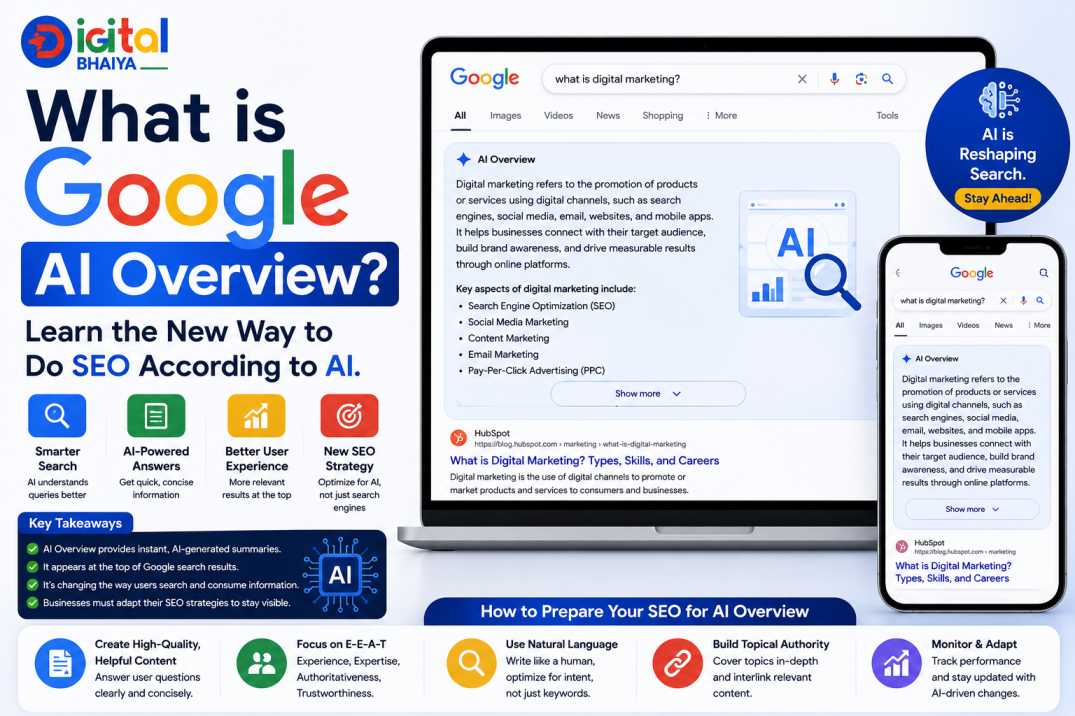
What is Google AI Overview? Learn the New Way to Do SEO According to AI.
-

- Published Updated
- 5,714 views
Something has changed on Google. And if you have not noticed it yet — you will very soon.
Open Google right now and search for anything. Before you see a single blue link — a large, AI-generated answer box appears at the very top of the page. It reads the question. It understands the context. And it gives a complete answer — instantly.
This is Google AI Overview. And it is changing SEO forever.
The moment most website owners see this — one question hits them immediately.
"If Google is answering everything directly — why would anyone click on my website?"
This is the right question. And it deserves an honest answer.
The rise of Google Search Generative Experience has made thousands of business owners and marketers genuinely worried about their website traffic, their rankings, and the future of everything they have built online.
But here is the truth.
SEO is not dead. It has evolved.
The businesses and websites that are still doing SEO the old way — stuffing keywords, chasing backlinks, writing thin content — will suffer. Their traffic will drop. Their rankings will slip. And they will not understand why.
But the businesses that understand how Google AI Overview works — and adapt their SEO strategy accordingly — will not just survive this change. They will thrive. Their traffic will grow. Their authority will increase. And Google's AI will actively recommend them to the right customers at the right time.
This blog will show you exactly how. Let us begin.
What Is Google AI Overview?
Let us break this down in the simplest way possible.
Google AI Overview — previously known as SGE or Search Generative Experience — is Google's newest and most powerful search feature. It sits at the very top of the search results page — above every paid ad, above every organic result, above everything.
When you type a question into Google — instead of just showing you a list of links and letting you figure it out — Google's AI reads hundreds of web pages simultaneously, pulls the most relevant and trustworthy information from all of them, and generates one clear, structured, easy-to-read summary answer — right there on the search results page.
No clicking required. No scrolling through ten websites. Just one complete answer — instantly.
Think of it this way.
In the past — Google was a librarian who pointed you to the right books and said "go read these." Today — Google has read every book in the library itself and gives you the answer directly.
That is Google AI Overview.
Where Do the Links Go — And Why This Matters for Your SEO?
Here is where it gets interesting for website owners and marketers.
Google AI Overview does not operate in isolation. It does not just generate an answer from thin air. It pulls data from real websites — and it shows exactly where that data came from.
Inside every AI Overview — you will notice two types of source links:
Small Source Cards at the Top
In the top right corner of the AI Overview box — Google displays small cards showing the websites it pulled information from to generate the answer. These cards show the website name, a small logo, and a brief excerpt. Websites that appear here receive high-visibility traffic from users who want to read more detail beyond what the AI summarized.
Expandable Dropdown Links Within the Answer
Inside the AI Overview text itself — specific sentences and claims are linked to the source websites that provided that information. Users can click directly on these inline links to visit the original source for more context.
What This Means for Your Website:
This is the single most important shift in SEO strategy that the Google AI Overview has created.
The goal of modern SEO is no longer just to rank on page one of Google's blue links. The new goal — the goal that drives real traffic in the AI era — is to become one of the source websites that Google's AI pulls from when generating its Overview answers.
When Google's AI cites your website as a source — your website appears inside the AI Overview itself. Right at the top of the page. In front of every user who searches that query. Before they see a single competitor.
This is more valuable than a number one ranking in traditional search results.
And the websites that get cited are not necessarily the biggest or the oldest. They are the ones that are most helpful, most specific, most authoritative, and most clearly structured — the ones that Google's AI can easily read, understand, and trust.
That is exactly what the rest of this blog will show you how to become.
Old SEO vs New SEO — The Mindset Shift You Cannot Ignore
This is the most important section of this entire blog.
Because the biggest reason most websites will lose traffic in the AI era is not a technical problem. It is a mindset problem. They are still playing by rules that no longer apply.
Here is exactly what has changed — and what you need to do differently starting today.
The Core Shift in One Sentence:
Old SEO was about telling Google what your page is about.
New SEO is about proving to Google's AI that your page is the most helpful answer to a specific question.
Old SEO vs New SEO — Point by Point
Keywords — From Short to Conversational
Old Way:
Target high-volume, short keywords. Stuff them throughout the content as many times as possible.
Target keyword: "SEO Company"
Strategy: Repeat it 20 times across the page and hope Google ranks you
New Way:
Target conversational, long-tail, question-based phrases that mirror how real people actually search and speak.
Target keyword: "Mujhe local business ke liye best SEO strategy batao"
Strategy: Write the clearest, most complete, most helpful answer to that exact question
Google's AI does not reward keyword repetition. It rewards the best answer to a real question.
Content — From Quantity to Clarity
Old Way:
Write long articles stuffed with keywords. More words meant better rankings. A 3,000-word article full of repetition outranked a 800-word article that was genuinely useful.
New Way:
Write content that is clear, specific, and directly answers the question being asked. Google's AI pulls from content that is easy to read, well-structured, and answers questions without making the reader dig through paragraphs of filler.
A 600-word article that answers one question perfectly will outperform a 4,000-word article that answers nothing clearly.
Links — From Quantity to Authority
Old Way:
Build as many backlinks as possible from as many websites as possible. More links meant more authority. Link farms and paid links were common tactics.
New Way:
Earn backlinks from genuinely authoritative and relevant sources. Google's AI evaluates the trustworthiness of your sources — not just the number of links pointing to your site. One link from a respected industry publication is worth more than 100 links from irrelevant directories.
On-Page SEO — From Meta Tags to Structured Data
Old Way:
Focus on meta title, meta description, and H1 tags. Make sure the keyword appears in the right places and the page is technically correct.
New Way:
Implement structured data and schema markup that tells Google's AI exactly what your content is about — in a language the AI understands perfectly. FAQ schema, Local Business schema, and Article schema give Google's AI rich, structured information it can pull directly into AI Overviews.
User Intent — From Traffic to Trust
Old Way:
Drive as much traffic as possible to the website. High traffic numbers meant success — regardless of whether visitors found what they were looking for.
New Way:
Satisfy user intent completely. Google's AI measures whether your content actually answered the question the user was asking. High bounce rates and short time-on-page tell Google your content did not deliver. Content that keeps users engaged and satisfied gets featured in AI Overviews. Content that disappoints gets buried.
The New Way to Do SEO According to AI
This is the section that will actually change how you do SEO.
Not theory. Not vague advice. Concrete, specific, actionable steps that you can start implementing today — and see results from within weeks.
Tip 1 — Write Clear and Direct Answers — E-E-A-T Focus
Google's AI has one job — find the best answer to a user's question and present it clearly.
It does not reward long introductions. It does not reward flowery language. It does not reward content that takes three paragraphs to get to the point.
It rewards content that answers the question immediately — clearly, specifically, and with genuine expertise behind it.
This is where E-E-A-T comes in.
E-E-A-T stands for Experience, Expertise, Authoritativeness, and Trustworthiness. It is the framework Google uses to evaluate whether a piece of content is worth citing in an AI Overview.
Experience — Has the author actually done what they are writing about? First-hand experience signals credibility that AI-generated or purely theoretical content cannot match.
Expertise — Does the content demonstrate deep knowledge of the subject? Surface-level content gets ignored. Specific, detailed, knowledgeable content gets cited.
Authoritativeness — Is the website and author recognized as a credible source in their field? Author bios, credentials, and backlinks from respected sources all build authority.
Trustworthiness — Is the information accurate, consistent, and verifiable? Outdated facts, broken links, and inconsistent information destroy trust signals.
How to Implement E-E-A-T in Your Content:
- Answer the main question in the first 2 to 3 sentences — do not make the reader scroll to find the answer
- Use clear headings that state exactly what each section covers
- Include specific examples, real numbers, and case studies from actual experience
- Add an author bio with credentials and relevant experience on every article
- Cite credible sources — link to Google, industry publications, and authoritative websites
- Keep content updated — add the publication date and update date to every article
- Write in a confident, direct tone — avoid vague language like "it might be" or "some experts say"
The Golden Rule of AI-Era Content:
If someone asks you a question and you answer it in one clear sentence — Google's AI notices. If someone has to read 500 words before finding the answer — Google's AI moves on to a better source.
Tip 2 — Target Long-Tail and Conversational Keywords
People no longer type keywords into Google. They talk to it.
They ask questions the same way they would ask a knowledgeable friend. And Google's AI is designed to understand and answer exactly these kinds of natural, conversational queries.
"How do I get my local business to rank on Google without spending money on ads?"
"Why is my Google Ads campaign not generating leads despite good traffic?"
"What is the best digital marketing strategy for a small business in Lucknow with a ₹10,000 monthly budget?"
These are not keywords. They are conversations. And they represent the fastest-growing segment of search queries in India today.
How to Find and Target Conversational Keywords:
Go to Google and type your main service — look at the "People Also Ask" section. Every question there is a conversational keyword opportunity.
Scroll to the bottom of Google search results — the "Related Searches" section shows exactly how real people phrase their queries
Use Answer The Public — answerthepublic.com — to generate hundreds of question-based keyword ideas around any topic
Listen to your customers — the questions they ask on WhatsApp, in consultations, and in emails are your best conversational keyword research
Structure Your Content Around Questions:
Create a dedicated FAQ section on every service page and blog post
Use "How to," "Why," "What," "Which," and "When" as section headings throughout your content
Write each FAQ answer in 3 to 5 clear sentences — specific enough to be useful, concise enough for Google's AI to pull directly into an Overview
Include location-specific questions — "How does Google Ads work for small businesses in Lucknow?" — to capture local conversational searches
Tip 3 — Schema Markup Is Now 100% Non-Negotiable
If E-E-A-T is the what of AI-era SEO — schema markup is the how.
Schema markup is structured code added to your website that speaks directly to Google's AI in a language it understands perfectly. Without schema — Google has to guess what your content means. With schema — you tell Google exactly what every piece of content on your website is, who it is for, and what question it answers.
In the AI era — this difference is enormous.
The Three Most Important Schema Types for AI-Era SEO:
Article Schema
Tells Google that your blog post or article is an authoritative piece of content — including the title, author, publication date, and topic. Article schema makes your content significantly more likely to be pulled into AI Overviews as a cited source.
Implementation: Add Article schema to every blog post and informational page on your website. Include the author name, date published, date modified, and article headline.
FAQ Schema
This is the single most powerful schema type for AI Overview visibility right now.
FAQ schema marks up your question and answer content so Google can read and understand each individual question and answer as a structured data pair. Google's AI pulls these directly into AI Overviews — making your FAQ content appear inside the AI answer itself.
Implementation: Add FAQ schema to every FAQ section on your website. Make sure each question is phrased exactly the way a real user would ask it — conversational and specific.
Local Business Schema
For local businesses — this is the foundation of AI visibility in local search.
Local Business schema tells Google's AI your exact business name, address, phone number, opening hours, service area, and business category — in a perfectly structured format that the AI can instantly read and use to match your business to local queries.
Implementation: Add Local Business schema to your homepage and contact page. Include every detail — name, address, phone, email, opening hours, geo-coordinates, and service area. Keep it perfectly consistent with your Google Business Profile information.
How to Implement Schema Without Coding:
WordPress users — install Rank Math SEO or Yoast SEO plugin — both include built-in schema tools
Use Google's free Structured Data Markup Helper at search.google.com/structured-data/helper
After implementation — test every page using Google's Rich Results Test at search.google.com/test/rich-results
Fix any errors immediately — broken schema is worse than no schema
Tip 4 — Strengthen Your Reviews and Digital Footprint
Google's AI does not just read your website. It reads everything about your business across the entire internet.
Your Google Business Profile reviews. Your ratings on Justdial and Sulekha. Your social media presence. Your mentions in news articles and blog posts. Your consistency across every platform where your business appears.
This collective online presence is your digital footprint — and Google's AI uses it to determine how confidently it can recommend your business.
Why Reviews Matter More Than Ever in the AI Era:
Google's AI actively scans review content — not just star ratings — to understand what your business is genuinely good at and who it serves best.
A review that says "Digital Bhaiya provided the best affordable Google Ads service in Lucknow for our real estate business — we got 40 leads in the first month" gives Google's AI specific, keyword-rich, credible information that it can use to match your business to highly specific local queries.
A review that says "Good service, recommend" gives Google's AI almost nothing.
How to Build a Strong AI-Ready Digital Footprint:
- Ask every satisfied client for a specific, detailed Google review — guide them on what to include — service name, result, location, and experience
- Send clients the direct Google review link on WhatsApp immediately after project completion — make it effortless for them
- Respond to every review — positive and negative — with specific, keyword-rich responses that add relevant context about the service mentioned
- Ensure your business Name, Address, and Phone number — NAP — is perfectly identical across Google, Justdial, Sulekha, Facebook, Instagram, and every other platform
- Get your business mentioned in local news websites, industry blogs, and community platforms — each mention strengthens your digital footprint and signals credibility to Google's AI
Consistency Is Everything:
Even a small difference — "Digital Bhaiya" vs "Digital Bhaiya Agency" vs "Digitalbhaiya" — across different platforms creates inconsistency that confuses Google's AI and weakens your local authority. Audit every platform where your business is listed and make everything identical.
Tip 5 — Build Topical Authority — Go Deep, Not Wide
This is the strategy that separates websites that get consistently cited in AI Overviews from those that never appear.
Most websites make the same mistake. They write one blog post about Google Ads. One post about SEO. One post about social media. One post about website design. Covering everything at a surface level — and becoming the authority on nothing.
Google's AI does not cite generalists. It cites specialists
What Is Topical Authority?
Topical authority means your website is recognized by Google as the most comprehensive and expert source on a specific subject. When Google's AI encounters a query about that subject — it goes to your website first because it knows your website covers that topic more completely and reliably than anyone else.
Building topical authority means writing everything about one topic — not a little bit about everything.
How to Build Topical Authority — The Pillar and Cluster Model:
Step 1 — Choose Your Core Topic
Pick the main subject your business wants to be the authority on. For Digital Bhaiya — this might be "Digital Marketing for Small Businesses in Lucknow."
Step 2 — Create a Pillar Page
Write one comprehensive, in-depth guide covering the entire topic. This is your pillar page — the most complete resource on your chosen subject. It should cover every major aspect of the topic in detail — typically 3,000 to 5,000 words.
Step 3 — Build Cluster Content
Write individual blog posts covering every specific subtopic within your main topic. Each cluster post goes deep on one specific aspect and links back to the pillar page.
Examples of cluster content for Digital Bhaiya:
"How Google Ads Works for Small Businesses in Lucknow"
"The Complete Guide to Meta Ads for Local Restaurants in Lucknow"
"Why Lucknow Real Estate Businesses Need Local SEO in 2025"
"How to Optimize Your Google Business Profile for AI Overviews"
"Step-by-Step SEO Guide for Small Businesses in Uttar Pradesh"
Step 4 — Connect Everything
Link every cluster post to the pillar page. Link the pillar page to every cluster post. This internal linking structure tells Google's AI that your website covers this topic comprehensively — from every angle — making it the most trustworthy source to cite.
The Depth Rule:
Every piece of content you publish should answer its specific question more completely than any other page on the internet. Not longer — more complete. More specific. More helpful. More genuinely useful.
When Google's AI encounters your content and finds that it answers a question better than everything else it has read — it cites you. Every time.
Conclusion
Let us end with complete honesty.
Google AI Overview is the biggest change in search since Google itself was invented. It is real. It is here. And it is only going to get more powerful.
But fear is the wrong response.
Every major shift in technology creates two groups of people. The ones who see a threat — and freeze. And the ones who see an opportunity — and move fast.
When Google first launched — businesses that listed themselves online early dominated their markets for years. When social media arrived — brands that showed up first built audiences their competitors spent years trying to match. When mobile search overtook desktop — websites that went mobile-first captured traffic that non-optimized sites lost permanently.
Google AI Overview is that moment — right now — for SEO.
The New Rules Are Actually Simple
Everything we covered in this blog comes down to five things.
Write content that answers real questions — clearly and directly
Target conversational, long-tail keywords that mirror how people actually speak
Implement schema markup so Google's AI can read and cite your content easily
Build a strong, consistent, keyword-rich digital footprint across every platform
Become the deepest, most authoritative source on your specific topic
None of these are complicated. None of them require a massive budget. They require a shift in thinking — and consistent, patient execution.
The websites that implement these five things today will be the ones Google's AI cites tomorrow. They will appear inside AI Overviews — at the very top of the page — in front of every customer searching for their service.
The websites that keep doing old SEO will slowly fade. Not dramatically. Not overnight. But steadily — until one day they check their analytics and wonder where all their traffic went.
This is not a prediction. It is already happening.
Businesses that optimized their Google Business Profiles, built topical authority, implemented schema markup, and started targeting conversational keywords six months ago are already seeing the results. They are appearing in AI Overviews. They are getting more calls. They are generating more leads — with the same or less ad spend.
The window to get ahead is open right now. But windows do not stay open forever.
The businesses that act today will build an AI-era SEO advantage that will compound for years. The businesses that wait will spend twice the effort trying to catch up later.
How Is AI Affecting Your Website Traffic?
Now we want to hear from you.
Have you noticed a change in your website traffic since Google AI Overviews started appearing in search results? Are you seeing fewer clicks despite maintaining your rankings? Or have you already started adapting your SEO strategy for the AI era?
Drop your experience in the comments below — we read every single one and respond personally.
And if you are not sure where to start — or if you want an expert to audit your current SEO strategy and show you exactly what needs to change for the AI era — Digital Bhaiya is here to help.
FAQs
1. What is Google AI Overview and when did it start?
Google AI Overview — previously known as Search Generative Experience or SGE — is Google's AI-powered search feature that generates a complete, structured answer at the very top of search results — above all paid ads and organic links. It pulls information from multiple trusted websites simultaneously and presents one clear summary answer to the user's query. Google officially launched AI Overviews globally in May 2024 and has been expanding it rapidly across all search categories since then.
2. Will my website's traffic completely stop due to Google AI Overview?
Not completely—but it will change. Zero-Click Searches will increase — meaning some users will get their answer directly from the AI Overview without clicking any website. However businesses and websites that are cited as sources inside AI Overviews will actually see higher quality traffic — users who click through from an AI citation are already informed and highly motivated. The key is shifting your goal from just getting clicks to getting cited inside AI Overviews as a trusted source.
3. What should be done first to be featured in Google AI Overview?
The single most important first step is ensuring your content follows the E-E-A-T framework — Experience, Expertise, Authoritativeness, and Trustworthiness. Write content that answers specific questions directly and clearly. Implement FAQ schema and Article schema on your website. Keep your Google Business Profile 100% complete and updated. And start targeting conversational, long-tail keywords that match how real users actually search. These four actions together give you the strongest possible foundation for AI Overview visibility.
4. What is Schema markup and is it actually necessary?
Schema markup is structured code added to your website that communicates directly with Google's AI in a language it understands perfectly. Without schema — Google has to interpret your content by reading it. With schema — you tell Google exactly what every piece of your content means — whether it is an FAQ, a local business listing, an article, or a product. In the AI era — schema markup is no longer optional. It is one of the most direct ways to signal to Google's AI that your content is structured, trustworthy, and ready to be cited in AI Overviews.
5. Why are old short keywords of no use at all?
Short keywords will not disappear entirely — but their effectiveness for driving qualified traffic is declining rapidly. Google's AI is specifically designed to answer conversational, question-based queries — not match short keyword strings. A business targeting only "SEO Company Lucknow" will increasingly lose visibility to competitors targeting "Which SEO company in Lucknow is best for small businesses with a limited budget." Start building your content strategy around conversational long-tail keywords immediately — while continuing to target relevant short keywords as supporting signals.
6. What does Google AI Overview mean for local businesses?
For local businesses — Google AI Overview is actually a massive opportunity. When someone searches for a local service — the AI Overview often features a set of local business cards pulled directly from Google Maps and Google Business Profiles. Businesses with complete GBP profiles, strong specific reviews, accurate business information, and local schema markup are significantly more likely to appear inside these AI-featured local cards. This placement is more valuable than a traditional number one ranking — because it appears above everything else on the page.
7. What is Topical Authority and how to build it?
Topical authority means Google recognizes your website as the most comprehensive and expert source on a specific subject. It is built by creating a network of deeply interconnected content — a pillar page covering your main topic comprehensively and multiple cluster posts covering every specific subtopic in detail. For example — Digital Bhaiya builds topical authority on "Digital Marketing for Small Businesses in Lucknow" by publishing in-depth guides on Google Ads, Meta Ads, SEO, GMB, website design, and social media — all linked together. This tells Google's AI that this website covers the topic from every angle — making it the most reliable source to cite.