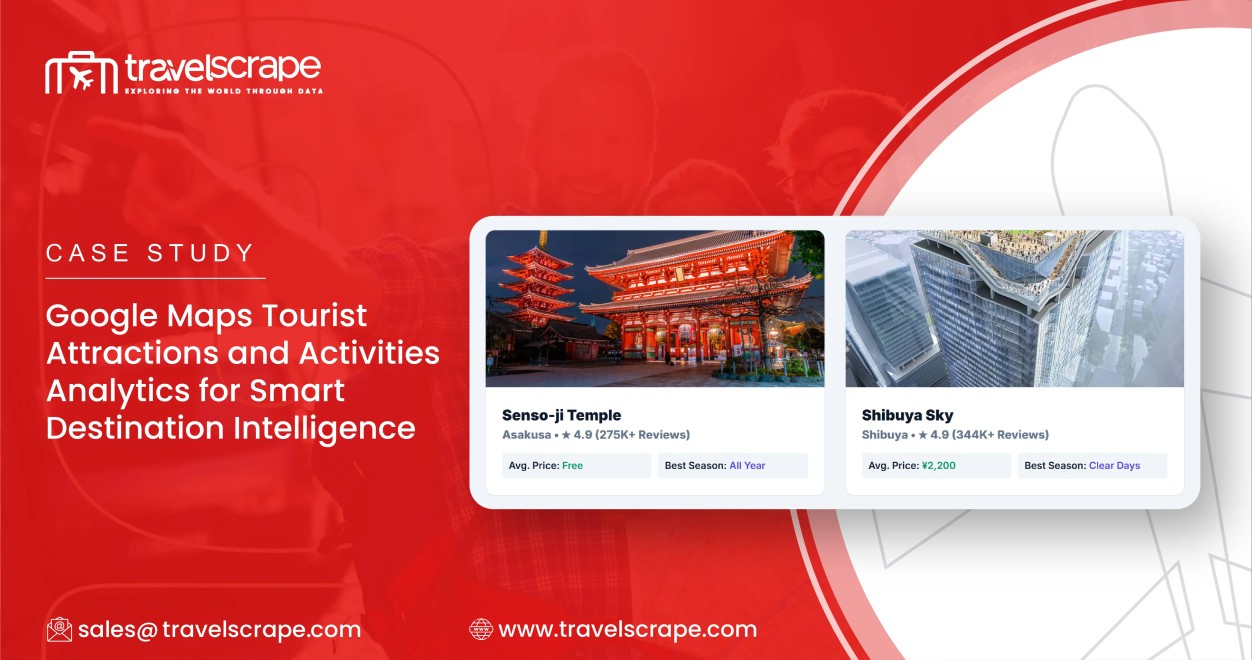
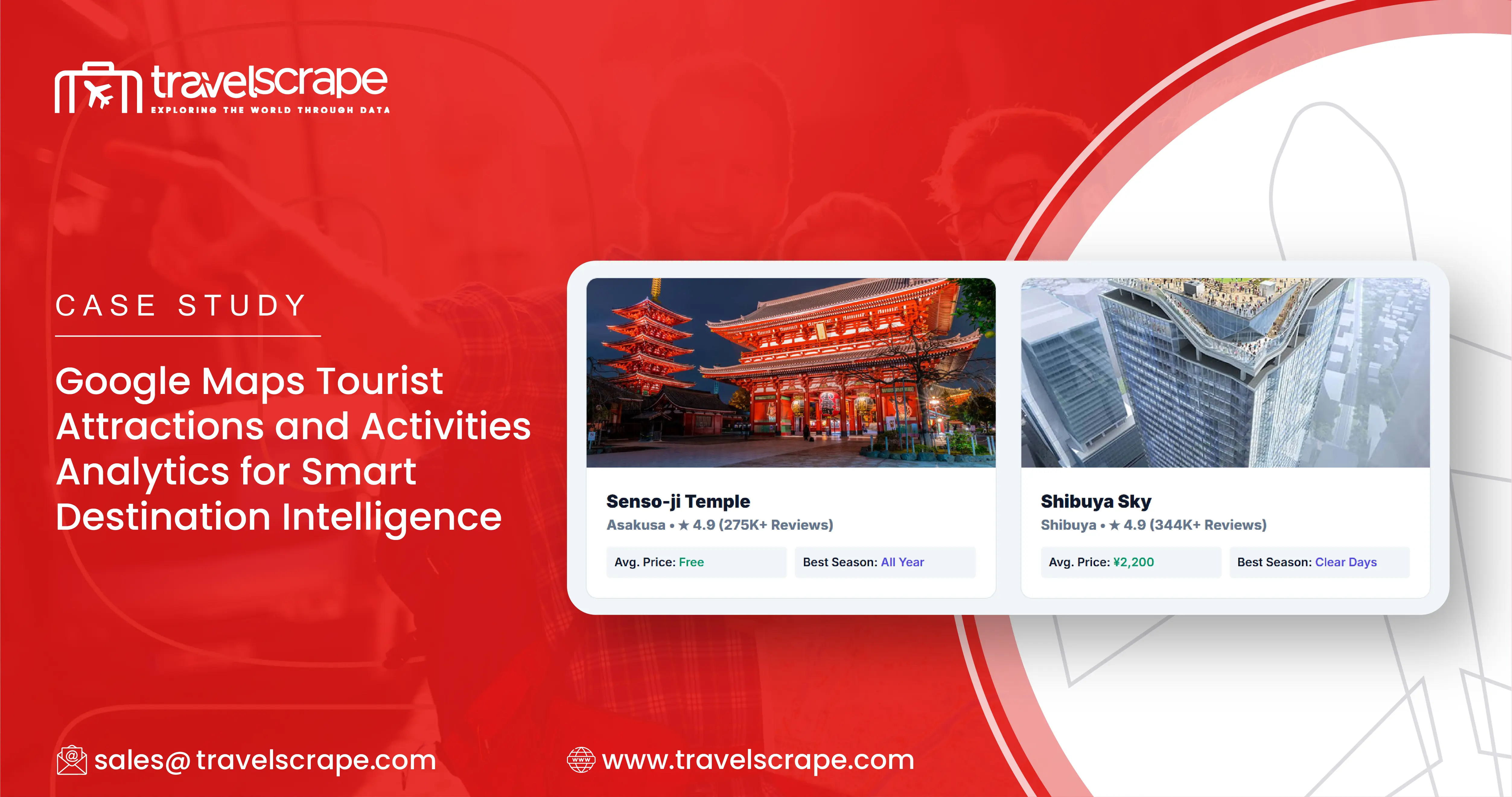
Google Maps Tourist Attractions and Activities Analytics
-

- Published Updated
- 7,850 views
Introduction
A travel-tech client used advanced location intelligence to improve destination planning and visitor targeting across multiple regions. By leveraging Google Maps tourist attractions and activities analytics, the client identified high-traffic hotspots, seasonal demand patterns, and emerging tourist clusters. This enabled them to redesign their marketing campaigns and prioritize high-performing locations for partnerships and promotions.
Additionally, structured Google Maps tourism activity data scraping helped the client gather real-time insights on reviews, visitor engagement, and attraction popularity trends. This reduced manual research efforts and improved decision-making speed.
The integration of Travel & Tourism Datasets further enriched their predictive models, allowing accurate forecasting of tourist flows and revenue potential. As a result, the client achieved higher engagement rates, optimized ad spend, and improved ROI across key travel markets. The case demonstrates how location intelligence and data-driven strategies transform tourism planning into a scalable, insight-led growth engine that supports long-term sustainable expansion for digital travel platforms worldwide. Ultimately it enhances personalization, efficiency, and competitive advantage significantly in tourism analytics systems.
The Client
The client is a fast-growing travel analytics company focused on building intelligent destination discovery and tourism optimization solutions for global markets. It specializes in transforming large-scale location data into actionable insights that help travel platforms, tourism boards, and hospitality brands improve decision-making and customer targeting. By leveraging advanced data pipelines, the client continuously enhances its ability to map visitor behavior, identify trending destinations, and optimize travel experiences across regions.
Using tourist attraction intelligence using Google Maps, the client is able to analyze attraction popularity, footfall patterns, and user engagement signals to support strategic tourism planning.
With travel activity analytics from Google Maps data, it gains deeper visibility into seasonal travel trends, traveler preferences, and real-time activity flows across destinations.
Through Tour & Travel Data Intelligence, the client delivers predictive insights that help stakeholders optimize campaigns, improve ROI, and build more personalized travel experiences at scale.
Challenges in the Travel Industry
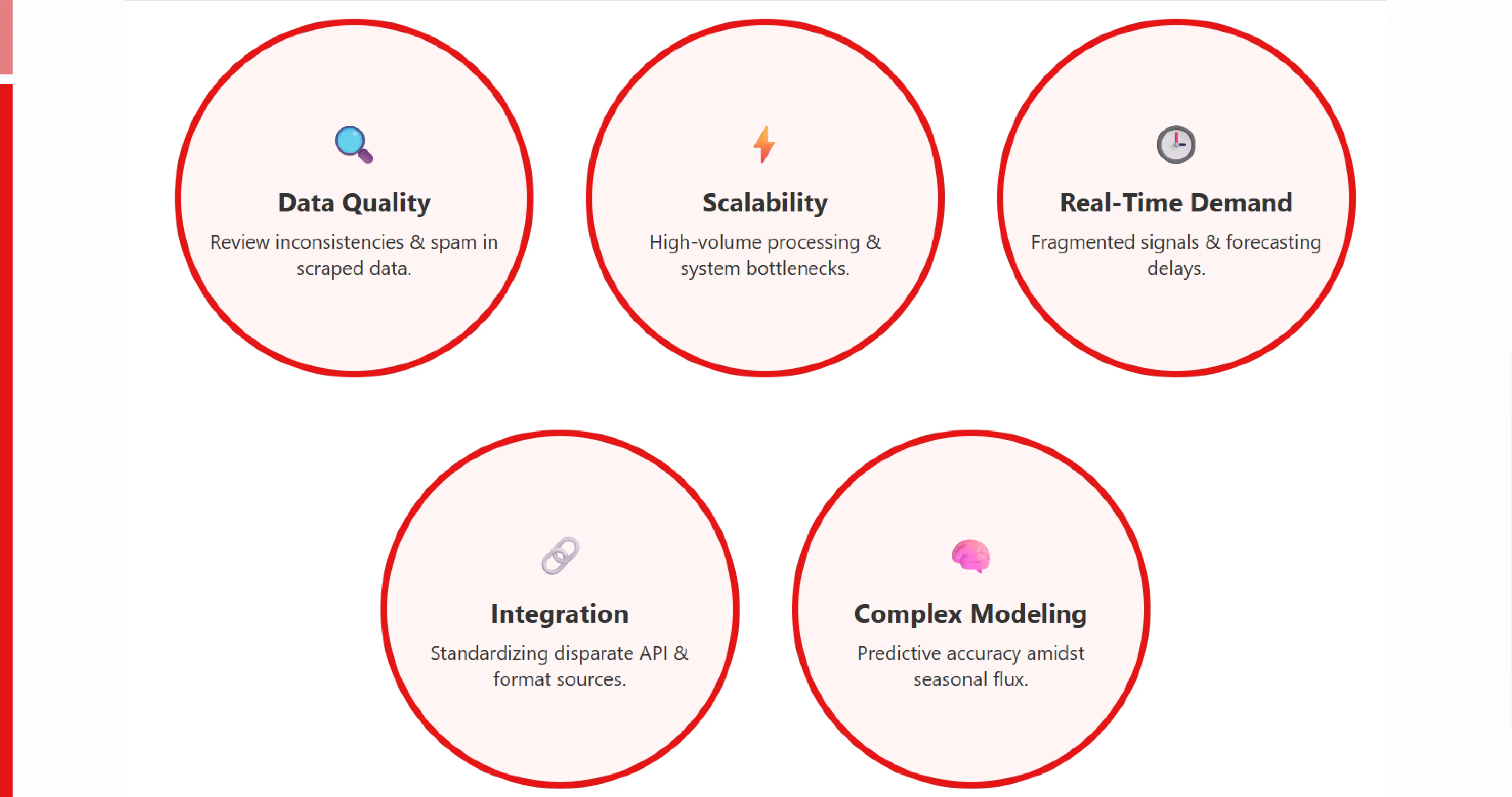
The client operates in the travel analytics ecosystem, focusing on extracting and processing large-scale location intelligence to enhance tourism decision-making. Tour & Travel Data Scraping leverages advanced digital signals to improve destination insights, optimize traveler experiences, and strengthen data-driven growth strategies for global platforms.
Data Quality and Review Inconsistencies
The client faced major challenges in maintaining accurate and clean datasets due to inconsistent user-generated content, duplicate listings, and outdated attraction details. These issues directly impacted sentiment accuracy and reduced reliability of tourism insights derived from large-scale data sources.
A major hurdle was google map tourism review and rating scraping, where biased reviews, spam entries, and missing feedback signals distorted overall attraction performance analysis and affected decision-making accuracy across tourism platforms globally.
Scalability and High-Volume Data Processing Issues
With rapid growth in location-based data, the client struggled to scale its infrastructure efficiently. Processing millions of records in real time led to latency issues, pipeline slowdowns, and difficulties in maintaining continuous data synchronization across global tourism systems.
Handling activity listing intelligence using Google Maps at scale required constant updates, which created system bottlenecks and increased computational load, affecting overall performance of analytics dashboards and real-time reporting tools significantly.
Real-Time Demand Prediction Challenges
The client faced limitations in accurately predicting sudden changes in tourist activity levels across destinations. Delayed signals and fragmented booking patterns reduced forecasting accuracy and weakened the effectiveness of marketing and operational planning strategies for travel stakeholders.
Tracking activity booking demand insights using Google Maps was particularly challenging due to inconsistent availability data and lack of unified booking signals across different platforms and regional tourism ecosystems.
Data Integration and Standardization Difficulties
Integrating multiple travel data sources posed significant challenges due to varying formats, APIs, and refresh rates. This created inconsistencies in datasets and made it difficult to build a unified analytics framework for comprehensive tourism intelligence and reporting systems globally.
Complexities in Advanced Travel Intelligence Modeling
Developing accurate predictive models was difficult due to fluctuating seasonal demand, regional travel behavior variations, and incomplete datasets. These limitations affected forecasting accuracy and reduced the effectiveness of automated recommendation systems used for tourism optimization and strategic planning purposes.
The implementation of Travel Data Intelligence helped improve insights but still required continuous refinement to achieve higher precision and scalability across diverse global travel markets.
Our Approach
Multi-Source Data Collection Strategy
We implemented a structured approach to gather tourism data from multiple digital sources, ensuring broad coverage of destinations, activities, and user interactions. This helped create a unified data foundation for deeper analysis and improved visibility into travel patterns across regions.
Advanced Data Cleaning and Normalization
Our approach focused on removing duplicates, correcting inconsistencies, and standardizing diverse datasets. By applying robust cleaning rules and normalization techniques, we ensured higher accuracy, improved data reliability, and created a consistent structure for downstream analytics and reporting systems.
Scalable Data Processing Architecture
We designed a scalable pipeline capable of handling large volumes of location-based data efficiently. Distributed processing frameworks and optimized workflows allowed real-time data handling, reduced latency, and ensured smooth performance even during peak data inflow periods globally.
Real-Time Insight Generation Framework
The system was built to process incoming data continuously and generate near real-time insights. This enabled faster identification of tourism trends, behavioral shifts, and destination performance, supporting timely decision-making for marketing, operations, and strategic planning initiatives.
Predictive Analytics and Visualization Layer
We integrated predictive models with interactive dashboards to transform raw data into actionable insights. This approach helped forecast travel demand, identify emerging destinations, and provide clear visual reports that improved business understanding and strategic tourism planning efficiency.
Results Achieved
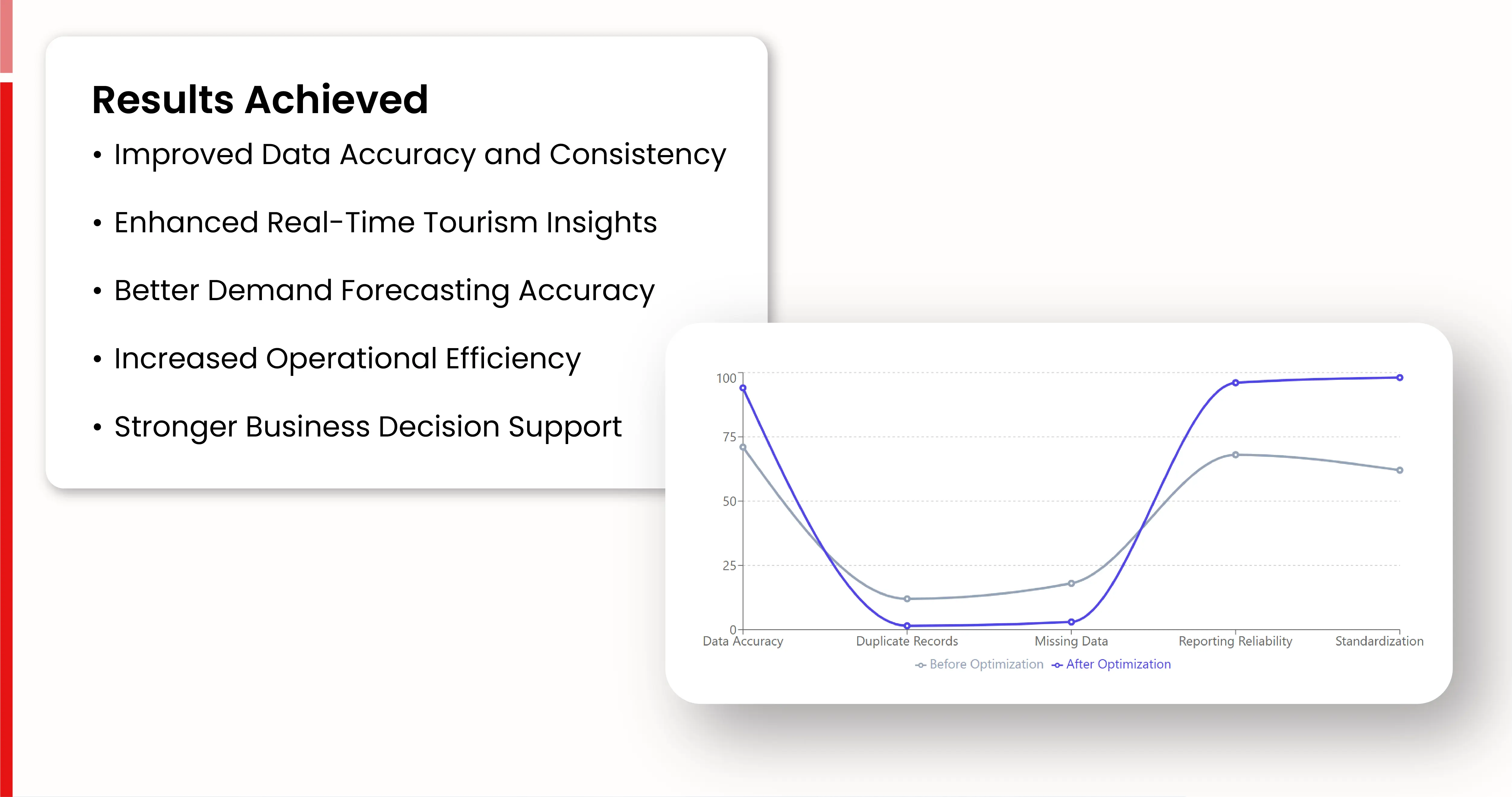
The project delivered strong improvements in tourism insights, enabling faster decisions, better forecasting, and highly accurate destination intelligence outcomes.
Improved Data Accuracy and Consistency
We achieved significant improvement in data accuracy by cleaning and standardizing large-scale tourism datasets. Duplicate records were reduced, inconsistencies eliminated, and structured outputs were generated. This resulted in more reliable insights, stronger reporting quality, and improved trust in analytical outputs.
Enhanced Real-Time Tourism Insights
The system enabled near real-time monitoring of travel behavior and destination performance. This helped stakeholders quickly respond to demand changes, identify trending attractions, and optimize strategies effectively. Faster insights improved decision-making speed and strengthened operational efficiency across platforms.
Better Demand Forecasting Accuracy
Predictive models showed higher accuracy in estimating tourist flow and activity demand. Seasonal variations and behavioral patterns were captured more effectively, allowing precise forecasting. This helped clients plan campaigns, allocate resources, and improve overall tourism business performance significantly.
Increased Operational Efficiency
Automation of data collection and processing reduced manual effort and operational delays. Teams were able to focus more on strategy rather than data handling. This resulted in faster workflows, improved productivity, and streamlined analytics operations across multiple tourism datasets.
Stronger Business Decision Support
The final system provided actionable insights that improved strategic planning. Clients could identify high-performing destinations, optimize marketing spend, and enhance customer targeting. This led to better ROI, improved engagement rates, and stronger competitiveness in the travel analytics ecosystem.
Sample Scraped Data Table
| Destination ID | Attraction Name | Location | Rating | Reviews Count | Monthly Visits | Category | Peak Season | Average Stay (hrs) | Engagement Score |
|---|---|---|---|---|---|---|---|---|---|
| 101 | Heritage Museum | Delhi | 4.6 | 12,450 | 85,000 | Historical | Winter | 2.5 | 92 |
| 102 | Beach View Point | Goa | 4.4 | 18,300 | 120,000 | Nature | Summer | 3.0 | 89 |
| 103 | Hilltop Adventure Park | Manali | 4.7 | 9,800 | 60,000 | Adventure | Winter | 4.0 | 94 |
| 104 | City Food Street | Mumbai | 4.3 | 22,100 | 150,000 | Culinary | Year-round | 2.0 | 88 |
| 105 | Lake Serenity Point | Udaipur | 4.8 | 15,600 | 95,000 | Scenic | Monsoon | 3.5 | 96 |
Client’s Testimonial
“Working with the team has significantly transformed our tourism analytics capabilities. Their data-driven approach helped us unlock deeper insights into traveler behavior, destination popularity, and seasonal trends. The accuracy and scale of the datasets we received allowed us to improve forecasting, optimize marketing strategies, and enhance customer targeting. We especially value the speed, reliability, and clarity of the insights delivered, which have directly improved our operational efficiency and ROI. Their solution has become an integral part of our decision-making process, enabling us to stay competitive in a rapidly evolving travel industry with confidence and precision.”
— Head of Data Strategy
Conclusion
In conclusion, the project successfully demonstrated how large-scale travel data can be transformed into actionable intelligence for better decision-making in the tourism industry. By integrating multiple data sources and applying advanced analytics, the client achieved improved visibility into traveler behavior, destination performance, and market trends. This enabled more accurate forecasting, optimized marketing strategies, and enhanced operational efficiency across platforms. The solution also strengthened data reliability and reduced manual effort, making insights faster and more scalable. Overall, it created a strong foundation for continuous innovation in travel analytics, helping the client stay competitive and responsive in a rapidly evolving digital tourism ecosystem.
Scrape Aggregated Travel Deals to identify competitive pricing patterns and promotional opportunities across multiple platforms.
Similarly, Scrape Travel Website Data for comprehensive collection of structured travel information for deeper market analysis and benchmarking.
In addition, Scrape Travel Mobile App data to help capture real-time user behavior insights, improving personalization and demand prediction accuracy significantly.