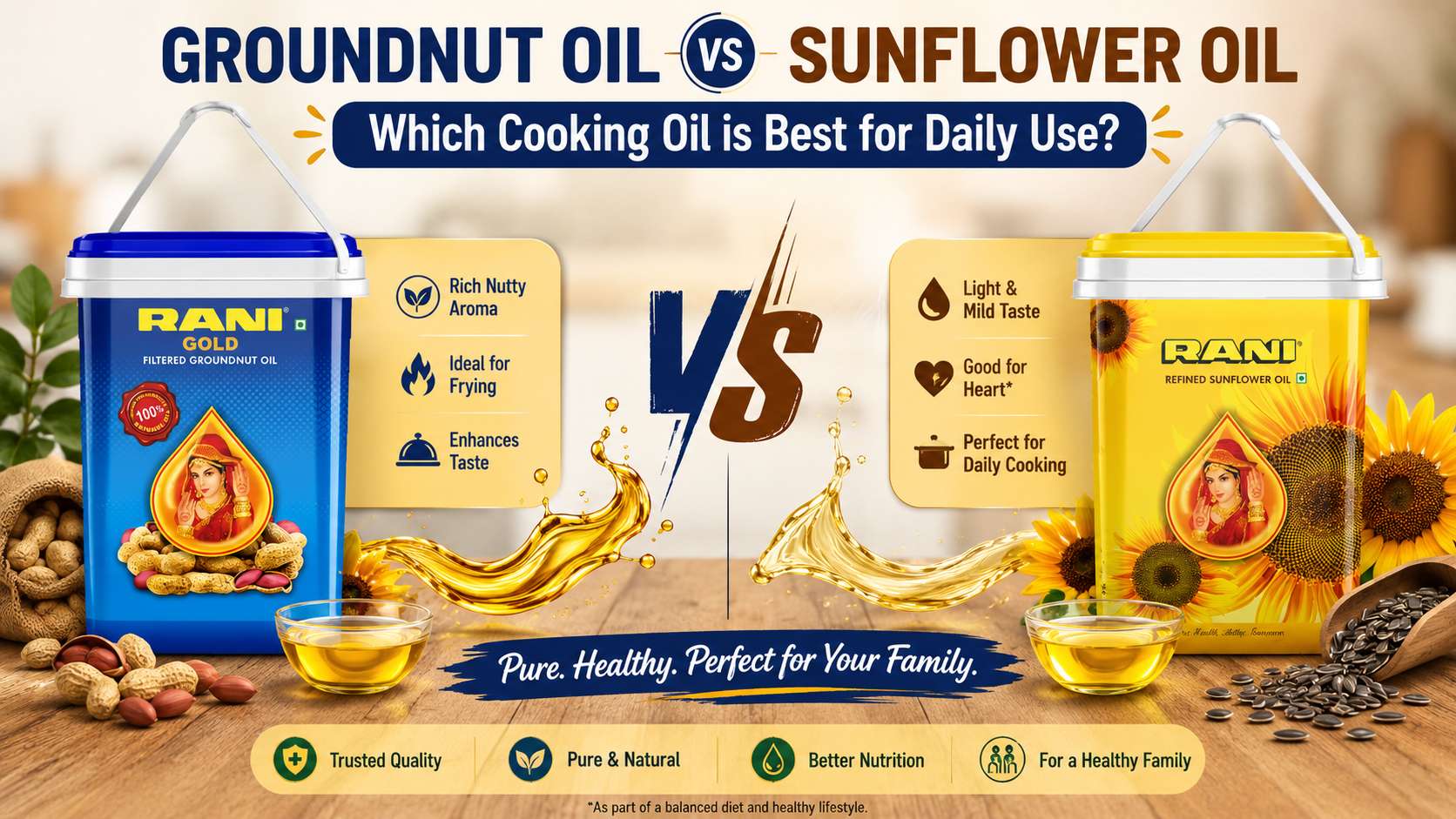
Groundnut Oil vs Sunflower Oil: Which Cooking Oil is Best for Daily Use?
-

- September 13th, 2026
- 4,922 views
Introduction
Think about the last time you made dal tadka at home. The moment the mustard seeds hit the hot oil and started to sputter, the whole kitchen came alive with that smell. That smell — that feeling — begins with the oil. Not the dal, not the spices, but the oil you poured into the pan first.
Groundnut oil and sunflower oil are the two most commonly used cooking oils in Indian homes today. Most families have at least one of them in their kitchen right now. But many people have never really stopped to think about the difference between the two, and it is a difference that shows up in every meal you cook.
This guide lays it all out honestly. No jargon, no confusing charts. Just a clear, straightforward comparison that helps you pick the right oil for your family — and cook every meal with full confidence.
Groundnut Oil vs Sunflower Oil: Side-by-Side Comparison
Before anything else, here is a plain-language comparison table so you can see the main differences at a single glance:
Feature |
Groundnut Oil |
Sunflower Oil |
Source |
Pressed from peanuts (moongphali) |
Extracted from sunflower seeds |
Taste |
Rich, nutty, full-bodied |
Mild and neutral — adds no flavour |
Aroma |
Warm, natural, genuinely appetising |
Very faint — almost odourless |
Smoke Point |
~160–180°C filtered; higher when refined |
~225°C (refined variety) |
Best For |
Tadka, deep frying, curries, farsan, poori |
Stir-frying, light sabzi, baking |
Traditional Roots |
Gujarat & Western India — for generations |
Common across all Indian states |
Effect on the Dish |
Deepens and lifts overall flavour |
Keeps the ingredients as the star |
Processing |
Double-filtered or cold-pressed available |
Usually refined |
Who Uses It Most |
Families who cook authentic Indian food daily |
Cooks who prefer a neutral cooking base |
Rani Oil Variant |
Rani Filtered Groundnut Oil |
Rani Sunflower Oil |
Note: Rani Oil produces both filtered groundnut oil and sunflower oil — with the same care and quality standards applied to every batch.
Groundnut Oil: Why It Has Been in Indian Kitchens for Generations
Walk into any older home in Gujarat and you will almost certainly find a tin of groundnut oil sitting near the stove. This is not sentiment or habit—it is the result of decades of cooking experience telling people what actually works.
Groundnut oil, known as moongphali ka tel in Hindi, is made by pressing dried peanuts. When it is processed properly—double-filtered, not stripped down through heavy refining — it keeps a natural golden colour, a warm peanut aroma, and a full-bodied flavour that makes a real difference in Indian cooking.
The best versions are the ones that have not been over-processed. Rani Oil's filtered groundnut oil is one of those—made from good-quality peanuts, filtered carefully, and bottled without cutting corners.
What Groundnut Oil Actually Does Better in the Kitchen
Indian food is built on layers. Every dish starts with a base — oil, heat, and aromatics coming together before anything else goes in. The oil is not a passive ingredient in that process. It is an active one. And groundnut oil plays that role better than most.
Here are the specific situations where it makes a noticeable difference:
• Deep frying: Whether it is bhajiya, pakora, poori, or mathia, foods fried in groundnut oil come out with a better crust, a more even golden color, and a flavor that plain refined oil just cannot give you.
• Tadka and tempering: When mustard seeds, dried chilies, and curry leaves hit hot groundnut oil, they release their flavor more fully. A tadka made with groundnut oil has more depth and aroma than one made in a neutral oil.
• Traditional Gujarati snacks: Farsan, chevdo, fafda—the reason these snacks taste the way they do in a traditional Gujarati home is partly because they have always been made in groundnut oil. The oil is part of the recipe.
• Everyday sabzi and curries: Even a simple aloo sabzi or toor dal tastes more rounded and satisfying when made in good groundnut oil. It is a subtle difference, but once you notice it, you cannot un-notice it.
How to Recognize the Best Groundnut Oil
Not every bottle labeled groundnut oil is worth buying. The difference comes down to how it was processed. A heavily refined version will be almost as neutral as sunflower oil — the processing has stripped out the natural character of the peanut along with any impurities.
When you are looking for the best groundnut oil, here is what to check: the label should say double-filtered" or "cold-pressed," the color should be a natural golden yellow (not water-white and not dark), and there should be a faint, pleasant peanut smell when you open the bottle. Rani Oil's groundnut oil will pass all three of these tests.
Sunflower Oil: The Light, Versatile Option That Works Every Day
Sunflower oil did not become popular in Indian kitchens by accident. It genuinely meets a need—especially for households where the cooking tends to be lighter or where people prefer the flavor of their food to come entirely from the spices and vegetables rather than the oil.
It is extracted from sunflower seeds and then refined, which gives it a clean appearance, a high smoke point, and a taste that is almost completely neutral. It does not add anything to the food — and for many dishes and many cooks, that is exactly what they want.
The best sunflower oil is consistent. It handles heat well, it works across a wide variety of recipes, and it never interferes with the food. Rani Oil's sunflower oil is made to that standard — the same clean sourcing and careful processing that goes into all their products.
When Sunflower Oil Is the Right Call
There are real cooking situations where sunflower oil is genuinely the better choice:
• Light stir-fries where you want the vegetables and spices to dominate completely
• Baking—cakes, breads, and muffins where you need a fat with no flavor of its own
• Mild everyday sabzis where a strong-flavored oil would overpower the dish
• Cooking for children or guests who are sensitive to strong aromas in their food
• Dishes from other cuisines—Chinese stir-fries, Continental cooking—where groundnut oil's character would feel out of place
For these situations, a good quality sunflower oil is the practical answer. And when you need to buy sunflower oil online, Rani Oil delivers it to your door with the same quality assurance as all their other products.
So Which Oil Should You Actually Use? Here Is Our Honest Take
We get asked this question all the time, and the honest answer is that there is no single right oil for everyone. But there is a right oil for the way you cook—and once you understand that, the decision becomes easy.
Reach for Groundnut Oil When:
• You cook traditional Indian food most days—dal, sabzi, curries, poori, fried snacks
• You want your oil to actively contribute to the flavor of the dish
• You are deep frying anything and want the best possible result
• You are making Gujarati or Western Indian recipes that were designed around this oil
• You are looking for the best cooking oil in India for authentic, satisfying home cooking
Reach for Sunflower Oil When:
• Your cooking is light and you want the oil to stay completely in the background
• You are making dishes with subtle flavors that would be overwhelmed by a stronger oil
• You are baking or cooking something outside the Indian tradition
What Smart Indian Cooks Actually Do
Many experienced home cooks in India keep both oils. Groundnut oil handles everything traditional—the daily tadkas, the festival frying, and the snacks and curries that define Indian home cooking. Sunflower oil takes care of the lighter days—quick weekday stir-fries, dishes where you want the ingredients to speak for themselves.
This is not wasteful or complicated. It is the practical approach of someone who cooks real Indian food and knows their kitchen. Rani Oil makes it easy to stock both, since you can order them together and have them delivered at the same time.
|
Not sure which to pick today? Use this: Poori, bhajiya, dal tadka, or any traditional recipe? Groundnut oil, every time. Light sabzi, stir-fry, or baking? Sunflower oil does the job well. Want both covered without overthinking it? Order both from Rani Oil and keep them both in the kitchen. |
Why Indian Families Keep Coming Back to Rani Oil
Rani Oil has been in Gujarat's kitchens for years. Not because of advertising, but because people kept coming back after trying it. Once you have cooked with genuinely good oil — oil that tastes like it was actually made from peanuts, not just processed to look like it — you notice the difference every time.
The team behind Rani Oil is made up of people who work directly with groundnut farmers in Gujarat, who understand what good pressing and filtration actually mean in practice, and who have spent years listening to what families actually need from their cooking oil. That experience shows up in the product.
What Sets Rani Oil Apart
• Peanuts and sunflower seeds are sourced directly and carefully—quality is checked at the source, not just at the end
• The double-filtration process for groundnut oil keeps the natural flavour intact while removing impurities
• No shortcuts, no unnecessary additives—what goes into the bottle is what comes out of the bottle
• The brand is open about sourcing and processing, because people who care about food deserve to know what they are cooking with
• Home delivery across India means you never have to compromise and settle for whatever is available locally
When you buy groundnut oil online or buy sunflower oil online from Rani Oil, you are not just placing an order. You are choosing an oil that was made with the same seriousness you bring to your cooking. That matters — because everything you serve your family starts with what is in that bottle.
Frequently Asked Questions
1. Which is better for daily cooking — groundnut oil or sunflower oil?
It really depends on what you cook every day. If your kitchen produces traditional Indian food — dal, sabzi, poori, tadka, and fried snacks—then groundnut oil is the better daily oil. Its natural flavor works with Indian spices in a way that neutral oil simply does not. If your cooking is lighter and you prefer the oil to stay invisible, sunflower oil is the right pick. Plenty of families use both — groundnut oil as the main cooking oil and sunflower oil for lighter meals.
2. Is groundnut oil really better for deep frying? Why?
Yes, noticeably so—and there is a real reason behind it. Good filtered groundnut oil has a fat composition that holds up well at frying temperatures without breaking down too quickly. On top of that, it adds a gentle, pleasant flavor to fried food that you simply do not get from a tasteless refined oil. If you have ever eaten bhajiya or poori at a traditional Gujarati home and thought it tasted better than yours, the oil is very often the reason. Rani Oil's filtered groundnut oil is made specifically with home frying in mind.
3. Why has groundnut oil been used in Gujarat for so long?
There is a practical reason behind this, not just tradition. Gujarat produces a large share of India's groundnut crop, which means families in the region have always had access to freshly pressed, locally made oil. The food culture of Gujarat—the farsan, the theplas, the gathiya, the undhiyu—developed around the oil that was most available and most flavorful. The two grew up together. At Rani Oil, we source directly from Gujarat's groundnut farmers and continue that tradition with care.
4. What should I look for when I buy groundnut oil online?
Three things matter most when you buy groundnut oil online: the processing method (double-filtered or cold-pressed means more flavor and better quality than heavily refined), sourcing transparency (a good brand tells you where the peanuts come from), and packaging (it should be in sealed, food-safe containers). Rani Oil's groundnut oil is available directly at www.ranioil.com with home delivery across India. You know exactly what you are getting.
5. Is sunflower oil genuinely good for Indian cooking or just a compromise?
It is genuinely good—for the right kind of cooking. Sunflower oil is not a lesser option; it is a different one. It is stable at cooking temperatures, it is widely trusted, and its neutral profile makes it ideal for dishes where the spices and vegetables should be front and center. The key is knowing when to use it and when groundnut oil would serve you better. For traditional Indian cooking, groundnut oil wins. For lighter, more neutral cooking, sunflower oil is a great choice.
6. Which is the best cooking oil in India for everyday home cooking?
For traditional Indian home cooking, groundnut oil is widely regarded as the best cooking oil in India — and that reputation has been earned over generations of real use. It suits Indian cooking techniques, it enhances Indian spices, and it produces better results in dishes that define Indian food. For lighter, everyday cooking where you want a neutral oil, sunflower oil earns its place too. At Rani Oil, we make both well—because different cooking needs different tools.
7. Can I use groundnut oil for all my cooking, or do I need to switch?
You can absolutely use groundnut oil for all of your cooking — it handles everything from high-heat frying to gentle tempering without any problems. That said, many cooks find it useful to have both on hand. Groundnut oil for bold, traditional, flavorful cooking. Sunflower oil for the light days, the baking, the milder dishes. Since Rani Oil offers both and you can order them together online, stocking both has never been easier.
8. How do I tell if a groundnut oil is genuinely good quality before buying?
A few quick checks tell you a lot. First, smell it — a good filtered groundnut oil has a mild, natural peanut aroma as soon as you open it. A heavily refined version will smell of almost nothing. Second, look at the color—it should be a clear, warm golden yellow, not pale and watery and not murky or dark. Third, taste a tiny amount on its own—there should be a clean, faintly nutty flavor, not bitterness or flatness. And check the label for double-filtered or cold-pressed. Rani Oil's groundnut oil passes all of these checks every time.
9. Where can I buy Rani Oil products and get them delivered at home?
You can buy groundnut oil online or buy sunflower oil online directly from www.ranioil.com. Rani Oil delivers across Gujarat and to many cities across India. All products come in multiple pack sizes, so you can order what suits your household — whether that is a small pack to try it first or a larger one for regular use.