Earlier Hair Fall: Why It Is A Thing Now At Age 25
-

- Published Updated
- 61 views
There are a few things in life that you are not supposed to worry about at age 25. Hair loss is one of them. Hair loss is something that you are supposed to worry about at age 55, not age 25. Hair loss is something that is supposed to happen to your parents and not to you who is still figuring out your career and sleep schedule.
But walk into any dermatologist’s clinic in India and you will see what I am talking about. The waiting rooms these days are filled with 25 year olds. Late 20s and even early 20s.
Something has changed. The reasons for hair loss have not changed. The age at which they have begun to show up has changed.
Why Are People in Their 20s and 30s Losing Their Hair?
Life has become much more demanding than people care to admit.
Irregular eating, skipping meals, work pressure that builds up for months, dieting for a wedding, taking protein supplements that don’t meet the body’s requirements, family drama, breakups, physical and mental exhaustion. The body is running on reserves. It has to make tough choices about where to focus its resources. Hair is not a priority. Muscles come first. Organs come first. The immune system comes first.
In times like these the body decides to take a lean approach and cut off anything that is not necessary for survival. Hair is not essential for survival. The body is that blunt about it.
Understanding this is important before spending money on anything.
The Product Trap That Most People Fall Into
Purchasing a new shampoo, a biotin supplement, or other products that promise results in four weeks. Rarely do they work. Most of the time they don’t help and the product is just replaced by a new one. The hair loss cycle continues.
The problem is treating hair fall as a scalp problem when it is almost always a body problem.
The scalp is where the hair fall shows up. The cause is usually somewhere else. In blood work, in hormonal levels, or in what is or is not eaten regularly. Addressing the scalp when the cause is somewhere else is similar to mopping the floor when the tap is still running.
What Is Actually Behind the Hair Fall
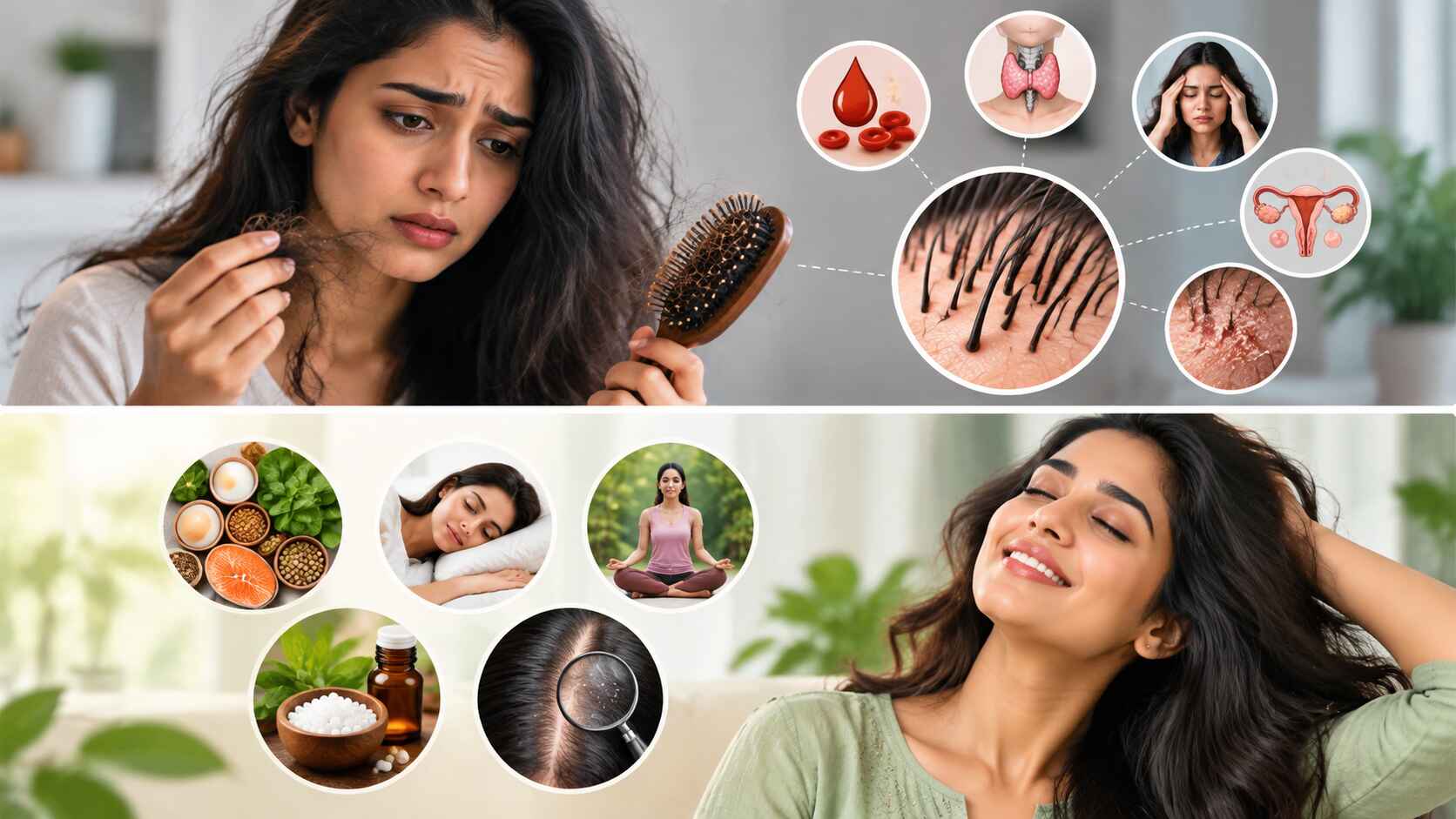
Most people have more than one cause at the same time. The causes that show up most frequently in young adults and are most often overlooked are as follows:
Ferritin, not Haemoglobin
It is true that hair fall is associated with anaemia. However, the relationship is more complicated than most people understand. People often have a normal haemoglobin level and still have low ferritin levels. Routine blood tests do not often check ferritin and it is usually done at the patient’s request.
A ferritin level below 30 ng/mL has a direct effect on the hair cycle. Many people find this out after they have years of unexplained hair fall that does not respond to any treatment.
Thyroid Function, Tested Only Once
The thyroid plays a role in almost all systems in the body and hence affects the health of hair follicles. Both underactive and overactive thyroid function push hair follicles into the resting phase too early.
The results take time, which makes it hard to track. The changes from thyroid conditions take 2 to 3 months to be noticed. A result from 6 months ago will not reflect current conditions. The only way to tell is to do a new test with TSH, Free T3, and Free T4.
Protein Intake That Seems Fine But Is Not Enough
Hair is made up of keratin which is made up of protein. The math seems simple, but often there is a shortfall that goes unnoticed for a long time. Women especially require more protein than people realise to support the growth of healthy hair. People assume they eat enough because a dal-chawal meal covers the basics. The truth is that there is often a big shortfall, especially over long periods of time.
Stress That Becomes Chronic
Chronic stress, over a long time, can alter the hair cycle, causing more hairs to enter the resting phase. About 2 to 3 months later, a large number of hairs shed simultaneously.
The timing becomes unnerving. Shedding happens even when things are getting better. People begin treatment for hair fall because of shedding, but they should really be responding to the stressful event which triggered the condition.
PCOS and Androgen Sensitivity
Elevated androgens cause gradual shrinkage of hair follicles. This thinning of hair is misread as nutritional hair loss and is often ignored for a long time. Women who have PCOS and experience hair loss often go through numerous rounds of ineffective treatments before the link with androgens is explored.
Vitamin D, Quietly Low
Despite the hot weather, many adults in India are deficient in Vitamin D. From changing trends in sun exposure to not having adequate sources of Vitamin D in their diet, many adults remain deficient without knowing it.
The good news is that it is an easily testable and correctable cause of hair fall. Vitamin D helps maintain the cycling of hair follicles and regulate hair density on the scalp.
Hair Fall in Women Versus Men: Not the Same Problem
This is something that does not get discussed enough. Most of the public conversation around hair fall is built around men. Male pattern baldness has a clear visual, a clear genetic story, and a clear set of products aimed at it.
Women’s hair fall is quieter. It does not follow a recognisable path. It spreads across the scalp rather than concentrating at the crown or temples. This makes it harder to catch early and much easier to misread.
In women, ferritin deficiency and hormonal imbalances do the most damage and are the most frequently missed. A woman in her mid-20s with diffuse thinning across the top of the scalp is far more likely to be dealing with low ferritin or PCOS-linked androgen sensitivity than with genetic hair loss. But because her hair fall does not look like what hair fall is supposed to look like, she often spends years on the wrong treatment before someone tests the right things.
Getting a proper evaluation early saves a significant amount of time. The causes are correctable. The delay in identifying them is what turns a temporary problem into a longer one.
Test Before You Spend
Many of the internal causes of hair fall can be ruled out with basic blood tests. It is worth getting these done before spending money on more invasive or expensive approaches.
The basic panel should include:
Ferritin, requested specifically (not just haemoglobin)
Thyroid panel: TSH, Free T3, Free T4
Vitamin D (25-OH)
Vitamin B12
Blood sugar and androgens if PCOS is suspected
These tests together cover most of the common internal causes of hair fall in younger adults and make every subsequent treatment decision much more targeted.
How Homeopathic Treatment Fits Into This
Homeopathy is very individualised. It takes into account how a person experiences stress, digestion, hormonal balance, and the condition of the scalp. Two people with the same type and amount of hair fall can be prescribed two completely different remedies based on their full health picture.
A homeopathic approach can be a good place to start for people who have not seen results from conventional treatments, or whose lab results come back normal but whose hair fall continues.
The kinds of hair loss that respond well are post-illness shedding, stress-related telogen effluvium, and hair loss in women due to hormonal changes. People who have normal lab results but continued hair fall benefit most from this type of evaluation, as it focuses on patterns that standard tests do not cover.
Methodex Health offers individualised homeopathic consultations for hair fall starting at Rs. 200. Their homeopathic medicine for hair fall page provides full detail on what the assessment covers and what to expect before booking.