Why Smart Schools Are Turning to Hands-On STEM Learning to Prepare Future Innovators
-

- April 22nd, 2026
- 4,167 views

FREE SEO Topical Map Generator: Find Your Next Content Ideas
Step into a modern classroom today, and you’ll immediately notice a shift. Students are no longer just sitting quietly and taking notes—they are building, experimenting, and solving real-world problems. This transformation isn’t just a passing trend; it reflects a deeper understanding of what students truly need to succeed in a rapidly evolving world.
Traditional education systems have long focused on memorization and theoretical learning. While these methods have their place, they often fall short in preparing students for real-life challenges. Today’s careers demand more than knowledge—they require creativity, critical thinking, and adaptability. This is exactly where hands-on STEM learning is making a powerful impact.
From Passive Learning to Active Creation
For decades, classrooms were centered around textbooks and lectures. Students were expected to absorb information and reproduce it in exams. However, in a world driven by innovation and technology, simply knowing information is no longer enough.
Hands-on STEM learning transforms education by turning abstract concepts into tangible experiences. Instead of reading about engineering principles, students design and build structures. Instead of studying coding theory, they create real applications and solve practical problems.
This shift from passive learning to active creation helps students understand concepts more deeply. It also builds confidence, as learners can see the results of their efforts in real time. Programs introduced by organizations like MH Intellect are helping schools implement these practical approaches effectively, making classrooms more engaging and future-focused.
Why Engagement Matters More Than Ever
One of the biggest challenges in modern education is maintaining student engagement. With shorter attention spans and increasing distractions, traditional teaching methods often struggle to capture interest.
Hands-on STEM learning addresses this issue by making lessons interactive and meaningful. When students are actively involved in building a robot or solving a challenge, they become part of the learning process. They ask questions, explore ideas, and learn through experimentation.
This type of engagement not only improves retention but also makes learning enjoyable. Schools adopting structured programs such as STEM and robotics education are seeing significant improvements in student participation and enthusiasm.
Building Skills That Truly Matter
The real value of STEM education lies not just in knowledge, but in skill development. In today’s world, employers are looking for individuals who can think independently, adapt to change, and collaborate effectively.
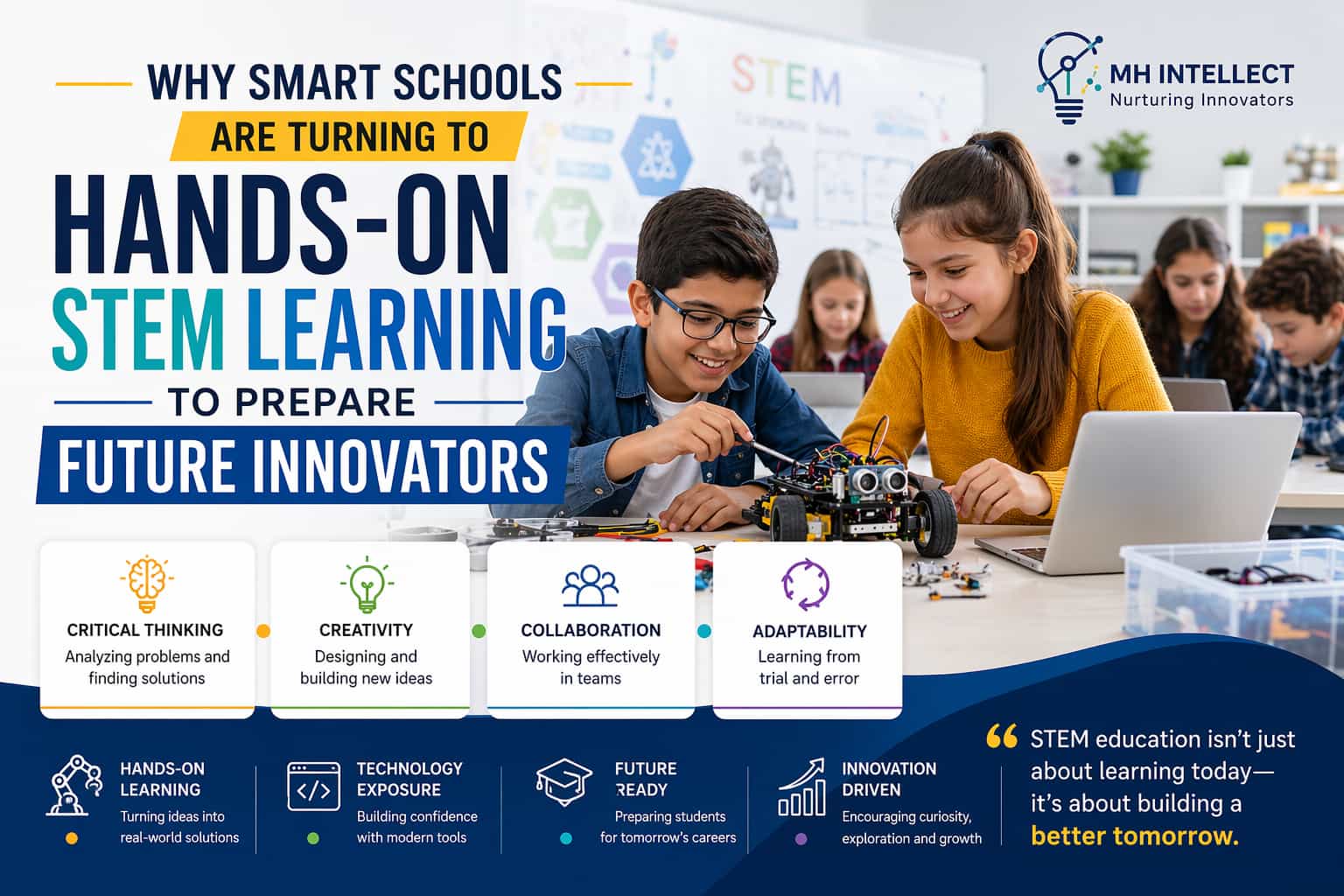
Hands-on STEM learning helps students develop essential skills such as:
- Critical thinking – analyzing problems and finding effective solutions
- Creativity – designing innovative ideas and approaches
- Collaboration – working with others to achieve common goals
- Adaptability – learning from mistakes and improving continuously
These skills are not only relevant for future careers but also for everyday life. By introducing them early, schools are giving students a strong foundation for long-term success.
The Importance of Early Exposure
One of the most impactful aspects of STEM education is early exposure. When students are introduced to technology and problem-solving at a young age, they develop a natural curiosity and confidence.
Young learners who engage with STEM tools don’t see technology as complex or intimidating. Instead, they view it as something they can understand, control, and use creatively. This mindset plays a crucial role in shaping their future learning journey.
That’s why many institutions are investing in STEM learning solutions for schools that cater to different age groups. These programs ensure a smooth progression from basic concepts to advanced applications, allowing students to grow at their own pace.
Schools as Drivers of Innovation
Education is no longer just about preparing students for exams—it’s about preparing them for life. Schools that embrace innovation are creating environments where students can explore, experiment, and think independently.
By integrating hands-on STEM programs, schools are not only improving academic outcomes but also fostering a culture of innovation. Students learn to approach challenges with confidence and creativity, qualities that are essential in today’s world.
Across regions like the UAE and beyond, schools are recognizing the importance of aligning education with global technological advancements. This shift is helping create a generation of learners who are better equipped to handle future challenges.
A Smarter Way Forward
The future belongs to individuals who can think critically, create solutions, and adapt to change. STEM learning is not just an enhancement to education—it is a necessary evolution.
For schools aiming to stay ahead, adopting practical and engaging learning models is no longer optional. It is the key to unlocking student potential and preparing them for a rapidly changing world.
To explore how schools are implementing these innovative approaches, visit:
https://mhintellect.com/education/stem-and-robotics