SEO Derby: How to Find High-Intent Keywords That Actually Generate Leads
-

- Published Updated
- 4,174 views
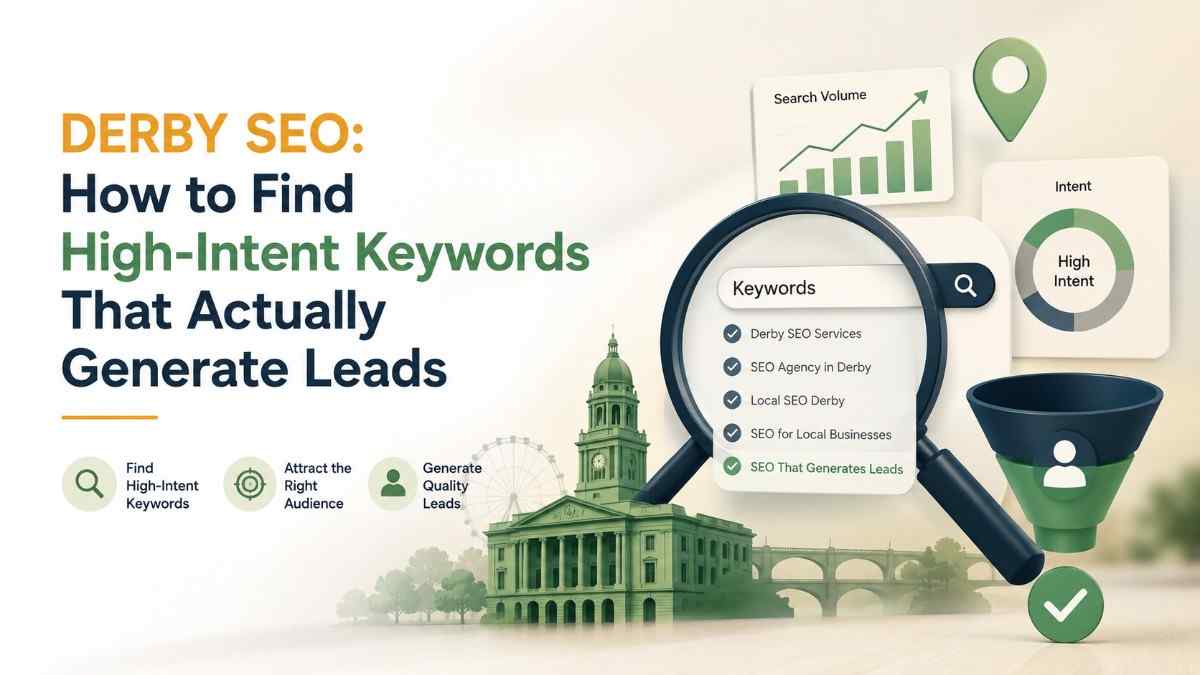
If you run a business in Derby and you've invested in SEO before without seeing real leads come through, you're not alone. It's one of the most common frustrations local business owners share: traffic goes up, rankings improve, but the phone still doesn't ring. The usual culprit isn't a lack of effort, it's a lack of focus on the right keywords. Ranking for a term nobody buys from is a wasted climb. This is why any serious approach to local SEO has to start with intent, not volume, and why many businesses eventually search for derby uk seo services when they realise generic keyword lists aren't converting.
This guide walks through exactly how to identify high-intent keywords for a Derby-based business, why most keyword research goes wrong, and how to build a strategy that brings in leads rather than just visitors.
What "High-Intent" Actually Means
Not all searches are created equal. Someone typing "history of Derby" and someone typing "emergency plumber Derby available now" are both using Google, but they want completely different things. One is browsing. The other is ready to buy.
High-intent keywords are search terms typed by people who are close to making a decision, booking a service, requesting a quote, visiting a shop, or signing up for something. These searchers have usually already done their general research. They know what they need; now they're looking for who to get it from.
Low-intent keywords, by contrast, attract people still in the information-gathering stage. They're valuable for building awareness and authority, but they rarely convert directly into leads. The mistake many Derby businesses make is chasing high-volume, low-intent terms because they look impressive in a keyword tool, while ignoring smaller, sharper terms that actually pay the bills.
Why Generic Keyword Research Fails Local Businesses
Most keyword research advice online is written for national or global brands. It focuses on search volume as the primary metric, which makes sense if you're selling a product to the entire country. But if you're a Derby-based electrician, dentist, accountant, or estate agent, a keyword with 10,000 monthly searches nationally might only represent a handful of genuinely local, ready-to-buy customers.
This is where a lot of local SEO effort gets wasted. Businesses target broad terms like "kitchen renovation" instead of "kitchen renovation company Derby" or "kitchen fitters near Allestree." The broad term brings traffic from people all over the country who were never going to hire a local Derby tradesperson in the first place. The specific, localised term brings fewer visitors, but far more of them are ready to convert.
A good local strategy flips the usual keyword research priorities. Instead of asking "what has the highest volume?" The better question is "what does someone type right before they pick up the phone or fill out a form?"
Step 1: Map Out Buyer Intent Categories
Before opening any keyword tool, it helps to categorise the types of searches your potential customers make. Most local searches fall into a few buckets:
Transactional searches the person wants to buy or book now. Think "boiler repair Derby same day" or "book dentist appointment Derby." These are gold for lead generation.
Commercial investigation searches the person and compares options before deciding. "Best SEO agency Derby reviews" or "cheapest car servicing Derby" fall here. They're not ready to buy this second, but they're close.
Local navigational searches the person already knows the business they want and is searching for it by name or near-name terms. Less useful for new customer acquisition but critical for reputation management.
Informational searches general questions with no immediate buying intent, like "how often should I service my car." These matter for content and authority building, but shouldn't be the primary target for lead-generation pages.
For most Derby businesses, the highest ROI work happens in the first two categories. That's where the buyer's wallet is already open.
Step 2: Use "Problem + Location" Keyword Structures
One of the simplest and most effective techniques for finding high-intent local keywords is combining a specific problem or need with a location modifier. Rather than targeting a single broad keyword, build out variations around:
The specific service ("emergency roof repair," "vans for rent," "wedding photographer")
The urgency or qualifier ("same day," "affordable," "24 hour," "family run")
The location ("Derby," "Derbyshire," or specific neighbourhoods like Chaddesden, Mickleover, or Littleover)
This produces phrases like "24 hour emergency roof repair Derby" or "affordable wedding photographer Mickleover." These aren't high-volume keywords in the traditional sense; some might get only a handful of searches a month but they convert at a dramatically higher rate because they match exactly what a ready buyer types.
A practical way to generate these combinations is to think like your customer at the exact moment they need you, not the moment they're mildly curious about your industry.
Step 3: Mine Google's Own Signals
Google gives away a surprising amount of intent data for free, if you know where to look.
"People also ask" boxes reveal the follow-up questions real searchers have, which often hint at objections or decision-stage concerns worth addressing on service pages.
Autocomplete suggestions show what people are actually typing, in their own words, often including modifiers like "near me," "cost," "prices," or "reviews" all strong intent signals.
Related searches at the bottom of the results page frequently surface commercial-intent variations that keyword tools miss entirely, because they're built from live search behaviour rather than historical estimates.
Google Business Profile insights for your own listing, if you have one, show the exact search terms people used before finding your business. This is arguably the single best source of high-intent local keyword data, because it's drawn from people who already found you relevant enough to click.
Running these checks specifically with Derby-based searches, rather than relying on national keyword databases, will surface terms that generic SEO tools underreport or miss completely, since local search volume is often too low for big platforms to track accurately.
Step 4: Check Competitor Gaps, Not Just Competitor Rankings
Most competitor analysis stops at "what are they ranking for." A more useful question is "what are they ranking for that's actually converting for them, and what are they missing?"
Look at competitor service pages and note which specific, long-tail service-plus-location combinations they've built dedicated pages for. If three Derby-based competitors all have generic "our services" pages but none of them have a dedicated page for a specific niche service combined with a specific Derby suburb, that's a gap. Filling it with a well-optimised, genuinely useful page can capture leads your competitors are leaving on the table.
This is also where reviewing what people are asking competitors on social media, in Google reviews, and in comment sections pays off customer language is often more specific and intent-rich than anything a keyword tool suggests.
Step 5: Validate Intent Before You Commit
Not every specific-sounding keyword is genuinely high-intent. Before building a page or campaign around a keyword, check what's actually ranking for it. If the top results are all blog posts and informational content, the keyword is probably informational too, regardless of how it reads. If the top results are service pages, quote request forms, and business listings, that's a strong signal of commercial or transactional intent.
This step is skipped surprisingly often, and it's why some Derby businesses build entire pages around keywords that never generate a single inquiry; the intent simply wasn't there in the first place.
Step 6: Build Pages That Match the Intent You Found
Finding the right keyword is only half the job. If a search term signals someone is ready to book, but the landing page is a generic paragraph about "our company values," the mismatch will kill conversions even with perfect rankings.
Pages targeting transactional, high-intent Derby-specific keywords should generally include:
A clear, specific headline matching the search intent, not a vague brand slogan
Visible pricing information or a clear next step, such as a quote request
Local trust signals Derby addresses, local project photos, local client testimonials
A simple, low-friction contact method, since high-intent visitors don't want to hunt for a phone number
Fast load times and mobile-friendly design, since local searches skew heavily toward mobile devices
A well-optimised page for a high-intent keyword should feel, to the visitor, like it was written specifically for the exact problem they searched for because it was.
Step 7: Track Leads, Not Just Rankings
The final piece often gets overlooked. Ranking position is a proxy metric, not the goal. The real measure of success is enquiries, calls, form submissions, and bookings that can be traced back to specific keywords and pages.
Setting up basic call tracking, form tracking, and goal tracking in analytics lets you see which keywords are actually driving business outcomes, not just traffic. Over time, this data becomes more valuable than any keyword research tool, because it reflects real buyer behaviour specific to your business and your part of Derby.
It's common to find that a handful of unglamorous, low-volume, highly specific keywords quietly generate the majority of leads, while broader terms that took far more effort to rank for bring in traffic but few actual customers. Reallocating effort based on this data, rather than vanity ranking positions, is often the single biggest improvement a local business can make to its SEO strategy.
Common Mistakes to Avoid
A few patterns show up again and again in Derby businesses that struggle to convert SEO traffic into leads:
Chasing volume over relevance. A keyword with more searches isn't automatically better if most of those searchers aren't in a position to buy.
Ignoring neighbourhood-level targeting. Derby is a diverse city with distinct areas, and a business serving Mickleover doesn't need to compete for searches clearly intended for someone in Chaddesden or Spondon, and vice versa.
Writing content for search engines instead of decision-makers. Keyword-stuffed pages with no clear next step rarely convert, regardless of ranking.
Neglecting Google Business Profile optimization. For many high-intent local searches, especially "near me" queries, the map pack matters as much as, or more than, organic rankings.
Treating SEO as a one-time project. Search intent and competitor landscapes shift, and keyword strategies that worked a year ago may already be underperforming.
Bringing It All Together
Finding high-intent keywords for a Derby business isn't about chasing the biggest numbers in a keyword tool, it's about understanding exactly what your potential customers type in the moments right before they're ready to act, and then building pages that meet them there. The businesses that get real leads from SEO are usually the ones that resist the temptation to target everything and instead focus tightly on the searches that map to genuine buying intent, backed by pages designed to convert that intent into an inquiry.
Getting this right takes ongoing research, testing, and refinement, which is why many Derby businesses eventually look for support from a team that specialises in derby uk seo services rather than trying to piece it together with generic national advice. Devoptiv is one option worth exploring for this kind of intent-first work identifying the keywords that map to real buyer behaviour in Derby, building pages designed around conversion rather than just ranking, and measuring success by leads generated, not just positions gained. Whichever route you take, the principle stands: SEO that starts with intent, not volume, is the SEO that actually turns into business.