Top Houston Software Development Trends in 2026: What's Actually Changing, and Why It Matters
-

- Published Updated
- 8,140 views
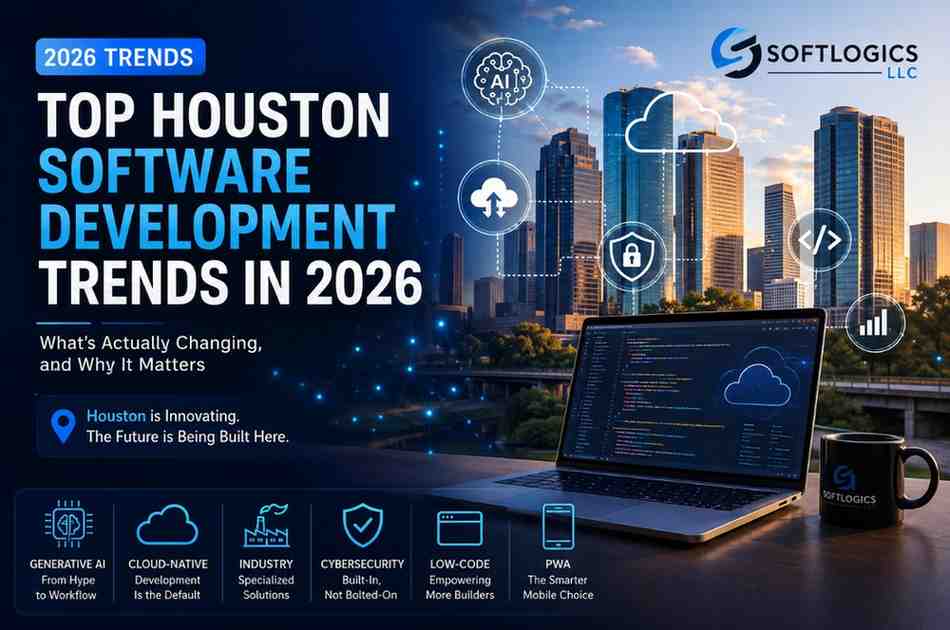
Houston's software development scene is undergoing a real transformation in 2026. Generative AI has moved from experiment to everyday workflow. Cloud-native and edge computing are reshaping how energy, healthcare, and logistics companies build their tech stack. Cybersecurity is no longer optional. And local firms, including boutique developers like Softlogics LLC, are playing a critical role in turning these trends into practical outcomes for Houston businesses.
Why 2026 Is a Turning Point for Software Development in Houston
Ask anyone working in Houston tech right now, and they'll tell you the same thing: something shifted.
It's not one big moment; it's a dozen quiet changes stacking up all at once. AI tools went from novelty to necessity. Cloud infrastructure has gotten cheaper and more capable. And industries like energy, healthcare, and logistics, the backbone of Houston's economy, started demanding software that actually connects the physical and digital worlds.
NVIDIA and Foxconn are building AI supercomputer factories in the city. Apple is constructing a 250,000-square-foot server facility here. Hewlett Packard Enterprise moved its global headquarters to Houston. The city now ranks #10 on the 2026 North American Tech Hub Index, employs over 230,000 tech workers, and generates a $21.2 billion economic impact from its tech sector alone.
All of that matters because it creates demand. And where there's demand, there's software being built.
This article covers the trends that are actually driving change in Houston right now, not the hype cycle but the stuff businesses and developers are dealing with on the ground.
Trend #1: Generative AI Has Moved from Hype to Workflow
Let's start with the biggest one, because there's no honest 2026 trends list that doesn't have it.
Generative AI in software development is no longer experimental. According to recent data, over 80% of professional developers now use AI tools in some part of their workflow, such as code generation, debugging, documentation, or automated testing. As of mid-2026, more than 46% of newly written code is AI-assisted, with projections suggesting that figure reaches 60% by year-end.
The generative AI market itself hit $182 billion in 2026, growing at a 37.2% CAGR since 2023. Code generation has emerged as the second-largest segment at $43.7 billion, underscoring how deeply AI tools have embedded themselves in development pipelines.
For Houston businesses, this has a few direct implications:
Faster builds: AI-assisted development significantly reduces time from spec to prototype. Teams that used to need three months for an MVP are doing it in six weeks.
But quality control matters more: AI-generated code contains 2.74x more vulnerabilities than human-written code, with 45% of AI code samples failing security tests. That statistic should be mandatory reading for any Houston company relying entirely on AI-generated output.
The developer role is shifting: Developers are increasingly acting as AI orchestrators, directing agents, reviewing output, and making strategic decisions rather than typing every line themselves.
The nuanced view: Most businesses don't need to build their own AI. They need to work with a development partner who knows how to integrate AI tools intelligently and build guardrails around them. That's a skill, not just a subscription.
Trend #2: Cloud-Native Development Is Now the Default Starting Point
A few years ago, the conversation was about whether businesses should move to the cloud. That conversation is over. In 2026, the question is which cloud architecture fits your specific workload and how to build applications that take full advantage of it from day one.
Houston's data center market reflects this. It was valued at 800 MW in 2025 and is projected to grow to 947 MW by 2032. CenterPoint Energy's interconnection queue jumped from 1 GW to 8 GW in under a year, signaling energy demand that dwarfs current installed capacity. This is the physical infrastructure that software runs on, and Houston is building a lot of it.
For software development in the city, cloud-native means a few specific things:
Microservices over monoliths: Applications built as independent, loosely coupled services that can be deployed, updated, and scaled individually.
Container-first deployments: Kubernetes and Docker aren't optional extras, they're standard infrastructure for any serious application.
API-first architecture: Everything connects via APIs, enabling integrations across the energy, healthcare, and logistics systems that Houston businesses depend on.
Edge computing for industrial use: Companies like ExxonMobil and Halliburton are deploying edge computing at field sites to process data locally before sending it back to Houston's data centers. For IoT and industrial applications, edge architecture is becoming mission-critical.
The practical advice here? If someone is pitching you a software project without a clear cloud architecture story, ask them to explain it. That answer will tell you a lot.
Trend #3: Houston's Industry Mix Is Creating Unique Software Specializations
This is where Houston genuinely differs from every other tech city in America, and why generic software trends lists don't tell the full story.
Houston's software development market isn't driven by consumer apps or social media. It's driven by industries that operate at a massive physical scale: energy, healthcare, logistics, manufacturing, and aerospace. And each of those industries is going through a specific version of digital transformation right now.
Energy Tech
With over 3,600 energy organizations operating in Houston, software for the oil and gas sector is a world of its own. Digital twin platforms, predictive maintenance systems, IoT sensor integration, and real-time field operations software are all growing categories. Texmark Chemicals' IoT deployment showed how relocating analytics to the edge can help technicians prevent equipment failure and save tens of millions annually in maintenance costs.
Healthcare IT
The Texas Medical Center, the world's largest medical complex, is right here. That concentration drives constant demand for EHR integrations, patient portals, clinical trial management software, and healthcare AI tools. Houston's HealthTech startup cluster has been one of the fastest-growing in the country, with nearly $12 billion in total startup funding raised across the city's ecosystem.
Logistics and Supply Chain
The Port of Houston is one of the busiest in North America. Software that powers inventory management, route optimization, freight tracking, and warehouse operations is a growth market here in a way it isn't in most other cities.
Trend #4: Boutique Development Partners Are Winning on Outcome Quality
Here's a trend that doesn't show up in the usual listicles, but businesses that have navigated the local market know it well: the mid-market sweet spot in Houston software development is increasingly being served by focused, boutique firms rather than giant agencies or offshore teams.
Why? Because Houston's industries demand context. A developer who doesn't understand the difference between upstream and downstream operations in oil and gas, or who can't navigate HIPAA requirements in a healthcare workflow, is going to cost you more in revisions and miscommunications than they'll ever save you on an hourly rate.
That's part of what makes firms like Softlogics LLC relevant in this conversation. As a Houston-based software development company, they work with businesses that need custom software solutions, web applications, and digital transformation support with the kind of focused, senior-level attention that larger agencies often can't provide at the mid-market scale.
What's notable about their approach is the emphasis on understanding the business problem before writing a line of code. In a market where AI can now generate functional boilerplate in minutes, the real differentiator isn't typing speed; it's judgment. Knowing which architecture will scale. Knowing which integrations will create problems down the road. Knowing when to push back on a spec.
For Houston businesses exploring software development partnerships, visit Softlogics LLC to learn how the team approaches custom web and software solutions for local clients.
The insight most businesses miss: Bigger isn't always better in software. A 200-person agency might assign your mid-size project to a junior team. A boutique partner with five senior engineers will often deliver a better product, faster, with fewer surprises.
Trend #5: Cybersecurity Is Now Built In, Not Bolted On
DevSecOps , integrating security into every stage of the development pipeline rather than treating it as an afterthought , has moved from best practice to table stakes in 2026.
The shift is being driven partly by regulation, partly by very public failures, and partly by the realities of AI-generated code. That 2.74x vulnerability increase in AI-assisted code isn't an abstraction , it translates directly into exploitable security gaps in production software. Houston's energy, healthcare, and financial services sectors are all high-value targets for cyberattacks, which means the companies serving those sectors have to build with security front of mind.
What DevSecOps looks like in practice:
Automated security scanning integrated into CI/CD pipelines Infrastructure-as-code security reviews before deployment
Regular penetration testing as part of the development cycle, not just at launch
Compliance-by-design for HIPAA, SOC 2, and energy sector regulations
For Houston businesses commissioning software: if your development partner's security conversation starts at launch, that's a problem.
Trend #6: Low-Code and No-Code Are Expanding Who Can Build
By 2027, the global no-code market is expected to exceed $45 billion, and nearly 65% of application development will happen outside traditional IT departments. That second statistic is the more important one for Houston businesses.
Low-code and no-code tools are not replacing professional developers; they're expanding the surface area of what gets built. Operations teams can now build internal workflow tools without a six-month development queue. Marketing teams can prototype customer-facing features. Data teams can build dashboards and automation without writing SQL.
The implication for Houston's diverse industries is significant. Energy companies with large operational teams, hospital systems with clinical staff, and logistics companies with dispatch operations- all of them have use cases that low-code can now serve without involving a development team at all.
However, and this is the part most vendors don't advertise, low-code hits hard walls when you need custom logic, complex integrations, or anything that has to comply with industry-specific security requirements. Knowing where that wall is before you start building on a low-code platform saves a lot of expensive pivots.
Trend #7: Progressive Web Apps Are Replacing Mobile-First for Many Use Cases
Progressive Web Apps (PWAs) combine the best features of websites and mobile apps- fast loading, offline functionality, push notifications, and device integration- without requiring a separate native app build and App Store submission.
For Houston businesses that need mobile capability but don't want to maintain separate iOS and Android codebases, PWAs have become the practical choice in 2026. They're especially relevant for field operations tools in energy, patient-facing applications in healthcare, and internal logistics tools where workers need reliable offline access in low-connectivity environments.
The development efficiency argument is simple: one codebase serves all platforms. For companies with tight budgets and real operational needs, that's not a minor convenience; it's a meaningful cost reduction.
FAQ: Houston Software Development Trends in 2026
What is the biggest software development trend in Houston in 2026?
The single biggest trend is the mainstream adoption of generative AI in software development workflows. Over 80% of professional developers are now using AI tools daily, and more than 46% of newly written code is AI-assisted. In Houston specifically, this is layered on top of continued growth in energy tech, healthcare IT, and cloud-native infrastructure, all of which are accelerating simultaneously.
How is AI changing software development for Houston businesses?
AI is accelerating development timelines, reducing boilerplate coding work, and enabling smaller teams to build more capable software. However, it also introduces new challenges: AI-generated code has a significantly higher vulnerability rate than human-written code, requiring stronger security review processes. For Houston businesses, the best path is working with development partners who use AI tools intelligently while maintaining strong quality control.
Should Houston businesses use cloud-native development in 2026?
Yes, cloud-native architecture is now the default starting point for new software projects. It enables better scalability, easier updates, and lower long-term maintenance costs. Houston's rapidly growing data center infrastructure supports this approach, and industries like energy, healthcare, and logistics are all moving toward cloud-native platforms for their critical operations software.
What industries drive the most software development in Houston?
Energy and oil & gas technology drive the highest volume of specialized software development in Houston, followed closely by healthcare IT (centered around the Texas Medical Center ecosystem), logistics and supply chain software, financial technology, and aerospace. Each sector has unique compliance requirements, data architecture needs, and operational constraints that differentiate Houston's software market from other cities.
How do I choose a software development company in Houston in 2026?
Focus on three things: industry-specific experience, communication quality, and post-launch support. Ask whether they've built for your industry. Pay attention to how they communicate before you sign; that behavior won't improve after the contract is signed. And verify who owns the IP and what ongoing support looks like. Local boutique firms like Softlogics LLC often deliver better value for mid-size projects than large agencies because senior engineers stay on the project from start to finish.
Final Thoughts: What This Means for Your Business Right Now
Houston's software development landscape in 2026 is genuinely exciting and genuinely complex. The trends aren't happening in isolation. AI, cloud-native architecture, industry specialization, cybersecurity, and low-code platforms are all evolving at the same time. and the businesses that navigate this well are the ones who approach it strategically rather than reactively.
The most important shift isn't any single technology. It's the overall raising of the bar. Businesses that were comfortable with outdated software or inconsistent tech partners are finding that gap is now costing them real money in inefficiency, in missed opportunities, and in the increasing gap between themselves and competitors who have invested in the right tools and the right team.
Houston has the tech talent, the infrastructure, and the industry depth to support serious software development. The city ranked #10 globally for tech hub strength in 2026, and that number will keep moving up.
Whether you're a business owner looking for a development partner, a tech professional staying current with local trends, or a content creator mapping the Houston tech landscape, the direction is clear. Build well, build securely, and build with people who understand this market.
Ready to Build Smarter Software for Your Houston Business?
If you're looking for a Houston-based software development partner who brings genuine technical depth and business understanding to every project, Softlogics LLC is worth a conversation. They work with businesses across Houston and Texas to design and build custom software solutions that solve real operational problems, not just technical ones.
Visit softlogicsllc.com to explore their services, see examples of their work, and connect with their team. Whether you have a fully scoped project or just a business problem you need help thinking through, they'll give you a straight answer.