HR AI Agent Development In India: The Gap Between Adoption and Value
-

- Published Updated
- 3,382 views
Why HR AI Adoption Does Not Automatically Create Business Value
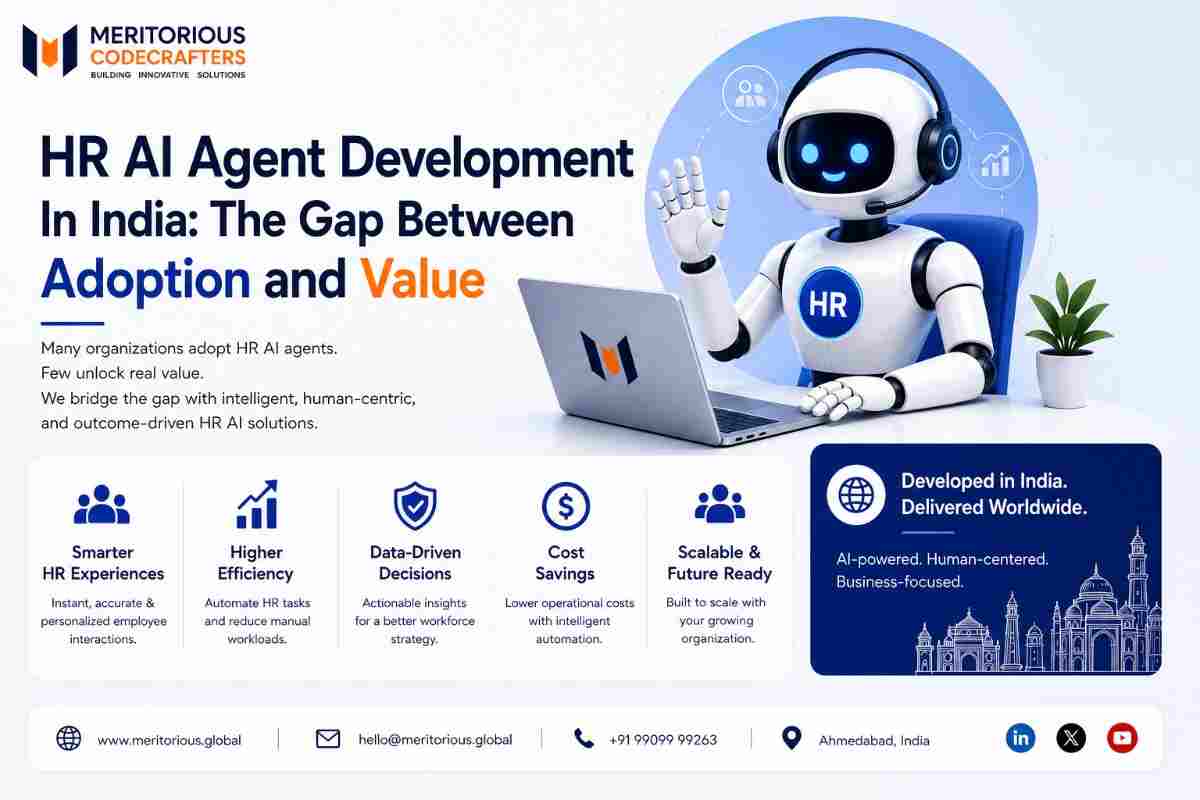
The efficiency case for AI across recruiting, onboarding, employee self-service, and workforce management is becoming increasingly difficult to ignore. Yet adoption alone does not guarantee measurable business value, particularly when organizations introduce AI into existing processes without redesigning the workflows around it. HR leaders may automate individual tasks while leaving approval bottlenecks, fragmented employee data, and inconsistent decision-making untouched. This can create the appearance of transformation without producing meaningful improvements in hiring speed, employee experience, retention, or operating cost. Measurement needs to be established before deployment so organizations can determine whether an AI system is actually improving the outcomes it was introduced to change. A well-designed HR AI agent development in india strategy therefore starts with business objectives and measurable outcomes rather than simply selecting an AI tool. The strongest implementations identify where AI can remove friction, establish clear success metrics, and redesign the surrounding workflow so automation contributes directly to organizational performance.
Employment AI Requires Governance From the Beginning
Employment-related AI carries unusually high consequences because its decisions can affect people's access to jobs, promotions, compensation, and other opportunities. Regulatory expectations have consequently increased, with employment-related AI receiving significant scrutiny under frameworks such as the EU AI Act and local requirements around algorithmic bias and transparency. For multinational organizations, compliance cannot be treated as a final checklist completed immediately before deployment. Systems need appropriate governance throughout data preparation, model evaluation, decision workflows, monitoring, and human review. This is especially important when AI is involved in candidate screening or ranking, where seemingly neutral criteria can produce disproportionate outcomes for particular groups. Businesses must also understand which jurisdictions apply to their operations and ensure that legal and compliance teams are involved early in the design process. Building the necessary controls from the beginning reduces both regulatory exposure and the risk of discovering fundamental fairness problems after an HR system is already influencing real employment decisions.
What Separates a Governed HR Agent From a Screening Tool
A basic screening system may rank candidates according to predefined criteria, but a properly governed HR agent requires considerably more oversight. Disparate-impact testing should be incorporated throughout the process, from sourcing and screening through selection and recommendation, rather than performed only when an audit becomes necessary. The organization should understand which data the system uses, which factors influence its recommendations, and when a human decision-maker must intervene. Human review is particularly important when an AI recommendation could materially affect an individual's employment opportunity. A well-engineered system should also maintain appropriate records so organizations can investigate decisions and demonstrate how controls were applied. This makes governance part of the product rather than an external compliance layer. For businesses evaluating HR automation, the objective should be to create a system that improves efficiency while preserving fairness, explainability, accountability, and meaningful human oversight.
Human Oversight Is Essential for Consequential Decisions
HR agents can automate administrative workflows, but automation should not eliminate accountability when decisions have meaningful consequences for employees or candidates. The same permission boundaries used in broader AI Agent Development in india should apply to HR systems, defining exactly what the agent can access, recommend, initiate, or complete independently. Routine tasks such as answering policy questions or preparing onboarding documentation may require relatively little intervention, while employment recommendations and other consequential decisions should involve documented human judgment. A clear separation between recommendation and decision helps organizations maintain accountability while still benefiting from AI-assisted analysis. Every important action should also be traceable so authorized stakeholders can understand what the system did and why. This governance model allows businesses to increase automation without allowing an AI system to become an undocumented decision-maker inside the employee lifecycle. The result is a more controlled architecture in which AI supports HR professionals rather than quietly replacing responsibility.
Grounded Employee Support Builds Trust
Employee self-service is one area where AI can provide immediate value without necessarily making high-stakes employment decisions. An internal assistant can answer questions about benefits, leave policies, onboarding procedures, workplace guidelines, and other HR information when its responses are grounded in current organizational documentation. This principle closely resembles what makes a customer support AI agent in india reliable: both systems need to retrieve accurate information from trusted sources rather than generate plausible answers from outdated model knowledge. Escalation is equally important because employees may encounter questions involving sensitive circumstances, exceptions, or issues that require human HR involvement. Businesses should therefore design clear handoff rules and preserve relevant context when a conversation moves from AI to an HR professional. Organizations looking to hire AI developers in india should also evaluate whether development teams understand bias testing, transparency, data governance, and human oversight as essential trust mechanisms rather than merely legal requirements. When these principles are embedded into the architecture, AI can improve employee access to information without compromising confidence in the HR function.
Build HR AI Your Legal Counsel Will Approve
HR AI can create meaningful operational value, but only when efficiency and governance are designed together. Meritorious CodeCrafters approaches HR AI development with an emphasis on bias-aware architecture, measurable outcomes, human oversight, security, and regulatory readiness. Its ISO-certified processes support structured development and quality assurance while helping organizations prepare for the governance expectations surrounding employment-related AI. Instead of treating compliance as a document produced after development, businesses can build transparency, testing, permission controls, and auditability into the system from the beginning. This approach gives HR and legal leaders greater visibility into how AI operates and where human judgment remains essential. For organizations planning to introduce AI across recruiting, onboarding, employee self-service, or workforce workflows, the right architecture can make the difference between adoption and sustainable value. A free bias-readiness assessment with Meritorious CodeCrafters can help identify the governance requirements and technical controls needed before an HR AI system moves into production.