10 HR Challenges Businesses Can Solve With HR and Payroll Software
-

- Published Updated
- 3,670 views
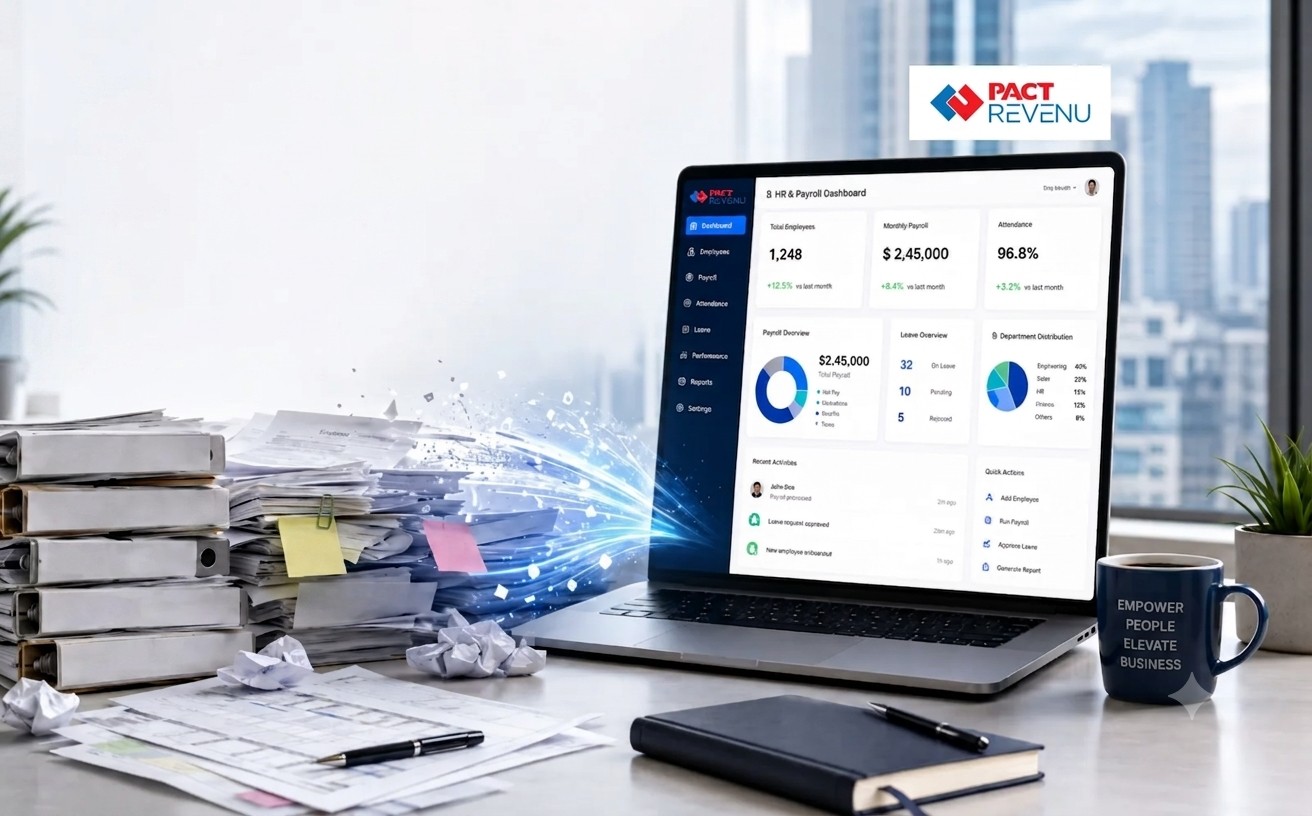
HR teams are increasingly expected to work faster, manage larger employee databases, and provide accurate workforce information to management. At the same time, employees expect digital access to payslips, leave information, attendance records, and other HR services.
The problem is that many businesses still run important HR activities through spreadsheets, email approvals, paper documents, and separate applications. These methods may appear inexpensive, but they create hidden costs through repetitive work, delayed decisions, data inconsistencies, and manual verification.
Modern HR and Payroll Software can address these problems by turning routine HR activities into technology-enabled workflows. The goal is not simply to replace paperwork. It is to create a reliable flow of information from employee onboarding through payroll and workforce reporting.
Here are 10 HR challenges where technology can make a measurable difference.
1. HR Teams Spend Too Much Time on Routine Queries
An HR department can lose hours every week answering the same questions.
“Where can I find my payslip?”
“How many leave days do I have?”
“Was my leave request approved?”
“Has my attendance been updated?”
These questions may be simple, but answering them repeatedly takes HR staff away from more important work.
Technology can introduce employee self-service portals where employees can access approved information themselves. Instead of HR acting as the middleman for every routine request, employees can retrieve information directly from the system.
This creates a more efficient operating model: HR manages the system and exceptions rather than manually responding to every basic request.
2. Onboarding Takes Too Many Manual Steps
Employee onboarding often involves collecting documents, creating employee profiles, assigning departments, recording salary information, configuring access, and completing internal approvals.
When these activities are handled through email and paper forms, HR may have to chase employees for missing information and manually enter the same data several times.
A technology-based onboarding workflow can standardize these steps.
Employee information can be captured digitally, documents can be organized systematically, and required approvals can be tracked through predefined workflows.
This is particularly valuable when a company hires employees frequently. A standardized digital process can provide a more consistent onboarding experience without requiring HR to recreate the process for every new employee.
3. HR Has No Clear View of Workforce Costs
Employee costs are not limited to basic salaries. Businesses may also have allowances, incentives, overtime, benefits, deductions, and other payroll-related expenses.
When workforce information is stored separately from payroll and financial data, management may struggle to understand the real cost of maintaining different teams.
Technology can provide more structured workforce information and help management analyze payroll-related data.
For example, management could compare workforce costs across departments or monitor how salary revisions are affecting overall payroll expenditure.
This type of visibility is useful for budgeting and workforce planning because HR decisions have a direct financial impact on the organization.
4. Salary Revisions Are Difficult to Track
Salary changes are common, but manually tracking them can become surprisingly complicated.
Employees may receive annual increments, promotions, role-based adjustments, incentives, or other compensation changes. HR needs to know when each change becomes effective and ensure the correct information reaches payroll.
A centralized system can maintain salary history and relevant employee information in a structured manner.
Instead of searching through emails to determine when a salary revision was approved, authorized users can refer to the employee's digital record.
This creates better traceability and reduces the risk of using outdated compensation information.
5. Payroll Deadlines Create Unnecessary Pressure
Payroll has a fixed deadline. If employee data is incomplete or approvals are delayed, HR teams may end up working under unnecessary pressure near the salary processing date.
Manual payroll processing often requires HR to gather information from several sources before payroll can be finalized.
A technology-driven workflow can help organize these activities before the payroll deadline. Pending approvals, missing information, and employee changes can be handled through structured processes rather than last-minute spreadsheet checks.
Automation can also reduce repetitive calculations.
The purpose of payroll processing technology is therefore not simply to calculate salaries faster. It is to make the entire payroll cycle more predictable.
6. HR Data Is Difficult to Audit
Businesses occasionally need to determine who changed an employee record, when a leave request was approved, or how a particular payroll figure was generated.
Paper files and shared spreadsheets provide limited visibility into these activities.
Modern systems can provide activity records, approval workflows, and access controls, depending on the platform.
This creates better operational traceability.
For example, if a salary record changes, the organization may be able to identify the relevant update and approval history instead of searching through multiple email conversations.
This is an important technology advantage for organizations that need greater control over HR operations.
7. Payroll and Attendance Data Do Not Match
One of the most frustrating HR problems occurs when attendance information and payroll information tell different stories.
An employee may have approved leave in one record but be shown as absent in another. Overtime may be recorded by a department but not reflected in the information used for salary calculations.
These inconsistencies usually occur because systems are disconnected.
Payroll software with appropriate integrations can help reduce these gaps by connecting relevant employee information with payroll workflows.
Businesses should verify exactly what integrations a platform supports rather than assuming that every HR system automatically connects with every attendance or finance application.
8. HR Managers Lack Real-Time Information
Traditional HR reporting often follows a request-based model.
Management asks for a report. HR collects data. Someone cleans the spreadsheet. Another person verifies the numbers. The final report is then prepared.
By the time the report reaches management, the information may already be outdated.
Modern HR management software can provide dashboards and structured reports that make workforce information easier to access.
Depending on the platform, managers may be able to monitor headcount, payroll costs, leave patterns, employee changes, and other metrics without waiting for a manually prepared report.
This changes HR from a record-keeping function into a more data-driven business function.
9. Small Businesses Outgrow Manual HR Systems
A small company may not initially need a complex HR platform. With a handful of employees, the owner or administrator may manage attendance and salaries using spreadsheets.
The problem appears when the company starts growing.
Twenty employees become fifty. Fifty become one hundred. The same spreadsheet-based process now requires considerably more time and creates more opportunities for mistakes.
This is where HR and Payroll Software for small business becomes useful.
The objective is not to buy the most complicated system available. Small businesses should choose a platform that covers their current requirements while allowing them to scale.
When evaluating the Best payroll software for small business in India, businesses should consider usability, payroll capabilities, employee management, security, reporting, scalability, integrations, and ongoing support.
10. HR Technology Is Disconnected From the Rest of the Business
HR does not operate independently from the rest of an organization.
Employee costs affect finance. Headcount affects budgeting. Department changes affect organizational planning. Payroll information contributes to financial reporting.
If HR operates in one isolated application while finance, accounting, and other departments use separate systems, information has to move manually between departments.
An integrated technology approach can reduce this fragmentation.
This is where businesses should look beyond individual features and consider how their HR technology fits into the wider business environment.
How Modern HR Technology Changes the Workflow
The most important change is the movement from manual administration to connected workflows.
Consider a salary revision.
In a traditional environment, HR may receive an approval email, update an employee spreadsheet, notify payroll, change another document, and inform finance.
In a connected technology environment, the approved change can be recorded in the employee's centralized profile and made available to relevant processes according to the system's permissions and integrations.
The same principle applies to onboarding, leave, attendance, and payroll processing.
Technology therefore creates value by reducing unnecessary movement of information.
What Makes HR Technology Actually Useful?
A long feature list does not automatically make software good.
Businesses should ask practical questions before choosing an HR platform:
- Can employees access their own information?
- Can HR control user permissions?
- Can salary structures be configured?
- Can attendance and leave data support payroll workflows?
- Can management generate useful reports?
- Can the system integrate with existing business applications?
- Can it handle a growing workforce?
- How is sensitive employee information protected?
- What support is available when something goes wrong?
These questions are more useful than simply asking how many features the software contains.
Why PACT REVENU?
PACT REVENU provides an integrated business management platform for organizations looking to manage business processes through a connected technology environment.
For companies trying to reduce fragmented applications, an integrated approach can help bring different operational functions closer together and reduce unnecessary information transfer.
The right technology should make HR operations easier to control, easier to measure, and easier to scale.
If your HR team is still spending significant time chasing approvals, correcting spreadsheets, checking payroll data, or preparing repetitive reports, those processes are strong candidates for automation.
Explore PACT REVENU to evaluate how an integrated business management platform can support more efficient HR, payroll, and wider business operations.
Frequently Asked Questions
What is HR and Payroll Software?
It is a digital platform that helps businesses manage employee information, HR workflows, attendance, leave, salary data, payroll, payslips, and reporting from a centralized environment.
How does HR software help employees?
Employee self-service capabilities can allow employees to access payslips, check leave information, submit requests, and view permitted HR information without depending on HR for every routine task.
Is HR and Payroll Software for small business useful?
Yes. It can help small businesses replace fragmented spreadsheets with structured employee and payroll workflows. The software should be selected according to the company's workforce size, budget, processes, and growth plans.
What should businesses consider when choosing Payroll software?
Businesses should examine payroll automation, salary configuration, employee management, attendance integration, reporting, security, scalability, support, and compatibility with their existing technology environment.
Can HR software eliminate payroll errors completely?
No. Properly configured technology can reduce many manual calculation and data-entry errors, but organizations still need appropriate validation, approvals, and review before payroll is finalized.
How can PACT REVENU help businesses?
PACT REVENU offers an integrated business management environment that businesses can evaluate for connecting HR, payroll, finance, and other operational processes according to their specific requirements.
Conclusion
The biggest HR technology problems are rarely caused by a complete lack of software. They are usually caused by disconnected systems, repetitive data entry, manual approvals, poor visibility, and processes that were never designed to scale.
Modern HR and Payroll Software can address these weaknesses by creating centralized information, automated workflows, employee self-service, structured reporting, and better connections between HR and payroll.
For small businesses, the priority should be finding practical technology that can grow with the organization. For larger businesses, integration, security, reporting, and process automation become increasingly important.
PACT REVENU provides businesses with an integrated technology approach to business management.
If manual HR administration is consuming valuable time, assess your current processes and explore PACT REVENU (https://pactsoft.in/10-common-hr-challenges-that-hr-payroll-software-can-fix/) to identify where technology can reduce repetitive work and improve operational efficiency.