Hydrogen Blending Market Opportunities Across Europe, North America, and Asia-Pacific
-
- July 14th, 2026
- 4,367 views
Hydrogen Blending Market Size
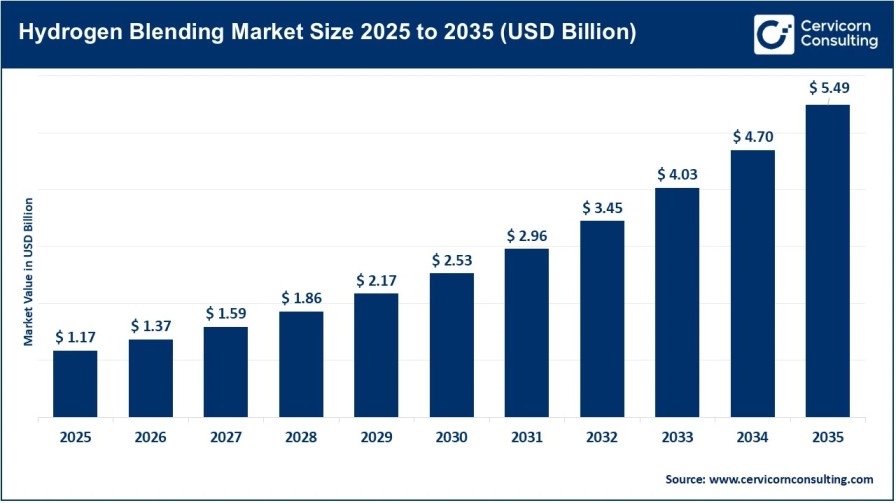
The global hydrogen blending market was valued at approximately USD 1.17 billion in 2025 and is expected to reach around USD 5.49 billion by 2035, growing at a strong 16.8% CAGR over the forecast period. Rising investments in clean energy technologies, supportive regulatory frameworks, and increasing efforts to reduce carbon emissions are key factors driving market expansion.
Read a Full Report: https://www.cervicornconsulting.com/hydrogen-blending-market
Understanding the Hydrogen Blending Market
The hydrogen blending market refers to the practice of incorporating hydrogen into existing natural gas infrastructure, including transmission pipelines, storage systems, distribution networks, and end-user applications. In most cases, hydrogen is blended with natural gas at concentrations ranging from 5% to 20%, enabling energy providers to lower greenhouse gas emissions while continuing to utilize current gas infrastructure.
As a transitional solution toward a hydrogen-powered future, hydrogen blending helps governments, utility providers, and industrial sectors advance decarbonization goals without requiring immediate investments in dedicated hydrogen networks. The market includes hydrogen production technologies, blending systems, transportation infrastructure, storage facilities, monitoring solutions, and specialized engineering services.
Access a complimentary sample report:
https://www.cervicornconsulting.com/sample/2967
Significance of the Hydrogen Blending Market
Hydrogen blending is becoming increasingly important as countries worldwide pursue ambitious net-zero emission targets. By introducing hydrogen into existing gas networks, energy providers can reduce the carbon intensity of fuel consumption without replacing current infrastructure.
Key advantages of hydrogen blending include:
Supporting global climate and decarbonization initiatives
Improving energy security through diversified energy sources
Accelerating renewable energy integration
Lowering reliance on imported fossil fuels
Creating a practical pathway toward a hydrogen economy
Extending the service life of existing gas assets
Assisting industries in meeting ESG and sustainability objectives
Furthermore, hydrogen blending serves as an important bridge technology, enabling stakeholders to gain operational expertise before transitioning to fully dedicated hydrogen systems.
Market Growth Drivers
The hydrogen blending market is experiencing rapid growth due to increasing commitments to carbon neutrality, growing investments in green hydrogen production, and expanding renewable energy capacity worldwide. Favorable government policies promoting clean energy adoption and infrastructure modernization are further supporting market development.
Additional factors contributing to market growth include:
Increasing demand for low-carbon energy solutions across industries
Technological advancements in hydrogen transportation and storage
Expansion of hydrogen pilot and demonstration projects globally
Implementation of national hydrogen roadmaps and transition strategies
Declining renewable energy costs that improve green hydrogen economics
Partnerships between utilities and hydrogen technology developers
Funding and incentives from governments and international agencies
Leading Industry Participants
Several prominent infrastructure operators and energy companies are helping advance hydrogen blending technologies globally:
Snam – Investing in Europe's hydrogen backbone infrastructure and supporting the SoutH2 Corridor project.
National Gas – Leading the FutureGrid initiative to evaluate hydrogen readiness across the UK's gas transmission network.
Enagás – Developing hydrogen transport corridors and playing a significant role in the H2Med project.
Fluxys – Expanding hydrogen transportation capabilities through its extensive European energy network.
Gasunie – Supporting hydrogen valley developments and large-scale hydrogen transport projects across Northern Europe.
Emerging Trends in the Hydrogen Blending Market
Growth in Green Hydrogen Production
The rapid expansion of renewable-powered electrolysis projects is increasing the supply of low-carbon hydrogen for blending applications.
Expansion of Hydrogen Transportation Corridors
Large-scale hydrogen pipeline projects are enhancing regional connectivity and enabling cross-border hydrogen trade.
Advanced Pipeline Monitoring Technologies
Digital monitoring systems, AI-driven analytics, and advanced sensors are improving safety, operational performance, and leak detection.
Higher Hydrogen Blending Percentages
Several pilot projects are moving beyond initial blending levels and successfully demonstrating hydrogen concentrations of up to 20%.
Industrial Decarbonization Initiatives
Industries are increasingly utilizing hydrogen-blended gas to reduce emissions and comply with environmental regulations.
Renewable Energy Storage Applications
Hydrogen is emerging as an effective solution for storing excess renewable electricity and enhancing energy system flexibility.
Noteworthy Hydrogen Blending Projects
A number of successful projects have demonstrated the practicality and scalability of hydrogen blending technologies:
HyDeploy (United Kingdom): Successfully validated the safe use of up to 20% hydrogen in public gas distribution systems without appliance modifications.
FutureGrid (United Kingdom): Testing hydrogen transportation through existing gas transmission infrastructure.
GRHYD (France): Demonstrated hydrogen blending for residential heating and transportation applications.
HyNet (United Kingdom): Combines hydrogen production, blending, and carbon capture technologies to support regional decarbonization.
Hydrogen Valley Projects (Netherlands): Integrate hydrogen production, storage, and distribution across industrial clusters.
H2Med Corridor (Spain, Portugal, France): Developing a strategic hydrogen transport network connecting major European markets.
Regional Market Analysis
Europe
Europe remains the dominant market for hydrogen blending, supported by ambitious climate policies, extensive gas infrastructure, and programs such as the European Green Deal and REPowerEU.
North America
The region is witnessing growing investments through initiatives such as the Inflation Reduction Act (IRA), Hydrogen Shot Program, and Regional Clean Hydrogen Hubs.
Asia-Pacific
Asia-Pacific is expected to experience some of the highest growth rates, driven by national hydrogen strategies and large-scale investments in Japan, South Korea, China, and Australia.
Latin America
Abundant renewable energy resources are positioning the region as a promising hub for green hydrogen production and future blending opportunities.
Middle East & Africa
Governments across the region are investing heavily in hydrogen development as part of economic diversification efforts. Flagship projects such as Saudi Arabia's NEOM green hydrogen initiative are expected to drive future market growth.