Hydrogen Fuel Cell Mobility Market Trends and Growth Opportunities
-
- May 27th, 2026
- 6,015 views
Hydrogen Mobility Market Size
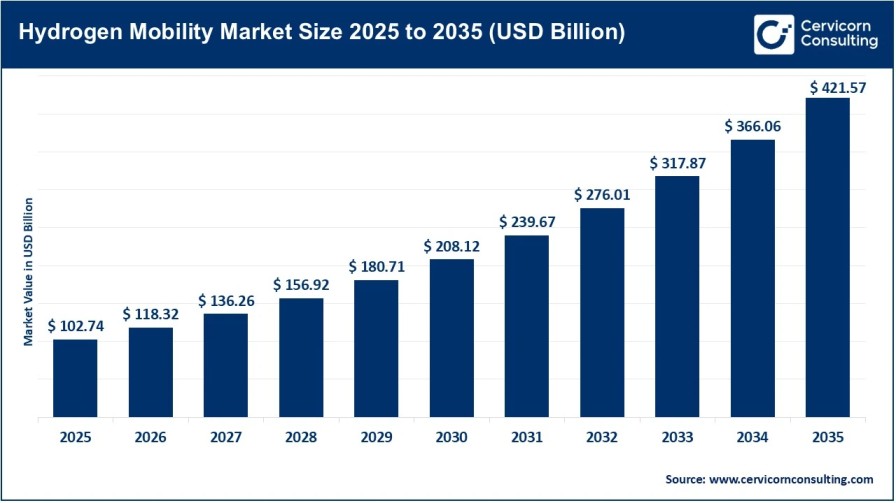
The global hydrogen mobility market was valued at approximately USD 102.74 billion in 2025 and is projected to reach nearly USD 421.57 billion by 2035. The market is anticipated to grow at a robust CAGR of 15.2% from 2026 to 2035, fueled by increasing investments in sustainable transportation infrastructure, rapid adoption of hydrogen technologies, and the rising demand for zero-emission mobility solutions across the globe.
Read the report: https://www.cervicornconsulting.com/hydrogen-mobility-market
What is the Hydrogen Mobility Market?
The hydrogen mobility market refers to the global industry focused on developing, manufacturing, and deploying hydrogen-powered transportation systems along with the supporting infrastructure needed for efficient operations. This includes fuel cell electric vehicles (FCEVs), hydrogen-powered combustion vehicles, hydrogen refueling stations, hydrogen production technologies, storage systems, and transportation networks.
Hydrogen mobility solutions are being increasingly adopted across multiple transportation sectors such as passenger vehicles, buses, commercial trucks, railways, maritime transportation, and even emerging aerospace applications.
Hydrogen fuel cells generate electricity through an electrochemical reaction between hydrogen and oxygen, enabling electric motors to operate without harmful emissions. Unlike traditional combustion engines that emit greenhouse gases and pollutants, hydrogen-powered systems release only water vapor and heat, making them a key solution in global decarbonization efforts.
The market has witnessed notable expansion due to growing investments in green hydrogen production, government incentives promoting sustainable transportation, and continuous innovation in fuel cell technologies. Automotive manufacturers and energy companies are collaborating to establish integrated hydrogen ecosystems that include renewable hydrogen generation, storage facilities, and refueling infrastructure. Rising concerns about climate change and tightening emission regulations worldwide are expected to further support market growth over the next decade.
Get a Free Sample: https://www.cervicornconsulting.com/sample/2957
Why the Hydrogen Mobility Market is Important
The hydrogen mobility market is becoming increasingly important because it offers a practical approach to decarbonizing transportation sectors that are challenging to electrify using battery-only technologies. While battery-electric vehicles have gained significant traction in passenger transportation, hydrogen fuel cell systems provide advantages such as faster refueling, longer operational range, and higher efficiency for heavy-duty applications.
Hydrogen-powered transportation is particularly valuable for industries such as commercial trucking, public transit, freight logistics, railways, and maritime shipping where vehicles require continuous operation and high energy density. Fuel cell vehicles can generally be refueled within minutes, reducing downtime and improving operational productivity.
Another major benefit of hydrogen mobility is energy diversification. Hydrogen can be produced from renewable resources such as wind, solar, and hydropower through electrolysis, helping countries reduce reliance on fossil fuels and imported oil. Green hydrogen production also supports renewable energy storage and power grid balancing.
Additionally, hydrogen mobility plays a crucial role in helping countries achieve climate and carbon neutrality targets. Governments worldwide are implementing policies to reduce dependence on diesel and gasoline vehicles, making hydrogen-powered transportation increasingly important for lowering emissions across industrial transportation, aviation, and shipping sectors.
The market is also generating economic opportunities through infrastructure expansion, technological innovation, research investments, and employment growth. Increasing deployment of fuel cell manufacturing facilities, hydrogen production plants, and refueling infrastructure is attracting substantial public and private investment globally.
Key Factors Driving Hydrogen Mobility Market Growth
The hydrogen mobility market is expanding rapidly due to the combined impact of technological advancements, environmental regulations, supportive government policies, and increasing demand for sustainable transportation systems.
Governments across Europe, North America, and Asia-Pacific are introducing stringent emission standards while offering subsidies, tax incentives, and funding programs to accelerate hydrogen vehicle adoption and infrastructure development.
Automotive manufacturers are expanding their hydrogen-powered vehicle portfolios while collaborating with energy providers to build integrated hydrogen ecosystems. Improvements in fuel cell efficiency, hydrogen storage technologies, and electrolyzer systems are helping lower operating costs and improve vehicle performance.
The growing demand for long-range transportation solutions in sectors such as freight trucking, railways, maritime shipping, and public transportation is also contributing significantly to market growth. At the same time, rising investments in renewable energy projects are strengthening green hydrogen production and improving the long-term sustainability of hydrogen mobility solutions.
Corporate sustainability goals and increasing global commitments toward net-zero emissions are expected to further accelerate the adoption of hydrogen-powered transportation worldwide.
Major Companies Operating in the Hydrogen Mobility Market
Toyota Motor Corporation
Toyota continues to lead innovation in hydrogen fuel cell mobility through advanced fuel cell technologies and passenger vehicle solutions. The Toyota Mirai remains one of the most recognized hydrogen-powered passenger vehicles worldwide.
Hyundai Motor Company
Hyundai is a major participant in hydrogen commercial transportation, focusing on hydrogen-powered trucks, buses, and logistics applications while expanding strategic hydrogen partnerships globally.
Honda Motor Co., Ltd.
Honda is investing heavily in next-generation hydrogen-electric technologies and collaborative fuel cell systems designed to support sustainable passenger mobility.
BMW Group
BMW is strengthening its position in premium hydrogen mobility through projects such as the BMW iX5 Hydrogen initiative and continued hydrogen technology research.
Daimler Truck AG
Daimler Truck AG is focusing on hydrogen-powered long-haul transportation and advanced fuel cell truck technologies for heavy-duty mobility applications.
Major Trends Reshaping the Hydrogen Mobility Market
Expansion of Green Hydrogen Production
One of the leading trends in the hydrogen mobility market is the rapid expansion of green hydrogen production. Green hydrogen is generated through electrolysis powered by renewable energy sources such as wind and solar energy.
Countries including Germany, Japan, South Korea, China, and the United States are investing heavily in green hydrogen infrastructure to reduce environmental impact and improve transportation sustainability.
Large-scale green hydrogen projects are expected to lower production costs over time, enhancing the commercial viability of hydrogen-powered mobility solutions.
Rapid Expansion of Hydrogen Refueling Infrastructure
Hydrogen refueling infrastructure is growing rapidly across international markets. Governments and private companies are developing hydrogen transportation corridors to support fuel cell vehicle deployment and long-distance commercial transportation.
Regions such as California, Germany, Japan, and South Korea are leading hydrogen station development. Expanded infrastructure availability is increasing consumer confidence and accelerating adoption of FCEVs.
Increasing Adoption in Heavy-Duty Transportation
Hydrogen mobility is gaining strong momentum in heavy-duty transportation sectors including buses, freight trucks, railways, mining equipment, and shipping.
Battery-electric technologies may face limitations related to charging times, driving range, and payload capacity in heavy-duty operations. Hydrogen fuel cells provide extended operational range and rapid refueling, making them highly suitable for industrial logistics and freight transportation.
Strategic Partnerships Across the Hydrogen Ecosystem
Collaborations between automotive manufacturers, renewable energy companies, industrial gas providers, and oil & gas firms are becoming increasingly common.
These partnerships help establish integrated hydrogen ecosystems covering production, transportation, storage, and fueling infrastructure while accelerating technological innovation and infrastructure deployment.
Advancements in Fuel Cell Technologies
Continuous innovation in fuel cell technologies is improving efficiency, durability, affordability, and lifespan. Manufacturers are developing lighter and more compact fuel cell systems with enhanced performance capabilities.
Innovations in hydrogen storage systems and next-generation electrolyzers are also improving the commercial feasibility of hydrogen-powered transportation solutions.
Successful Hydrogen Mobility Developments Worldwide
Japan’s Hydrogen Society Vision
Japan has established itself as a global leader in hydrogen mobility through strong government support and long-term hydrogen strategies. Companies such as Toyota and Honda have introduced fuel cell vehicles while expanding hydrogen refueling infrastructure nationwide.
Toyota’s Mirai remains one of the world’s best-known hydrogen-powered passenger vehicles.
South Korea’s Hydrogen Economy Roadmap
South Korea has implemented a comprehensive hydrogen economy roadmap focused on sustainable transportation and clean energy growth. Hyundai Motor Company has played a major role in deploying hydrogen-powered buses and trucks.
Government support and industrial partnerships have positioned South Korea as a major hydrogen mobility market.
Germany’s Hydrogen Train Projects
Germany has pioneered hydrogen-powered rail transportation through fuel cell train initiatives developed by companies such as Alstom.
These trains operate without diesel fuel and emit only water vapor, making them ideal for non-electrified railway routes.
California’s Hydrogen Infrastructure Expansion
California has become a major hydrogen mobility hub in North America through supportive regulations, infrastructure investments, and clean transportation incentives.
Hydrogen fueling stations across the state support both passenger fuel cell vehicles and commercial transportation fleets.
China’s Hydrogen Commercial Vehicle Growth
China is rapidly strengthening its hydrogen mobility market with a major focus on buses, heavy-duty trucks, and industrial transportation applications.
Government subsidies and pilot programs are accelerating fuel cell vehicle deployment while domestic manufacturers continue investing heavily in fuel cell technologies and hydrogen infrastructure.
Regional Analysis of the Hydrogen Mobility Market
North America
North America remains a key growth region due to increasing investments in hydrogen infrastructure and sustainable transportation technologies. The United States, particularly California, is leading fuel cell vehicle adoption through regulatory support and infrastructure funding initiatives.
Key support measures include:
- Hydrogen hub development programs
- Clean hydrogen tax incentives
- Zero-emission vehicle mandates
- Funding for hydrogen-powered public transit systems
Canada is also investing significantly in renewable hydrogen production and hydrogen-powered heavy transportation systems.
Europe
Europe is among the fastest-growing hydrogen mobility markets due to ambitious climate targets and supportive policy frameworks.
Countries including Germany, France, and the Netherlands are investing heavily in hydrogen trains, fuel cell vehicles, and commercial transportation solutions.
Major policy initiatives include:
- European Green Deal programs
- Clean Hydrogen Partnership funding
- Hydrogen corridor development
- Commercial fleet decarbonization strategies
Asia-Pacific
Asia-Pacific dominates global hydrogen mobility adoption due to strong government support, advanced automotive manufacturing capabilities, and ongoing technological innovation.
Japan and South Korea continue leading fuel cell transportation deployment, while China is rapidly expanding hydrogen commercial vehicle adoption. India is also exploring hydrogen mobility through its National Green Hydrogen Mission.
Latin America
Latin America is gradually entering the hydrogen mobility market through investments in renewable energy and green hydrogen production.
Countries such as Chile and Brazil are exploring hydrogen applications for mining transportation and industrial logistics operations.
Middle East & Africa
The Middle East and Africa region is increasingly investing in hydrogen mobility as part of broader clean energy diversification strategies.
Countries including Saudi Arabia and the United Arab Emirates are developing large-scale green hydrogen projects supported by abundant solar energy resources.
Projects such as Saudi Arabia’s NEOM hydrogen initiative are expected to strengthen the region’s role in the global hydrogen economy.
Future Outlook of the Hydrogen Mobility Market
The future of the hydrogen mobility market appears highly promising as governments, automotive manufacturers, and energy companies continue increasing investments in sustainable transportation technologies.
Commercial transportation sectors including freight logistics, public transportation, aviation, and maritime shipping are expected to become major adopters of hydrogen-powered systems during the coming decade.
Advancements in electrolyzer technologies, hydrogen storage systems, and fuel cell durability are expected to reduce operational costs and improve competitiveness compared to traditional transportation technologies.
Expanding renewable energy deployment and rising global commitments toward net-zero emissions are likely to further strengthen market growth. As hydrogen infrastructure expands and economies of scale improve, hydrogen mobility is expected to become a critical component of the future sustainable transportation ecosystem.
To Get Detailed Overview, Contact Us: https://www.cervicornconsulting.com/contact-us