Income Tax Slabs and Rates
-

- May 02nd, 2026
- 7,792 views
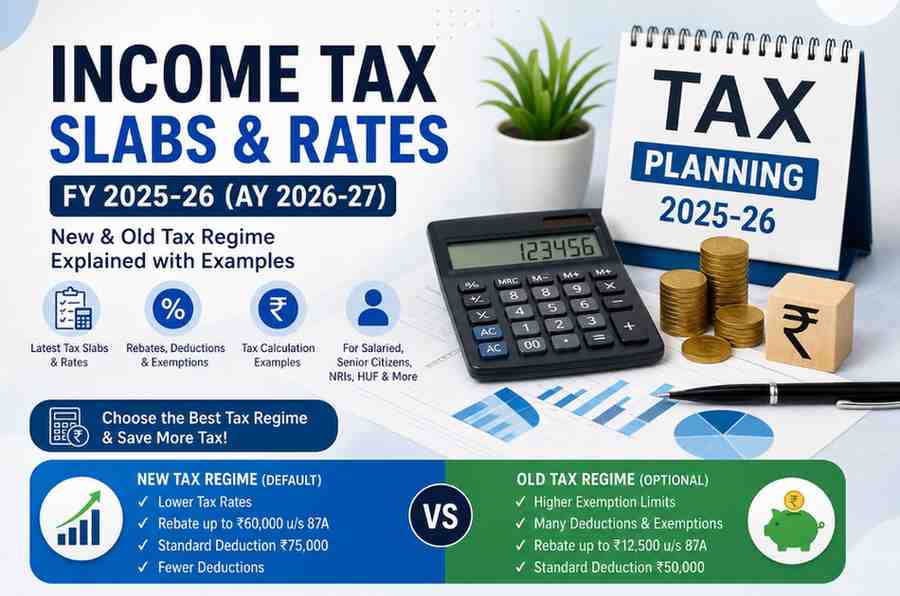
For FY 2025-26 (AY 2026-27), the New Tax Regime is the default option with updated, lower slabs. Zero tax is applicable on annual income up to ₹12 lakh due to rebates. Taxable income above ₹12 lakh starts at 15%, increasing to 30% for incomes over ₹24 lakh, with a standard deduction of ₹75,000 for salaried individuals.
Current Income Tax Slabs
The current income tax slabs under the Old Tax Regime are as follows: 0% up to Rs. 2.5 lakh, 5% on Rs. 2.5 lakh to Rs. 5 lakh, 20% on Rs. 5 lakh to Rs. 10 lakh, and 30% on income above Rs. 10 lakh.
The New Tax Regime slabs are 0% up to Rs. 4 lakh, 5% on Rs. 4 lakh to Rs. 8 lakh, 10% on Rs. 8 lakh to Rs. 12 lakh, 15% on Rs. 12 lakh to Rs. 16 lakh, 20% on Rs. 16 lakh to Rs. 20 lakh, 25% on Rs. 20 lakh to Rs. 24 lakh, and 30% on income above Rs. 24 lakh.
New Tax Regime Slabs for FY 2025-26 (AY 2026-27)
The new tax regime under Section 115BAC is the default tax structure for the fiscal year 2025-26. It provides reduced tax rates alongside restricted deductions and a basic exemption threshold of Rs. Four hundred thousand. The updated tax brackets are as follows:
|
New Tax Regime Slabs |
New Tax Regime Rates |
|
Up to Rs. 4 lakh |
Nil |
|
Rs. 4 lakh to Rs. 8 lakh |
5% |
|
Rs. 8 lakh to Rs. 12 lakh |
10% |
|
Rs. 12 lakh to Rs. 16 lakh |
15% |
|
Rs. 16 lakh to Rs. 20 lakh |
20% |
|
Rs. 20 lakh to Rs. 24 lakh |
25% |
|
Above Rs. 24 lakh |
30% |
Key Features of the New Tax Regime
Basic deduction of Rs. 75,000 for employees on a salary. Earnings up to Rs. 12 lakh are essentially exempt from tax because of the tax rebate provided by Section 87A. Deductions like HRA, 80C, 80D, etc., are not permitted under the revised tax structure.
Income Tax Calculator for FY 2025-26 and FY 2026-27
Use the tax calculator below and know which is the best tax regime for you to save tax.
Old Tax Regime Slabs for FY 2025-26 (AY 2026-27)
The previous tax system provides numerous deductions and exemptions for tax savings, though it has a higher tax rate. Taxpayers may choose the old regime if it offers greater advantages.
|
Income Tax Slabs |
Income Tax rate |
|
Up to Rs. 2.5 lakh |
Nil |
|
Rs. 2.5 lakh to Rs. 5 lakh |
5% |
|
Rs. 5 lakh to Rs. 10 lakh |
20% |
|
Above Rs. 10 lakh |
30% |
Key features of the old tax regime:
The previous tax system provides a greater basic exemption threshold of Rs. 3 lakh for elderly individuals and Rs. 5 lakh for highly senior citizens.
Standard deduction of ₹. Salaried individuals are permitted 50,000.
The previous tax system provides numerous deductions and exemptions for saving on taxes.
Earnings up to Rs. Due to the Section 87A rebate, 5 lakh is exempt from tax.
Section 87A Rebate & Standard Deduction
Section 87A of the Income Tax Act provides a tax rebate that can bring your final tax obligation down to zero if your taxable earnings are below the defined income threshold. Nonetheless, a tax rebate is not a deduction; it takes effect after your tax obligation is determined.
Rebate under Section 87A
The new tax regime provides a tax rebate of up to Rs. 60000, thus effectively making taxable income up to Rs. 12 lakh tax-free. The old tax regime offers a tax rebate of Rs. 12,500, making taxable income up to Rs. 5 lakh tax-free. Rebate is not allowed for incomes taxed at special rates, such as capital gains, under Section 111A and Section 112A.
Standard Reduction:
A flat standard deduction is available to salaried taxpayers and pensioners under the head “Income from Salary”. For FY 2025-26, the standard deduction under:
-
The new tax regime is Rs. 75,000 and
-
The old tax regime is Rs. 50,000.
Example
Mr X receives an income from his salary of Rs. 11.75 lakh in the fiscal year 2025-26 and chooses the new system. Following the usual deduction of Rs. 75,000, his taxable earnings will amount to Rs. 1.1 million. This is the way the Section 87A rebate operates:
|
Slab |
Amount |
Tax |
|
Up to Rs. 4 lakh |
Rs. 4 lakh @ 0% |
Nil |
|
Rs. 4 lakh to Rs. 8 lakh |
Rs. 4 lakh @ 5% |
20,000 |
|
Rs. 8 lakh to Rs. 11 lakh |
Rs. 3 lakh @ 10% |
30,000 |
|
Total Tax before Rebate |
50,000 |
|
|
Rebate u/s 87A |
50,000 |
|
|
Net Tax Liability |
0 |
Given that Section 87A provides a tax refund of up to Rs. 60,000, and Mr X owed Rs. in taxes. He qualifies for a tax refund of Rs. 50,000.
Surcharge & Cess
Surcharge is an extra tax that applies only if your total income surpasses certain threshold limits. The surcharge rates are as follows:
|
Income Limit |
New Tax Regime |
Old Tax Regime |
|
Up to Rs. 50 lakh |
Nil |
Nil |
|
Rs. 50 lakh to Rs. 1 crore |
10% |
10% |
|
Rs. 1 crore to Rs. 2 crore |
15% |
15% |
|
Rs. 2 crore to Rs. 5 crore |
25% |
25% |
|
Above Rs. 5 crore |
25% |
37% |
All taxpayers pay a 4% health and education surcharge on their tax liability regardless of their income level.
Income Tax Slabs for Specific Categories
Some of the different categories are listed below:
Income Tax Slabs for Senior Citizens (Aged 60 to 80)
The old tax regime provides a higher basic exemption threshold for resident senior citizens.
|
Income Tax Slabs |
Income Tax rate |
|
Up to Rs. 3 lakh |
Nil |
|
Rs. 3 lakh to Rs. 5 lakh |
5% |
|
Rs. 5 lakh to Rs. 10 lakh |
20% |
|
Above Rs. 10 lakh |
30% |
Nevertheless, the new tax regime slab rate remains the same.
Income Tax Slabs for Super Senior Citizens (Aged 80+ years)
2. For resident taxpayers over 80 years old, the basic exemption threshold in the old tax regime is Rs. Five hundred thousand.
|
Income Tax Slabs |
Income Tax Rate |
|
Up to Rs. 5 lakh |
Nil |
|
Rs. 5 lakh to Rs. 10 lakh |
20% |
|
Above Rs. 10 lakh |
30% |
The updated tax bracket stays unchanged with no elevated basic exemption thresholds.
Income Tax Slabs for Women
3. The income tax brackets for women remain unchanged at the current rates in both the old and new tax systems. The Income Tax Act does not provide varying tax brackets and rates for women.
Income Tax Slabs for NRIs
4. NRIs may opt for either the old or the new tax system. The tax brackets for NRIs remain unchanged under the new tax framework, with a basic exemption threshold of Rs. 4 lakh. 2.5 lakh within the previous tax system.
However, NRIs cannot benefit from the basic exemption limit relaxation for senior and super senior citizens under the old tax system, as this is exclusive to resident taxpayers.
Income Tax Slabs for HUF
5. The default tax regime for HUFs is the new tax system, and the tax brackets stay unchanged with a basic exemption limit of up to Rs. 4 lakh. HUFs can also choose the old tax regime with a basic exemption threshold of Rs. Two hundred fifty thousand.
lakh.
Special Income Tax Rates
The Income Tax Act imposes a specific flat rate on certain incomes instead of the regular slab rates. These incomes consist of Short-term capital gains as per Section 111A, Long-term capital gains, winnings from lotteries or game shows, and profits from virtual digital assets.
|
Income Type |
Tax Rate |
|
Short-term Capital Gains (Section 111A) |
20% |
|
Long-term Capital Gains |
12.5% |
|
Lottery or Game show winnings |
30% |
|
Crypto or Virtual Digital Assets |
30% |
Income Tax Slabs for FY 2026-27 (AY 2027-28)
According to Budget 2026, the tax slabs will remain unchanged for FY 2026-27. This indicates that the current tax slabs and rates will remain in effect under both the new and the old tax systems. Taxpayers continue to enjoy the same basic exemption limits of
-
4 lakh under the new taxation system
-
Rs. 2.5 lakh in the previous tax system
The revised tax system under Section 115BAC remains the standard tax framework.
Income Tax Slabs Comparison for FY 2023-24, FY 2024-25 & FY 2025-26
The previous tax regime slabs have stayed the same throughout the years. Nevertheless, important modifications have occurred in the new tax regime slabs. The subsequent modifications to the tax regime are as follows:
|
Income tax Slab |
FY 2023-24 |
FY 2024-25 |
FY 2025-26 |
|
Up to Rs. 3 lakh |
Nil |
Nil |
Nil |
|
Rs. 3 lakh to Rs. 4 lakh |
5% |
5% |
Nil |
|
Rs. 4 lakh to Rs. 6 lakh |
5% |
5% |
5% |
|
Rs. 6 lakh to Rs. 7 lakh |
10% |
5% |
5% |
|
Rs. 7 lakh to Rs. 8 lakh |
10% |
10% |
5% |
|
Rs. 8 lakh to Rs. 9 lakh |
10% |
10% |
10% |
|
Rs. 9 lakh to Rs. 10 lakh |
15% |
10% |
10% |
|
Rs. 10 lakh to Rs. 12 lakh |
15% |
15% |
10% |
|
Rs. 12 lakh to Rs. 15 lakh |
20% |
15% |
15% |
|
Rs. 15 lakh to Rs. 16 lakh |
30% |
20% |
15% |
|
Rs. 16 lakh to Rs. 20 lakh |
30% |
20% |
20% |
|
Rs. 20 lakh to Rs. 24 lakh |
30% |
30% |
25% |
|
Above Rs. 24 lakh |
30% |
30% |
30% |
Key changes in Income Tax Slabs:
The basic exemption limit was raised, and the slabs were restructured for FY 2023-24, starting from Rs. 2,50,000 to Rs. 3,00,000. Slabs were reorganised once more in FY 2025-26, and the fundamental exemption threshold was raised to Rs. 4 lakhs from Rs. 300,000. The limit for tax exemption was raised to Rs. 12 lakh in the fiscal year 2025-26 from Rs. 7 lakh in Indian Rupees. 2024-25 owing to the rise in the Section 87A rebate threshold.
Old v/s New Tax Regime- Which is Better for FY 2025-26?
The preferred tax regime relies on the deductions and exemptions permitted for the taxpayer. The revised tax system provides a reduced tax slab rate but prohibits nearly all deductions.
The previous tax system features higher tax slab rates but allows you to lower your taxable income through substantial deductions and exemptions.
Some of the key differences between the Old and New Tax Regime are listed below.
|
Feature |
Old Tax Regime |
New Tax Regime |
|
Default Regime |
No |
Yes |
|
Basic Exemption Limit |
Rs. 2.5 lakh |
Rs. 4 lakh |
|
Rebate u/s 87A |
Rs. 12,5000 (income up to Rs. 5 lakh) |
Rs. 60,000 (income up to Rs. 12 lakh ) |
|
Standard Deduction |
Rs. 50,000 |
Rs. 75,000 |
|
Section 80C Deductions |
Allowed |
Not Allowed |
|
HRA Exemption |
Allowed |
Not Allowed |
|
Home loan interest (Self-occupied) |
Allowed |
Not Allowed |
|
NPS Deduction |
Fully Allowed |
Only Employer Contribution |
|
Set-off of house property losses |
Allowed |
Not Allowed |
|
Section 80D Deduction |
Allowed |
Not Allowed |
Thus, select the old tax system if you possess considerable deductions and exemptions to report. Otherwise, opt for the new tax system.
How to Calculate Income Tax for FY 2025-26?
Income tax is determined by subtracting deductions and exemptions from the total gross income, applying applicable slab rates, and factoring in rebates, cess, and prepaid taxes.
Follow the steps given below to determine income tax obligation according to the Income Tax Act.
Step 1: Compute Gross Total Income by summing salary, house property, business or profession, other income sources, and capital gains.
Step 2: Decrease qualifying deductions or exemptions according to the selected regime.
Step 3: Calculate the taxable earnings.
Step 4: Utilise slab rates and calculate tax according to the selected regime.
Step 5: Utilise and request a rebate if qualified.
Step 6: Include a 4% cess (and surcharge, if relevant) on the tax calculated in Step 4.
Step 7: Deduct TDS, TCS, or any advance tax already settled to determine the net amount due or refund.
Income Tax Calculation Example
Example 1:
Mr Raj earns a salary of Rs. 15 lakh. His taxable income and tax liabilities for FY 2025-26 (AY 2026-27) will be determined as follows under the new tax framework to reduce tax payments:
|
Particulars |
Amount |
|
Income from Salary |
15,00,000 |
|
(-) Standard Deduction |
- 75,000 |
|
Taxable Income for FY 2025-26 (AY 2026-27) |
14,25,000 |
The tax liability of Mr Raj will be calculated as follows:
|
Income Tax Slabs |
Tax Liability |
|
|
Up to Rs. 4 lakh |
Rs. 4 lakh @ 0% |
0 |
|
Rs. 4 lakh to Rs. 8 lakh |
Rs. 4 lakh @ 5% |
20,000 |
|
Rs. 8 lakh to Rs. 12 lakh |
Rs. 4 lakh @ 10% |
40,000 |
|
Rs. 12 lakh to Rs. 14.25 lakh |
Rs. 2.25 lakh @ 15% |
33,750 |
|
Total |
93,750 |
|
|
Add: Health & Education Cess @ 4% |
3750 |
|
|
Total Tax Liability (New Tax Regime) |
97500 |
So, Mr Raj has the tax liability of RS. 97,500 under the new tax regime for FY 2025-26 (AY 2026-27)
Example 2:
Mr Anban for FY 2025-26 has the following incomes, exemptions and deductions.
-
Salary - Rs. 25 lakh
-
HRA Exemption Rs. 4 lakh
-
80C Deduction - Rs. 1.5 lakh
-
80D Deduction - Rs. 25,000
His taxable income and tax obligation for FY 2025-26 (AY 2026-27) will be assessed in the following manner:
|
Particulars |
New Tax Regime |
Old Tax Regime |
|
Income from Salary |
25,00,000 |
25,00,000 |
|
(-) Standard Deduction |
-75,000 |
-50,000 |
|
(-) HRA Exemption |
-4,00,000 |
|
|
24,25,000 |
20,40,000 |
|
|
Less: Other deductions |
||
|
(-) Section 80C |
- 150000 |
|
|
(-) Section 80D |
- 25000 |
|
|
TAxable Income |
24,25,000 |
18,75,000 |
Mr Anban's Tax Liability will be calculated as follows:
Under the New Tax Regime
|
Income Tax Slabs |
Tax Liability |
|
|
Up to Rs. 4 lakh |
0 |
|
|
Rs. 4 lakh to Rs. 8 lakh |
20,000 |
|
|
Rs. 8 lakh to Rs. 12 lakh |
40,000 |
|
|
Rs. 12 lakh to Rs. 16 lakh |
60,000 |
|
|
Rs. 16 lakh to Rs. 20 lakh |
80,000 |
|
|
Rs. 20 lakh to Rs. 24 lakh |
1,00,000 |
|
|
Rs. 24 lakh to Rs. 24.25 lakh |
7500 |
|
|
Total |
3,07,500 |
|
|
Add: Health & Education Cess @ 4% |
12300 |
|
|
Total Tax Liability (New Tax Regime) |
319800 |
Under the Old Tax Regime
|
Income Tax Slabs |
Tax Liability |
|
|
Up to Rs. 2.5 lakh |
Rs. 2.5 lakh @ 0% |
0 |
|
Rs. 2.5 lakh to Rs. 5 lakh |
Rs. 2.5 lakh @ 5% |
12,500 |
|
Rs. 5 lakh to Rs. 10 lakh |
Rs. 5 lakh @ 20% |
1,00,000 |
|
Above Rs. 10 lakh |
Rs. 8.75 lakh @ 30% |
2,62,500 |
|
Total |
3,75,000 |
|
|
Add: Health & Education Cess @ 4% |
15,000 |
|
|
Total Tax Liability (Old Tax Regime) |
3,90,000 |
Therefore, the tax liability of Mr Anban for FY 2025-26 (AY 2026-27) is as follows:
|
Tax Regime |
Tax Liability |
|
New Tax Regime |
3,19,800 |
|
Old Tax Regime |
3,90,000 |
So, by opting for the New Tax Regime, he can save Rs. 70,200 in taxes. However, many deductions & exemptions are not allowed under the new tax regime.
How to File ITR For FY 2025-26?
Once the tax owed or refund amount is established, the subsequent step is to submit the Income Tax Return. Selecting the appropriate ITR form and comprehending the proper way to file ITR is crucial. Taxpayers must submit their ITRs by the designated deadlines to prevent incurring late fees and interest. The deadline to submit ITR for FY 2025-26 (AY 2026-27) is 31 July 2026.
Conclusion
Understanding the income tax slabs and rates is essential for effective financial planning and responsible tax compliance. In India, the tax structure is designed to be progressive, meaning individuals with higher incomes are taxed at higher rates, ensuring a fair distribution of the tax burden. Taxpayers can choose between the old tax regime, which allows various deductions and exemptions, and the new tax regime, which offers lower tax rates with fewer deductions.
By staying informed about the latest tax slabs and using eligible deductions or the appropriate tax regime, individuals can manage their tax liability more efficiently while fulfilling their obligations to the Income Tax Department.