Choosing Between Indoor and Outdoor Cat 6 Ethernet Cable: What to Know
-

- Published Updated
- 1,720 views
The decision between Indoor vs outdoor Cat 6 Ethernet cable depends on where the cable will be routed, the environmental stresses it will face, and local building codes. Cat 6 is a balanced twisted-pair cable commonly used for gigabit and multi-gigabit Ethernet. Choosing the correct indoor or outdoor variant helps protect signal integrity, safety, and the lifespan of the installation.
- Indoor Cat 6: designed for protected indoor spaces, available in plenum (CMP), riser (CMR) and general-purpose (CM) ratings.
- Outdoor Cat 6: features UV-resistant jackets, water-blocking or gel filling, often direct-burial rated or intended for conduit use.
- Shielding, conductor gauge (typically 23 AWG for true Cat 6), and proper termination affect performance for both types.
- Follow local building codes and standards such as ANSI/TIA and, for Ethernet signaling, IEEE 802.3 recommendations when planning installations.
Indoor vs outdoor Cat 6 Ethernet cable: core differences
Construction, jacketing, and environmental protection are the primary differences between indoor and outdoor Cat 6 cable. Indoor cables typically use PVC or low-smoke halogen-free (LSZH) jackets for corridors and walls, while outdoor cable jackets are formulated for UV resistance, temperature extremes, and moisture resistance. Some outdoor cables are gel-filled or include a water-block tape to prevent moisture ingress; others are rated for direct burial.
Conductor, twist and shielding
Cat 6 performance depends on conductor quality, pair twist consistency, and shielding. Typical solid conductors for Cat 6 are 23 AWG (often required for the full Cat 6 spec). Outdoor and indoor varieties can be either unshielded (UTP) or shielded (STP/FTP). Shielded cables help in high-electromagnetic-interference (EMI) environments but require proper grounding and compatible connectors.
Jacket materials and environmental protections
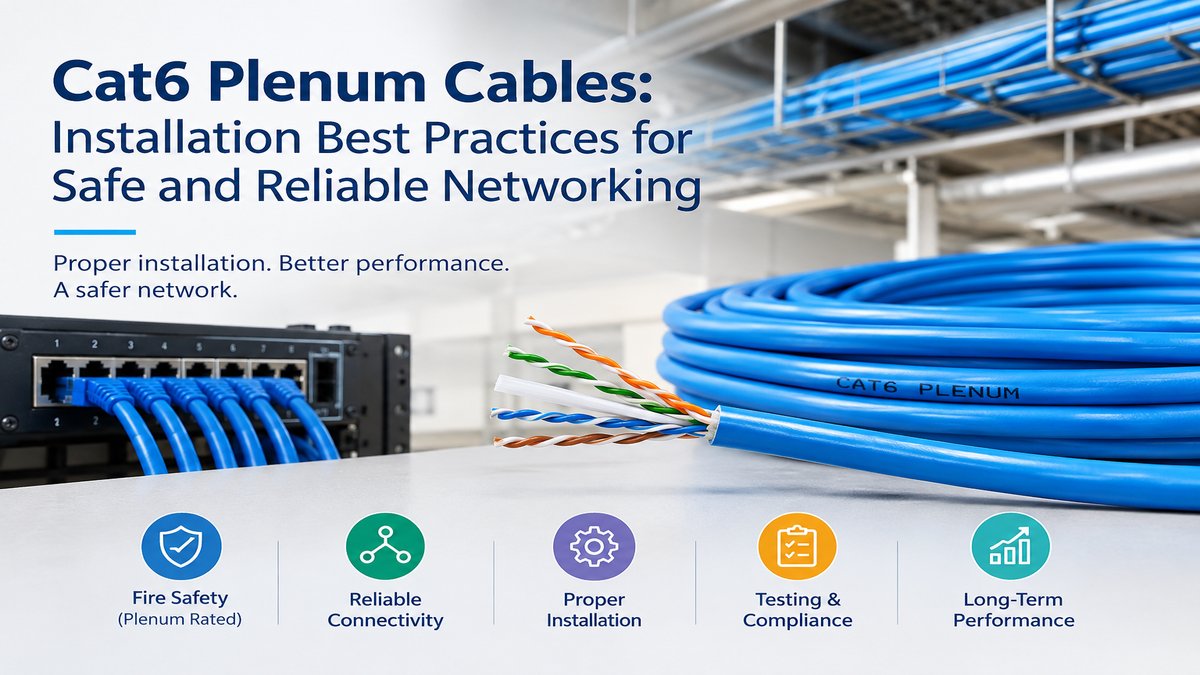
Outdoor jackets are formulated to resist UV degradation, ozone, and temperature fluctuations. Direct-burial cables have additional barriers — such as a polyethylene (PE) jacket and water-blocking compounds — that protect against soil moisture and insects. Indoor plenum-rated (CMP) cables use low-smoke, fire-retardant materials suitable for air-handling spaces; outdoor cables usually are not suitable for plenum use.
Ratings, codes and standards
Different regulatory ratings indicate where a cable can be used safely. Common ratings include:
- CM, CMR, CMP (General, Riser, Plenum): indicate flame and smoke characteristics for indoor spaces.
- Direct burial: indicates suitability for burial without conduit.
- Outdoor/UV-resistant: indicates resistance to sunlight and weather exposure.
Standards bodies to consult include the Telecommunications Industry Association (TIA) for cabling standards and IEEE for Ethernet signal standards. For guidance on structured cabling and performance categories, see the Telecommunications Industry Association (TIA) website.
Performance, installation and practical considerations
Signal performance and length
Cat 6 supports up to 1 Gbps over 100 meters and can support higher multi-gig speeds for shorter distances. Performance depends on maintaining pair twists, proper terminations (RJ45 jacks rated for Cat 6), and minimizing sharp bends or kinks. Outdoor exposure can increase attenuation over time if moisture penetrates the cable, so choose water-blocking construction for exposed runs.
Power over Ethernet (PoE)
Both indoor and outdoor Cat 6 cables can carry PoE, but heat dissipation differs by jacket type and bundle size. Ensure the cable rating and installation practice meet the power and temperature requirements for PoE devices.
Grounding and lightning protection
Outdoor shielded cables and exterior network equipment require proper grounding and surge protection per electrical codes. Ethernet wiring that crosses property lines or is exposed to lightning-prone environments should incorporate surge protectors and adhere to local regulations.
How to choose: scenarios and recommendations
When to use indoor Cat 6
- Runs entirely inside buildings, through walls, above ceilings, and inside conduits that are not exposed to sunlight or moisture.
- When plenum ratings are required for air-handling spaces.
When to use outdoor Cat 6
- Runs exposed to sunlight, temperature extremes, rain, snow, or buried directly in soil without conduit.
- Connections to exterior devices such as outdoor cameras, wireless access points, or POE lighting fixtures.
In mixed scenarios, run outdoor-rated cable to the building entry and transition to indoor-rated cable inside an enclosure or weatherproof junction box. This approach keeps the correct material where each environmental stress applies.
Installation tips
- Follow local building codes and pull cable carefully to avoid exceeding bend radius and pulling tension limits.
- Terminate shielded cables with compatible connectors and ensure correct drain-wire grounding.
- Use rated patch panels and jacks for the cable category to maintain performance.
- Label both ends and test runs with a certified cable tester after installation.
References and standards
Consult ANSI/TIA standards for detailed cabling requirements and IEEE 802.3 for Ethernet signaling and PoE specifications when planning installations. For structured cabling guidance, see the Telecommunications Industry Association (TIA) website: Telecommunications Industry Association (TIA).
FAQ
Indoor vs outdoor Cat 6 Ethernet cable: which should be used for an exterior camera?
Choose outdoor-rated Cat 6 for exterior cameras. Outdoor cable offers UV resistance, water-blocking, and temperature tolerance. For the best protection, use direct-burial rated cable or route the cable through conduit and use weatherproof junction boxes at the camera and building entry.
Can outdoor Cat 6 be used indoors?
Outdoor cable can be used indoors, but it may not meet indoor fire or smoke requirements (such as CMP plenum rating). For runs through plenum spaces, use plenum-rated indoor cable. When using outdoor cable indoors, verify compliance with local building codes.
Is shielded Cat 6 better for outdoor runs?
Shielding helps in high-EMI environments but requires proper grounding. Outdoor shielded cable can reduce interference from nearby electrical lines or radio sources; however, unshielded gel-filled outdoor cable can be sufficient for many installations and avoids grounding complexities.
How long does outdoor Cat 6 typically last?
Lifespan depends on environmental exposure, jacket quality, and installation. Proper outdoor-rated, UV-stable, and water-blocking cable can last many years; inspection and correct installation (conduit, burial depth, and surge protection) extend service life.
Can Cat 6 be buried directly in soil?
Only use cable explicitly labeled for direct burial if it will be placed in soil without conduit. Direct-burial cable includes protective layers against moisture and mechanical damage. When in doubt, use conduit for added protection and easier replacement.