Best Integrated Law Course Colleges in India for Future Legal Professionals
-

- Published Updated
- 7,352 views
In India, more individuals are considering law as a career option after class 12th. Selecting the right college for law education is a most significant decision in the academic journey. As this decision forms legal knowledge, career prospects, professional network and future growth in the legal industry. Integrated law courses have become more trendy among students who want to blend their undergraduate studies with legal training, saving both time and money. Such five-year programs, like BA LLB or BBA LLB, offer an exclusive advantage as candidates earn two degrees in the time it would usually take to complete them separately. Career opportunities are emerging due to the rapid growth of India’s legal sector. Choosing from the top law colleges in India has never been more critical for aspiring legal professionals.
Also read : https://www.vidyalive.com/blog/top-10-law-colleges-in-india/
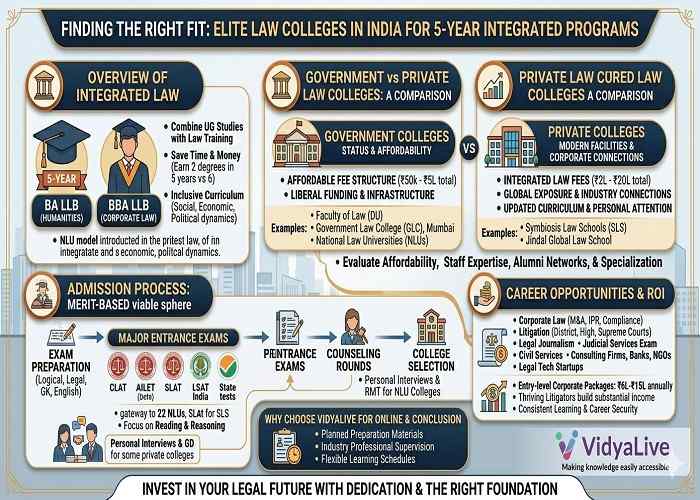
Overview of Integrated Law Courses in India
Integrated law programs unite undergraduate education with proficient law training, forming competent legal experts. Aspirants can select as per their interest from several combinations depending on their interests, BA LLB is appropriate for having interest in humanities, BBA LLB attracts to students interested in corporate law, and BSc LLB works for science fanatic preferring legal careers.
The biggest advantage of integrated law course colleges is their inclusive curriculum, planned to offer legal expertise and wider academic exposure. Rather than spending three years on a graduation degree and afterwards another three years on LLB, aspirants complete both in just five years in an integrated law course. Such an approach not just saves time but also offer a thorough comprehension of the ways several disciplines intersect with law. The candidates get introduced to subjects ranging from constitutional law and criminal procedure to economics, political science, or business management, depending on the selected specialization.
National Law Universities (NLUs) introduced this model in India, and today, it has been now adopted by government law colleges and private law colleges. The integrated approach has been proved to be greatly effective in creating legal professionals who comprehend law along with social, economic and political dynamics.
Top Career Opportunities after Integrated Law Programs
Pursuing law from the best law universities unlocks doors to different career paths beyond conventional courtroom practice. Corporate law has emerged as one of the highly rewarding career route, with foremost companies and law firms looking for experts in mergers, acquisitions, intellectual property rights, and regulatory compliance.
Litigation continues to be a differentiated career choice, whether professionals practice in district courts, present cases before the high courts, or the Supreme Court. Other than conventional legal careers, several graduates are discovering prospects in legal journalism and legal process outsourcing firms that cater to international clients. Judicial services examinations entitle candidates to pursue stable and important careers. Moreover, civil services appeal to law graduates who want to go for administrative roles forming public policy. As per law college placement records of top institutions, bachelors prefer to join consulting firms, banks, NGOs, and international organizations. Various law graduates are also exploring legal tech startups where they blend legal expertise with technology to form inventive solutions for the contemporary legal ecosystem.
Also read : https://www.vidyalive.com/blog/5-year-integrated-law-course/
Government vs. Private Law Colleges in India
A clear comparison between government and private institutions can help in making a well-versed choice. Government law colleges typically have an affordable fee structure, which enables candidates belonging to several economic backgrounds to get quality legal education. Institutions like the Faculty of Law (Delhi University), the Government Law College (Mumbai), and the National Law Universities receive liberal funding, which improves in their infrastructure and faculty skills. Private law colleges regularly have contemporary campuses, international collaborations, and industry connections that translate into better placement projections. The curriculum by such colleges is updated on a regular basis and maintains smaller class sizes for personalized attention. Though, fees charged by private institutions for integrated law course fees generally range from ₹2 lakhs to ₹20 lakhs for the complete program, while government colleges may charge between ₹50,000 and ₹5 lakhs for five years.
Both options have their own set of benefits. Government colleges signify status with affordability, although private colleges offer contemporary facilities and extensive corporate connections. Students should assess both affordability and unique advantages offered by each institution, comprising staff expertise, alumni networks and specialization opportunities.
Admission Process for Integrated Law Courses
The law admission process in India is highly viable and merit-based. A majority of top colleges in India accept scores of entrance exams like CLAT (Common Law Admission Test), which opens the door to 22 National Law Universities. AILET for National Law University Delhi, SLAT for Symbiosis Law Schools, and several state-level tests are some other exams. Preparation usually initiates a year before the exam, concentrating on legal reasoning, logical reasoning, English language, general knowledge, and fundamental mathematics. The pattern of the CLAT exam has been changed lately to focus on reading comprehension and current affairs, requiring candidates to advance their reasoning skills rather than just learn facts.
After passing the entrance exam, students appear for counseling rounds where they select colleges based on their rank and preferences. Some private colleges undertake personal interviews or group discussion rounds as a component of their selection procedure. Certain institutions even reserve seats for several categories, certifying diversity in student composition. Taking enough time for exam preparation, staying updated on current affairs and practicing mock tests frequently considerably enhance chances of securing admission to the chosen college.
Fee Structure and ROI of Law Education
The decision of investing in law education comes with careful financial planning. Integrated law course fees differ severely based on candidates’ resolution of choosing government or private institutions. Though government colleges offer exceptional value with minimal fees, private colleges validate their higher costs through superior infrastructure, global exposure, and placement assistance.
The return on investment becomes more evident when candidates assess their career outlooks. Entry-level positions in corporate law firms offer packages ranging from ₹6 lakhs to ₹15 lakhs yearly, with significant growth capability. Thriving litigators develop practices that form substantial income over time, though initial years may necessitate patience and perseverance.
Other than immediate earnings, law degrees offer long-term career security and esteem. The profession provides consistent learning prospects, intellectual motivation, and the chance to make consequential contributions to society. Several scholarships, education loans, and financial aid programs assist deserving aspirants manage costs, making quality legal education more approachable than ever.
Why Choose Vidyalive for Online Courses and Conclusion
As candidates think of equipping for law entrance exams or discover career options, platforms such as Vidyalive offer helpful assistance through inclusive online courses. Vidyalive offers planned preparation materials, industry professionals’ supervision and flexible learning schedules as per the routine. Whether candidates need assistance with CLAT preparation, comprehending legal notions, or career counseling, Vidyalive's resources align formal education and help in staying forward in this viable sphere.
Selecting a college for an integrated law course is about getting the right fit for ambitions, learning style and financial situation. The top law universities unite academic fineness with practical exposure, equipping students not just to practice law but to think perilously and unravel intricate problems. The aspirants are required to research extensively, visit the campus possibly and talk to alumni, current students, along with trusting instincts. Chasing legal education is not just an academic choice but an investment filled with learning, social impact, and professional growth. With devotion and right education foundation, students can be well-equipped and succeed in the dynamic legal setting of India.
FAQs
Are government colleges better than private colleges to pursue law?
Government law colleges provide quality education at affordable fees with robust reputations. On the other side, private institutions usually offer contemporary infrastructure with better industry connections and better placement assistance.
What is the average fee for integrated law courses?
The fee charged in the case of Government colleges is approximately ₹50,000 to ₹5 lakhs for the entire five-year program, though private law colleges can charge between ₹2 lakhs to ₹20 lakhs. National Law Universities fall somewhere in between, providing eminent education at comparatively reasonable costs.