Dynamic Intercity Bus Fare Scraping for Global Aggregators
-

- Published Updated
- 1,773 views
Introduction
Intercity bus travel has become increasingly dynamic, with operators and booking platforms continuously adjusting fares according to demand, route popularity, seat availability, departure times, booking velocity, and competitive conditions. For travel businesses, simply knowing the listed ticket price is no longer enough. They need continuous visibility into changing fares, competitor movements, and seat-level pricing behavior. This is where Dynamic Intercity Bus Fare Scraping becomes strategically valuable for travel companies, aggregators, and travel analytics providers.
Modern Bus Data Scraping solutions can collect structured information from multiple bus booking platforms, operators, and marketplaces at regular intervals. Businesses can use this information to monitor fare fluctuations, compare operators, identify pricing patterns, and understand how ticket prices change throughout the booking lifecycle.
Another important capability is Real-Time Seat-Level Price Tracking, which provides granular visibility into how seat availability and seat types influence ticket prices. By continuously observing these changes, travel businesses can better understand pricing behavior, identify demand-driven fare increases, and develop more informed pricing and competitive strategies.
Why Intercity Bus Fares Are Becoming More Dynamic?
Traditional bus pricing generally followed relatively simple rules. Operators typically maintained fixed fares for specific routes and introduced occasional promotional discounts. However, the intercity bus market has become significantly more competitive and data-driven.
Today, ticket prices can change according to booking demand, remaining inventory, departure proximity, route popularity, weekends, holidays, special events, bus categories, and competitor pricing.
For example, a ticket available for ₹700 in the morning could cost ₹850 later in the day after several seats have been booked. Similarly, an operator may reduce fares when a departure has significant unsold inventory and increase prices when demand accelerates.
For pricing analysts, this creates a critical question: what caused the fare to change?
A single price snapshot cannot answer that question. Businesses require continuous observations containing fare, seat inventory, departure time, operator, route, travel date, and timestamp information.
Automated data collection addresses this challenge by transforming constantly changing booking information into structured and historical datasets that can be analyzed for meaningful pricing patterns.
What Data Can Be Collected?
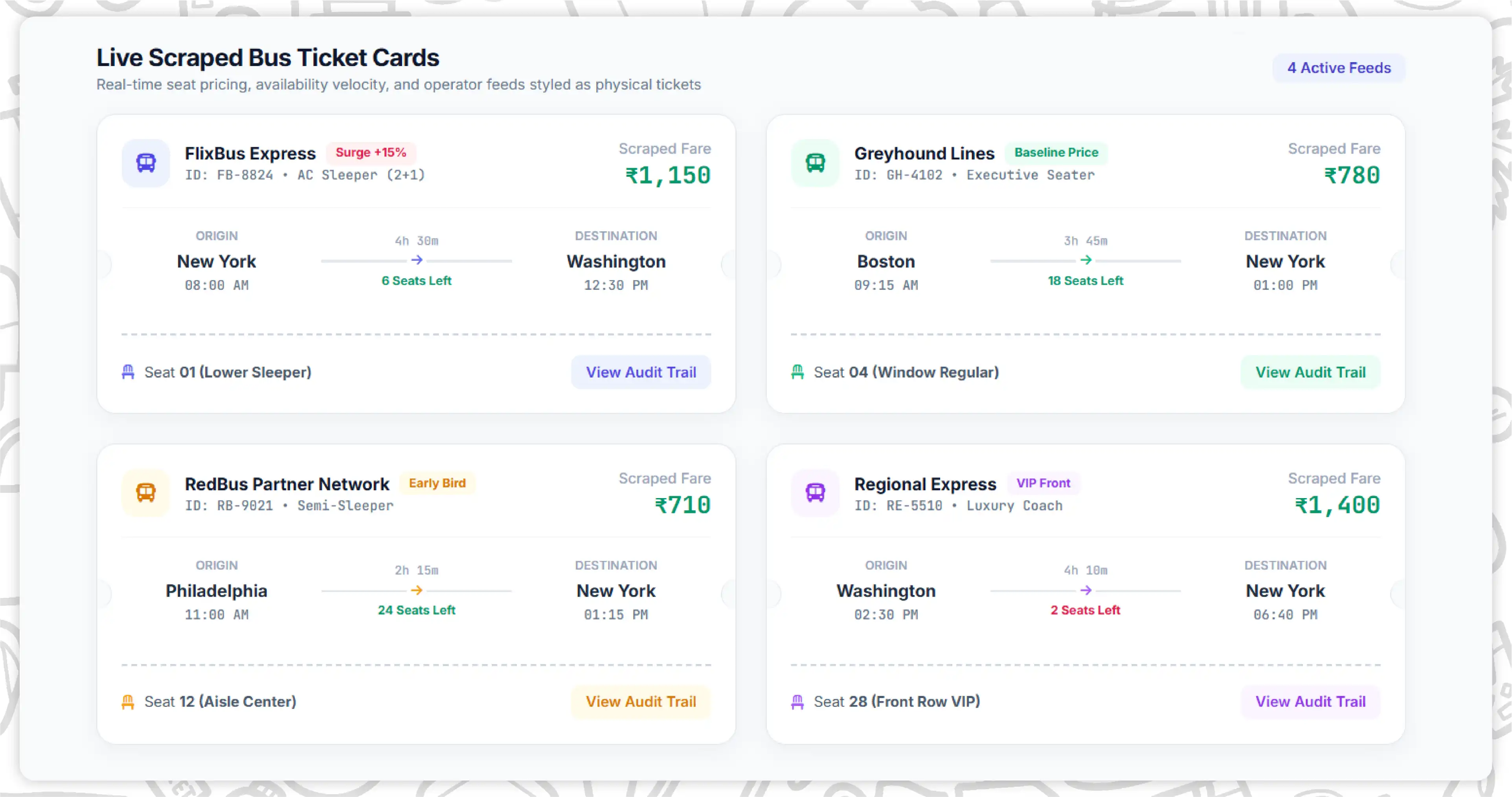
A comprehensive bus data collection solution can capture a broad range of information from booking platforms and operator websites.
Typical data fields may include:
- Bus operator and service name
- Origin and destination
- Travel date
- Departure and arrival time
- Bus type
- Seat number
- Seat category
- Current ticket price
- Discounted price
- Available seats
- Occupied seats
- Boarding points
- Dropping points
- Amenities
- Ratings and reviews
- Cancellation information
- Booking status
- Data collection timestamp
Seat-level information is particularly valuable because two seats on the same bus may have different pricing characteristics.
When these observations are collected repeatedly, companies can construct a detailed picture of how fares behave throughout the booking lifecycle.
This historical information can also help businesses distinguish between normal fare fluctuations and significant pricing events.
Understanding Seat-Level Pricing Behavior
Seat availability is one of the important signals associated with dynamic bus pricing.
Consider a 40-seat bus. When 30 seats are available, an operator may offer an attractive fare to encourage early bookings. Once only 10 seats remain, the price could increase because demand is strong and inventory is becoming scarce.
However, this relationship is not always linear.
Certain seat positions may carry premium pricing. Front-row seats, window seats, sleeper berths, lower berths, or seats offering additional comfort may have different prices.
This makes bus seat availability monitoring particularly important for travel companies interested in understanding pricing behavior at a granular level.
A robust scraping system can record individual seat status, seat category, price, and availability over time. Analysts can then determine whether prices increase after specific percentages of inventory are sold.
Businesses may discover that fares rise after 50% of seats are booked, while premium seats follow a different pricing curve. Such findings can help revenue teams better understand the mechanisms behind changing bus fares.
Understanding Booking Demand
Price information becomes significantly more valuable when combined with booking and availability signals.
Intercity bus booking demand analytics can help businesses identify routes experiencing rapid inventory depletion and distinguish them from routes that consistently maintain large amounts of unsold capacity.
Historical observations can reveal patterns involving weekend demand surges, holiday-season fare increases, morning versus evening demand, route-specific booking velocity, seasonal fluctuations, and last-minute price increases.
Suppose a travel company discovers that Friday evening services between two major cities consistently reach high occupancy. Historical data may show that fares begin increasing several days before departure.
This information can support better revenue planning, promotional timing, capacity management, and customer targeting.
Businesses can also identify routes where demand consistently exceeds supply and use those insights to evaluate additional services or capacity opportunities.
Creating a Reliable Fare Comparison Dataset
A standardized bus fare comparison dataset provides a strong foundation for comparing operators and booking platforms.
Rather than evaluating prices independently, businesses can normalize information according to route, travel date, departure time, bus category, seat type, availability, and booking window.
This makes it easier to answer important questions.
- Which operator consistently offers the lowest fare?
- Which platform displays higher prices?
- How much does the fare change during the final 24 hours before departure?
- Which routes experience the highest price volatility?
- Which operators maintain stable pricing despite changing demand?
The answers become considerably more meaningful when they are based on thousands or millions of timestamped observations instead of occasional manual checks.
A historical comparison dataset can also reveal recurring market patterns that are difficult to identify through individual searches.
Developing Dynamic Pricing Intelligence
Dynamic Pricing Intelligence can transform raw fare observations into actionable commercial insights.
Travel businesses can monitor fare movements and identify recurring pricing patterns across operators. They can calculate average fares, minimum and maximum prices, price volatility, fare-change frequency, and inventory-adjusted pricing.
For example, if a competitor consistently increases its fare when fewer than 15 seats remain, another operator can evaluate whether similar pricing behavior would improve revenue without negatively affecting demand.
Online travel agencies can also identify routes where their displayed prices are consistently less competitive than rival platforms.
This intelligence can support pricing teams, revenue managers, marketplace operators, travel aggregators, and transportation technology companies.
The goal is not simply to collect prices but to understand why those prices change and what those changes indicate about the market.
Comparing Dynamic Bus Pricing Across Competitors
Dynamic bus price benchmarking enables businesses to evaluate how their fares compare with competing operators over time.
Instead of comparing one fare at one moment, benchmarking can analyze thousands of comparable observations captured across different dates and booking windows.
Businesses can compare services using the same route, travel date, similar departure times, comparable bus categories, similar seat availability, and different operators.
This creates a much more realistic understanding of competitive positioning.
A fare that appears expensive in isolation may actually be competitive when competing buses have very limited inventory. Conversely, a seemingly low fare may still be unattractive if competitors provide better amenities at comparable prices.
Benchmarking therefore needs to consider context rather than relying only on the lowest available ticket price.
Monitoring Real-Time Availability
Inventory changes can provide valuable signals about customer demand and future pricing.
Real-Time Availability Tracking can reveal when seats disappear, when inventory changes suddenly, and when previously unavailable seats become bookable again.
Businesses can analyze availability at different intervals to calculate booking velocity.
For example, if a bus has 25 available seats at 9:00 AM and only 18 seats at noon, seven seats disappeared within three hours. If the fare increased during the same period, analysts can investigate the relationship between inventory reduction and price movement.
Availability monitoring can also help identify highly demanded routes, departure periods approaching capacity, and services that may require additional promotional activity.
Automating Real-Time Fare Collection
A sophisticated real-time bus ticket price scraping system can continuously collect ticket prices from selected routes, operators, and booking platforms.
Instead of manually searching websites several times each day, businesses can establish automated schedules based on their analytical requirements.
For highly volatile routes, data may be collected more frequently. For stable markets, scheduled intervals may be sufficient.
Every observation can be stored with a timestamp, allowing analysts to reconstruct how a ticket price evolved from the initial listing until departure.
This makes it possible to study early-booking discounts, mid-cycle price increases, last-minute pricing, promotional campaigns, and inventory-driven fare adjustments.
Delivering Data Through APIs
Travel businesses increasingly need data that can move directly into their internal applications.
A Real-Time Data API can provide structured fare and availability information to dashboards, pricing applications, travel search engines, forecasting platforms, and analytics systems.
API-based delivery eliminates the need for teams to repeatedly download and process raw datasets manually.
For example, a travel application could use continuously refreshed data to compare fares across multiple operators, while an internal revenue dashboard could use the same information to identify unusual pricing movements.
This makes real-time data useful not only for analysts but also for automated business systems.
Tracking Competitors Across Multiple Platforms
The modern bus booking ecosystem can include individual operators, online travel agencies, aggregators, regional marketplaces, and specialized transportation platforms.
Prices may differ because of promotions, commissions, platform-specific discounts, or inventory arrangements.
Automated monitoring enables businesses to observe these differences continuously rather than relying on occasional competitor research.
Companies can establish scheduled collection processes that capture fares, availability, schedules, discounts, and operator information at predefined intervals.
The resulting information can feed dashboards that highlight major price movements, inventory shortages, new services, promotional campaigns, and unusual market behavior.
This provides businesses with a clearer view of how competitors position themselves across different routes and booking periods.
Scaling Bus Data Collection
Large-scale scraping requires more than simply extracting information from web pages.
Modern booking platforms can use dynamic interfaces, JavaScript rendering, session-based interactions, location-specific inventory, and frequently changing page structures. A reliable data collection architecture therefore requires robust extraction, validation, normalization, monitoring, and storage processes.
A scalable workflow can include:
- Identifying relevant bus booking sources.
- Defining routes and required data fields.
- Automating scheduled data collection.
- Normalizing operator and route information.
- Recording timestamped price and inventory changes.
- Validating extracted records.
- Removing duplicate records.
- Storing historical observations.
- Delivering structured datasets or APIs.
- Generating analytical dashboards.
With the right architecture, the same framework can support thousands of routes across multiple cities and travel markets.
How Travel Scrape Can Help You?
Real-Time Fare Intelligence
Travel Scrape can collect frequently updated bus fares across selected routes, helping businesses identify price changes, promotional movements, and demand-driven increases before they affect competitive positioning.
Seat Availability Monitoring
Travel Scrape can track available seats, seat categories, and inventory changes across departures, helping analysts understand booking velocity and identify routes approaching capacity.
Competitor Benchmarking
Travel Scrape can consolidate comparable operator pricing into standardized datasets, enabling businesses to benchmark fares by route, departure, travel date, seat type, and availability.
Historical Pricing Analysis
Travel Scrape can create timestamped historical datasets for studying seasonal patterns, booking-window behavior, price volatility, route demand, operator strategies, and long-term fare movements.
API-Ready Data Delivery
Travel Scrape can provide structured travel intelligence through automated feeds and APIs, supporting dashboards, forecasting models, pricing applications, analytics systems, and travel platforms.
Conclusion
Intercity bus pricing is no longer simply a fixed number attached to a departure. It is an evolving market signal influenced by demand, inventory, timing, competition, route characteristics, and customer booking behavior.
Automated scraping allows businesses to move beyond occasional price checks and develop a continuous understanding of the market. By collecting fares, seat availability, operator information, departure schedules, and timestamped changes, travel companies can uncover patterns that would otherwise remain invisible.
The combination of seat-level monitoring, historical datasets, availability intelligence, and automated APIs creates a powerful foundation for modern travel analytics. Businesses can identify pricing opportunities, understand demand, evaluate market competitiveness, and improve decision-making with richer and more timely data.
Most importantly, Competitor Price Tracking becomes proactive rather than reactive. Instead of discovering that a competitor changed its fare after customers have already noticed, businesses can continuously monitor market movements and respond with greater speed and precision.
In a highly competitive intercity travel ecosystem, timely and structured data can become one of the most valuable assets for pricing, forecasting, benchmarking, inventory management, and revenue optimization.
Ready to elevate your travel business with cutting-edge data insights? Scrape Aggregated Flight Fares to identify competitive rates and optimize your revenue strategies efficiently. Discover emerging opportunities with tools to Extract Travel Website Data, leveraging comprehensive data to forecast market shifts and enhance your service offerings. Real-Time Travel App Data Scraping Services helps stay ahead of competitors, gaining instant insights into bookings, promotions, and customer behavior across multiple platforms. Get in touch with Travel Scrape today to explore how our end-to-end data solutions can uncover new revenue streams, enhance your offerings, and strengthen your competitive edge in the travel market.