
7 Interior Design Marketing Ideas for Real Estate [2026]
-

- Published Updated
- 444 views
Nowadays, homeowners and real estate agents are actively looking for great interior designers. Some want to live better; others want to sell their home faster.
“According to statistics, buyers offer 1–5% more on staged and well-designed homes than on unstaged ones.”
So the demand is there. The opportunity is real.
But when someone goes online to find a designer, they don't just find you; they find your competitors too. And if your marketing isn't strong enough, they'll pick someone else.
Not because that person is more talented. Just because their online presence looks more impressive and feels more trustworthy.
The real problem is not your work. It's your marketing and visualization. So let's fix it immediately
In this article, I have given 7 simple interior design marketing ideas to help you get found, stand out from competitors, and get your work the attention it truly deserves.
So let’s get started,
TL;DR - Interior Design Marketing
Homeowners and agents want better ways to understand your work
A strong interior design marketing strategy should help you:
Visualize your designs with virtual tours
Build a brand identity that attracts the right clients
Use social proof to build instant trust
Get found on Google with basic SEO
Build lasting relationships with real estate agents
The fix is simple: stop showing your work and start letting people experience it.
Final Verdict: Use WPVR to showcase your work immersively and make it stand out over your competitors.
7 Interior Design Marketing Ideas That Win Clients
If you want to attract more real estate agents and home sellers, the right marketing strategies can make a huge difference for your interior design business.
Now I am going to explain 7 effective interior design marketing ideas that can help you build partnerships, generate quality leads, and grow your local presence.
1. Visualize Your Design with a Virtual Tour
You just finished designing a stunning property. The room looks incredible. The lighting is perfect. Every detail is exactly where it should be.
So you take a few photos, upload them to your portfolio, and wait for clients to reach out. But here's what actually happens.
Scenario 1:
A potential client lands on your portfolio, looks at the photos, and thinks, "It looks good, but I can't really picture it."
And just like that, they move on to someone else. Not because your work wasn't good enough.
Because a flat photo could never truly capture what that property actually feels like, and only photos and videos won’t increase your sales.
Scenario 2:
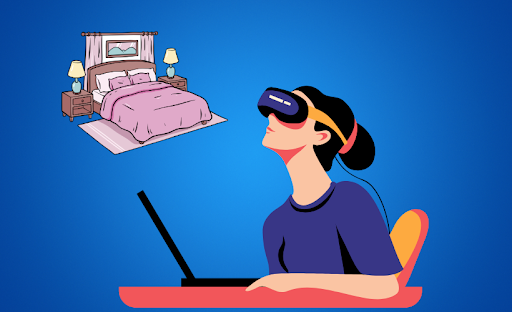
On the other hand, they land on your competitor's portfolio. Same skill level. Maybe even weaker designs. But something is different.
They can actually walk through your competitor’s project online - room by room, corner by corner. They can feel it. They get excited. And they book that designer without hesitating.
Your competitor is using virtual tours as proof of their work, and that's exactly why they're becoming a recognized brand while you're still waiting for inquiries.
Make a Virtual Tour for Your Work
Think of a virtual tour like Google Street View but for your interior design projects. A potential client can open it on their phone or laptop and actually walk through your client’s property with your design.
They can look left, look right, move from room to room, and truly feel what you created. It's the closest thing to being there in person.
“According to statistics, 77% of buyers say it's easier to visualize a property as their future home when they experience a virtual tour”
When people can feel your design as they are really there, they make decisions faster, and they choose with confidence. You can also make a virtual tour in 5 to 30 minutes with WPVR.
2. Build a Brand Identity That Attracts the Right People

Open any interior designer's website, and you'll notice something. They all look the same.
Same generic templates. Same fonts. Same bio that says "I'm passionate about creating beautiful spaces." Same everything.
And that's exactly the problem. When everyone looks the same, no one stands out. You become just another name in a long list of designers, and potential clients have no real reason to choose you over anyone else.
Now I am telling you that in interior design marketing, you don't need a massive ad budget to attract the right people. You just need a clear brand identity that makes someone instantly feel
"Yes, this is exactly who I've been looking for."
Think about it this way. Two designers. Same skill level. Same experience. But one says, "I do all styles for all kinds of spaces."
The other says, "I design warm, functional spaces for first-time homeowners who want to sell faster." Who gets the call? Every single time - the second one. Because they're speaking directly to the right person.
That's what brand positioning does. It stops the right clients in their tracks and makes them feel understood before they even speak to you.
So here's what to do. Define your niche: who do you help and what specific result do you give them?
Use consistent colors and tone across your website and social media. And write a bio that speaks to your client's desired outcome, not just your own passion for design.
Your brand identity isn't just a logo or a color palette. It's what makes someone choose and remember you over others.
3. Use Social Proof to Let Your Work Speak
You have just finished an amazing project. Your client is thrilled. The home sold faster than expected. And then… You just move on to the next job. No review. No testimonial. No record of that win anywhere online.
That's one of the biggest missed opportunities most interior designers don't even realize they're making.
Here's the thing. When a potential client lands on your portfolio, they're not just looking at your designs; they're asking themselves, "Can I trust this person?"
And nothing builds that trust faster than hearing it straight from someone who's already worked with you.
“According to BrightLocal, 93% of consumers say online reviews influence their purchase decisions.”
That means your happy clients aren't just happy clients, they're your best interior design marketing tool. You're just not using them.
Social proof is more important than other interior design marketing
For example, A real estate agent lands on your portfolio and sees a testimonial right under one of your projects: "She transformed the living room completely, and the home sold in just 4 days."
That one sentence does more work than any ad you could ever run. It shows real impact. It builds instant trust. And it makes that agent pick up the phone.
So start collecting social proof in every form you can.
Google reviews.
Testimonials on your website.
Before and after showcases.
Short video walkthroughs from happy clients.
Every single one of these builds lasting connections with your neighborhood and attracts high-quality clients who already trust you before they even reach out.
Pro tip: ask for a review right after you finish a project; that's when your client is most excited and most likely to say yes. You can use UGCify to make it more interesting in terms of different review formats.
Your work is already doing the heavy lifting. Let your happy clients tell the world about it.
4. Create Content That Educates Your Ideal Client

Suppose a homeowner is scrolling online, not even looking for a designer yet, and they stumble across your blog post. They read it, find it super helpful, and think "wow, this person really knows their stuff."
Weeks later, when they're ready to hire a interior designer, guess who they call first? You. That's the strength of content. And most interior designers are completely sleeping on it.
Here's what usually happens. A designer posts a few pretty photos on Instagram, gets a handful of likes, and wonders why no clients are coming.
But likes don't pay bills. What actually brings in clients is content that educates, content that answers the real questions your ideal clients are already typing into Google.
Content writing is not hard
As I know, you don't need a specialized interior design marketing team or a full-time marketer to do this. Seriously. Just 2–3 hours a week and a simple, consistent plan are more than enough to get started.
Think about it this way. You write one blog post a month, something like "5 signs your home needs a redesign before listing" or "how to choose the right colors to sell your home faster."
Over time, Google starts ranking you for searches like "interior designer in [your city]." Now, homeowners and real estate agents are finding you on their own without you spending a single dollar on ads.
You can also post before-and-after Reels on Instagram. Create Pinterest boards by room style. Share quick tips on Facebook.
Every single piece of content you put out there keeps working for you long after you hit publish - bringing ideal clients straight to you while you focus on designing.
Just start with one piece of content this week. Stay consistent. That's how most interior designers quietly become the go-to expert in their local market without cold calling, paid ads, or a big marketing budget.
5. Get Found on Google with Basic SEO

Right now, someone in your city is typing "interior designer near me" into Google. They're ready to hire. They have a budget. They just need to find the right person.
But if you're not showing up, your competitor is getting that call. Not you. That's basically what SEO is. It's just how Google decides whose website to show when someone searches for an interior designer in your area.
And I know the word SEO sounds scary and super technical. But let me clarify to you, the basics are really simple. And completely free.
“According to statistics, 46% of all Google searches are looking for local information.”
That means nearly half the people on Google right now are searching for someone or something in their own city. That's a huge opportunity sitting right there, and most interior designers aren't even touching it.
So what do you actually do?
Forget the complicated stuff for now. Just start with three simple things.
Add your city name to your website title, something like "Interior Design Services in [Your City]."
Create a free Google Business Profile; this alone can get you showing up on Google without a single dollar spent.
And use simple words like "interior design services" or "home staging designer" naturally in your bio and project descriptions.
That's genuinely it.
No marketing strategist.
No big budget.
No complicated interior design marketing plan.
Just small, simple steps that quietly build your presence on Google over time and keep bringing the right clients straight to your door.
Start with your Google Business Profile today. It takes 10 minutes, and it's completely free.
6. Build Relationships with Real Estate Agents

Now I am going to tell you something that most interior designers don't realize. Real estate agents desperately need you.
They need talented designers for staging, pre-sale redesigns, and making listings look irresistible before they hit the market. But most designers never reach out. Ever.
And that's a huge missed opportunity.
Think about it. One good relationship with one real estate agent can send you a steady stream of clients every single month.
No chasing.
No paid ads.
Just one person who trusts you enough to keep sending referrals your way.
And you don't need polished sales pitches to make this happen. You just need a genuine conversation and a strong portfolio, ideally with virtual tours, so agents can actually walk through your work before recommending you.
The simplest way to start your interior design marketing
Find one local real estate open house this month and just show up. Introduce yourself. Bring a QR code that links straight to your WPVR virtual tour portfolio.
Instead of handing over a boring business card, you're letting them walk through your work right there on the spot. Trust me, that's something they'll remember.
From there, join local real estate Facebook groups. Be helpful. Share tips. Offer one agent a free 30-minute staging consultation just to get your foot in the door.
Then follow up with a simple case study showing how your design helped a home sell faster.
You're not selling. You're just building real connections with the right people. And those connections turn into the most reliable stream of clients you'll ever have.
7. Tell Your Story Authentically
Look, there are thousands of interior designers out there with
beautiful portfolios
Stunning photos
Gorgeous spaces
Great work
So why would someone choose you over all of them?
Because of you.
Your story.
Your why.
The reason you do what you do.
That's what most designers miss. They focus so much on showing their work that they forget to show themselves.
And in a market full of beautiful design portfolios, authentic brand storytelling is what separates the designers who are fully booked from the ones still waiting for inquiries.
A designer posts a simple video - no fancy production, no big budget. She just looks at the camera and says,
"I grew up in this tiny apartment. I know what it feels like when a space drains you. And I know how a well-designed room can completely change how you feel walking through the door every single day. That's why I do this."
That one video got her more inquiries than any ad she ever ran.
Why? Because people felt something. They connected with her. They trusted her before even seeing her portfolio.
And that's exactly what authentic storytelling does for your business. It builds trust faster than any generic marketing agency ever could.
It turns your expertise into something people genuinely believe in. And when people trust you, they don't shop around; they just book you.
So share your why. Talk about what you believe about spaces and how they make people feel.
Be real. Be genuine. You don't need a massive ad budget to become a client magnet; you just need to let people see the real person behind the beautiful designs.
That's what builds a thriving interior design business that lasts.
Conclusion
At first, you may think a strong social page is enough to get regular clients. But in reality, successful interior designers use smart marketing, not just social media.
The designers who stay fully booked know how to present their work better. They use virtual tours, clear branding, and simple storytelling to make their designs more engaging.
When you combine virtual tours, steady marketing, and good relationships with real estate agents, more people can find and trust your work.
This helps turn their interest into real clients, and you can do it with a virtual tour as proof of your work to attract more than your competitors.
Get WPVR Now
** FAQs **
1. How do I market myself as an interior designer to real estate agents?
Build a strong portfolio that shows your staging work, ideally with virtual tours so agents can explore your designs online. Contact local agents directly, attend open houses, and offer a free staging consultation to start relationships. One good agent connection can bring you regular property projects without paid ads.
2. What is the best interior design marketing idea for getting more home staging clients?
Make your work feel real online using virtual tours so clients can experience your designs, not just see photos. This helps potential clients trust you faster and understand your value instantly. Add Google reviews to strengthen your credibility and attract more clients.
3. Do I need a big budget for interior design marketing?
You don’t need a big budget to market your interior design business. Use free tools like a Google Business Profile and consistent content to get visibility. Add virtual tour tools like WPVR to improve how clients experience your work.
4. How does SEO help interior designers get more real estate clients?
SEO helps your website appear when people search for interior designers in your area. Add your location and service keywords to your website to improve visibility. Over time, this brings you steady, free client leads.
5. Why are my interior design photos not getting me clients?
Photos only show a space, but they don’t help clients feel it. Without that connection, people lose interest and move on. Use virtual tours to make your work more engaging and convert more visitors into clients.
