What Is Interventional Radiology? An Interventional Radiologist Explains How It's Changing the Way We Treat Disease
-
- September 13th, 2026
- 3,863 views
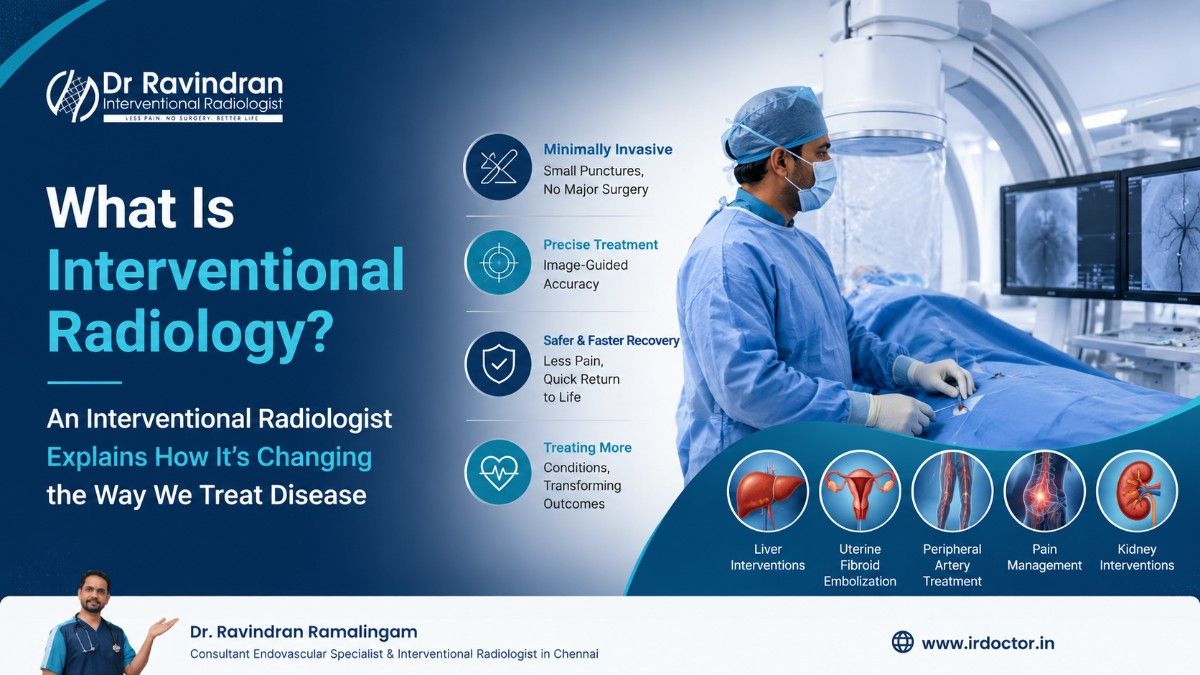
Patients often assume there are only two paths when they're diagnosed with something serious: medication or surgery. What most don't realize is that a third path has quietly existed for decades, and in many cases, it's now the better one. It's called interventional radiology. As someone who practices it every day, I still find that most patients walking into my clinic have never heard the term before their referring doctor mentioned it.
That gap in awareness is exactly why I'm writing this.
What Interventional Radiology Actually Is
Interventional radiology is a specialty where we diagnose and treat disease using imaging X-ray, ultrasound, CT, or MRI to guide instruments through the body without open surgery. Instead of a scalpel and an incision, we work through a needle puncture or a tiny access point, usually at the wrist or groin. From there, we navigate catheters and wires through blood vessels or directly into tissue to treat the problem from the inside.
The imaging isn't just for diagnosis here. It's how we see exactly where we're going while the procedure is happening, in real time. That's the fundamental difference between what I do and what a diagnostic radiologist does: they read the image and report on it, I use that same image to physically deliver treatment.
How a Typical Procedure Actually Works
Every IR procedure follows roughly the same logic, whether I'm treating a fibroid, a blocked artery, or a bleeding vessel:
- A small entry point is created, usually just a few millimetres, most commonly at the wrist or the groin
- A catheter or fine needle is guided in through that entry point
- Live imaging shows exactly where the catheter tip is at every moment, allowing precise steering to the target
- The treatment is delivered directly at the source blocking abnormal blood flow, clearing a blockage, delivering medication, or destroying abnormal tissue with heat or cold
Most of this happens under local anaesthesia with light sedation. The patient is often awake, sometimes even watching the screen with me. There's no large incision to close, no muscle layers to repair, and in most cases, no reason for a multi-day hospital admission.
The Conditions I See Most Often
The reach of this specialty genuinely surprises people once they hear the list. I treat uterine fibroids through embolization, which shrinks fibroids by cutting off their blood supply while leaving the uterus completely intact. I treat varicose veins with laser and radiofrequency ablation, which has largely replaced traditional vein stripping surgery. I treat peripheral artery disease blocked leg arteries with angioplasty and stenting, avoiding open bypass surgery in a large number of cases. I treat an enlarged prostate through prostate artery embolization, an option many men are never told about before being scheduled for TURP or open prostate surgery.
Beyond these, IR plays a central role in:
- Cancer care, through tumour ablation and chemoembolization for liver, kidney, and lung tumours
- Emergency medicine, through embolization to stop internal bleeding
- Blood clot management, through catheter-directed thrombolysis
- Drainage of abscesses or obstructed kidneys and bile ducts that would otherwise need surgery
What ties all of this together isn't the organ system. It's the principle if imaging can guide a needle or catheter to the exact site of disease with enough precision, we can often treat it without ever opening the body.
Why This Is Genuinely Replacing Surgery, Not Just Supplementing It
I want to be careful here, because I don't think "minimally invasive" should be treated as automatically superior. The right treatment depends on the individual case.
But for a growing number of conditions, the clinical case for IR over open surgery has become very strong. In practice, it comes down to a few consistent factors:
- Blood loss is typically minimal, since we're not cutting through tissue and vasculature the way open surgery requires
- Infection risk drops sharply without a large open wound to manage and heal
- Anaesthesia risk is lower, which matters enormously for older patients or anyone with heart or lung disease
- Recovery isn't measured in weeks most patients are back to their normal routine within days
There's one more factor that rarely gets discussed openly, and it's the one I think matters most to working patients: organ preservation. Fibroid embolization preserves the uterus. Prostate artery embolization avoids disrupting the urinary and sexual function pathways that prostate surgery can affect. Tumour ablation can spare healthy liver or kidney tissue that surgical resection would remove along with the tumour. When surgery removes an organ or a significant part of one, that's not always necessary anymore and patients deserve to know that before they consent to it.
Why Most Patients Never Hear About This Option
This is the part I wish more people understood. Most specialists refer patients toward the treatment they themselves perform. A gynaecologist recommends hysterectomy. A urologist recommends prostate surgery. A vascular surgeon recommends bypass. This isn't negligence it's simply how medical training and referral patterns work. But it means the interventional radiology option often never enters the conversation unless the patient, or a well-informed referring doctor, specifically asks for it.
I'd encourage anyone facing a surgical recommendation for a condition like fibroids, varicose veins, an enlarged prostate, or blocked arteries to ask one direct question before signing a consent form: is there an interventional radiology alternative for this? It's a fair question, it won't offend your doctor, and in a genuinely large number of cases, the answer changes the entire treatment plan.
What to Actually Check Before Choosing an IR Procedure
If you're considering this route, a few things are worth confirming:
- Whether the physician has completed dedicated interventional radiology fellowship training not every radiologist performs procedures, some are purely diagnostic
- How many of the specific procedure you need they've personally performed, since experience with that exact technique matters as much as the qualification itself
- Whether the facility has a dedicated IR suite with digital subtraction angiography, since image quality directly affects both precision and safety
Bring your existing scans and reports to the first consultation. In most cases, I can give a same-visit opinion on whether you're a reasonable candidate for the interventional approach, or whether your case genuinely needs a surgical referral instead.
Where This Specialty Is Heading
Interventional radiology has grown faster than almost any other field in medicine over the past two decades. India is catching up quickly, with more hospitals building dedicated IR suites and more conditions being added to the list of things we can treat without surgery. The direction is clear enough that I'd frame the real clinical question differently than most people do. It's no longer "surgery or not." It's "can this be treated better through imaging guidance instead?" For a growing number of conditions, the answer is yes.
Conclusion
Interventional radiology treats disease from the inside, using imaging precision instead of an open incision. For many of the conditions I see every week fibroids, varicose veins, an enlarged prostate, blocked arteries, certain tumours it has become a genuine first-line option, not a last resort. The biggest risk I see in practice isn't patients choosing the wrong treatment. It's patients never being told a second option existed at all. Before agreeing to any surgical treatment, it's worth asking that one question.
Consult Dr. Ravindra Ramalingam, Interventional Radiologist at Gleneagles Health City, Chennai, to find out whether a minimally invasive option exists for your condition irdoctor.in