ISO Certification in Agra: Understanding Standards, Process, Benefits and Business Relevance
-
- Published Updated
- 3,525 views
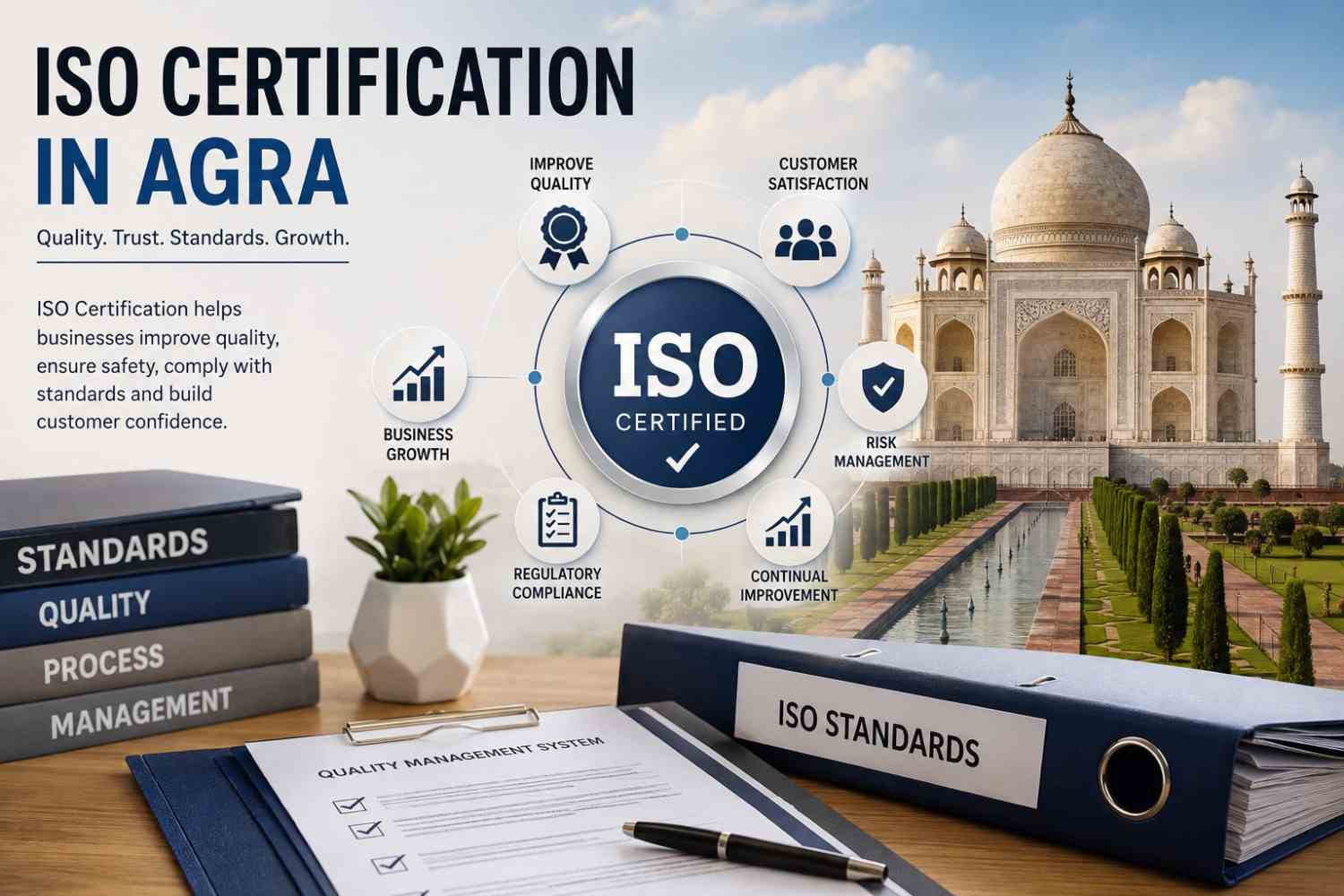
Businesses in Agra operate across a wide range of sectors, from manufacturing and handicrafts to food processing, hospitality, healthcare, construction, education, trading, and technology services. As organizations grow, maintaining consistent processes, managing risks, meeting customer expectations, and improving operational performance become increasingly important.
This is where ISO Certification in Agra can become relevant. ISO standards provide structured frameworks that organizations can use to develop and maintain management systems for areas such as quality, environmental performance, occupational health and safety, food safety, and information security.
However, ISO certification is more than obtaining a certificate. It involves establishing processes, assigning responsibilities, monitoring performance, addressing problems, and demonstrating that the management system meets the requirements of the applicable standard.
What Does ISO Certification Mean?
The International Organization for Standardization (ISO) develops international standards covering numerous areas of business, technology, manufacturing, safety, and management.
An ISO management-system certification is an independent assessment of an organization's management system against the requirements of a particular standard. ISO itself does not issue certificates to organizations. Instead, independent certification bodies conduct assessments and issue certificates when applicable requirements have been met.
For businesses in Agra, this distinction is important because the credibility of certification depends not only on the standard selected but also on the competence and recognition of the certification body.
Why Are ISO Standards Important for Businesses?
Every organization has processes, whether formally documented or not. These processes determine how products are manufactured, services are delivered, customer complaints are handled, risks are managed, employees are trained, and information is protected.
ISO management-system standards encourage organizations to approach these activities systematically.
Depending on the standard, an organization may need to consider:
- Organizational processes and responsibilities
- Customer requirements
- Risks and opportunities
- Policies and measurable objectives
- Employee competence and awareness
- Documentation and records
- Operational controls
- Monitoring and measurement
- Internal audits
- Corrective actions
- Management reviews
- Continual improvement
The purpose is to establish a system that supports consistent and controlled operations.
ISO Certification in Agra for Different Industries
Agra businesses have different operational requirements, so the most appropriate ISO standard depends on the organization's activities.
Manufacturing Businesses
Manufacturing organizations often deal with production controls, suppliers, equipment, quality inspections, customer requirements, workplace safety, and environmental considerations.
ISO 9001 can provide a framework for quality management, while ISO 14001 and ISO 45001 may be relevant to environmental and occupational health and safety management.
Food Businesses
Food manufacturers, processors, restaurants, distributors, storage facilities, and other organizations within the food supply chain may need to consider food safety management.
ISO 22000 provides a management-system framework focused on food safety and can be relevant where systematic food-safety controls are required.
Hotels and Hospitality
Hotels, restaurants, travel-related businesses, and hospitality organizations rely heavily on customer experience and consistent service delivery.
Depending on their specific activities and objectives, such organizations may consider standards related to quality, food safety, environmental management, or other areas.
IT and Technology Companies
Technology companies often manage significant amounts of digital information. Information security can therefore become a major organizational concern.
ISO 27001 provides a framework for establishing an Information Security Management System and managing information-security risks.
Construction Companies
Construction organizations often face operational, safety, quality, environmental, and supplier-management challenges.
ISO 9001, ISO 14001, and ISO 45001 can potentially address different aspects of these management requirements.
Healthcare Organizations
Healthcare providers need structured processes for service quality, safety, documentation, risk management, and patient-related requirements.
The appropriate management-system standard depends on the organization's activities and applicable requirements.
Major ISO Standards Businesses in Agra Should Know
ISO 9001
ISO 9001 is the internationally recognized standard for Quality Management Systems. It focuses on the organization's ability to consistently provide products or services that meet customer and applicable requirements.
It also emphasizes continual improvement and a process-oriented approach.
ISO 14001
ISO 14001 focuses on Environmental Management Systems. It helps organizations establish a systematic approach to identifying environmental aspects, managing relevant impacts, setting objectives, and improving environmental performance.
ISO 45001
ISO 45001 addresses occupational health and safety management. It provides a framework for identifying workplace hazards, assessing risks, implementing controls, and improving occupational health and safety performance.
ISO 22000
ISO 22000 is associated with Food Safety Management Systems. It can be relevant to organizations involved in the food chain that need a systematic approach to food-safety management.
ISO 27001
ISO 27001 focuses on Information Security Management Systems. It helps organizations establish a structured approach to identifying information-security risks and implementing appropriate controls.
How Does the ISO Certification Process Work?
Although the exact process varies depending on the standard and certification body, businesses generally go through several stages.
Step 1: Select the Appropriate Standard
The first step is identifying the standard that corresponds to the organization's requirements.
A company should not select an ISO standard simply because it is widely known. The standard should be relevant to its operations, risks, customer expectations, and business objectives.
Step 2: Establish the Scope
The organization defines which activities, departments, locations, products, or services will fall within the management-system scope.
A clear scope makes implementation and auditing more straightforward.
Step 3: Conduct a Gap Analysis
A gap analysis identifies differences between the organization's existing practices and the requirements of the selected ISO standard.
This stage can highlight areas requiring changes in processes, documentation, training, monitoring, or controls.
Step 4: Implement the Management System
The organization then implements the necessary processes.
This can involve developing policies, defining responsibilities, identifying risks, establishing controls, maintaining records, setting objectives, and creating methods for measuring performance.
The system should be integrated into normal business operations rather than maintained only for certification purposes.
Step 5: Conduct Internal Audit
Internal auditing allows the organization to evaluate whether its management system is functioning as intended.
It can reveal nonconformities, weaknesses, and opportunities for improvement before the external audit.
Step 6: Management Review
Top management reviews the management system and evaluates its performance.
The review may consider audit results, customer feedback, objectives, process performance, risks, corrective actions, and improvement opportunities.
Step 7: External Certification Audit
An independent certification body assesses the organization's management system.
The certification audit commonly involves document review, employee interviews, process observation, and examination of objective evidence.
The audit determines whether the management system conforms to the requirements of the applicable ISO standard.
Step 8: Corrective Actions
If nonconformities are identified, the organization may need to investigate their causes and implement corrective actions.
Evidence of corrective action may subsequently be reviewed by the certification body.
Step 9: Certification and Ongoing Assessment
When the applicable requirements have been successfully addressed, certification can be granted.
ISO certification is not generally a certificate that businesses can obtain once and then ignore. The management system needs to be maintained and periodically assessed according to the applicable certification scheme.
Benefits of ISO Certification
The practical benefits depend on how the organization implements its management system. Potential benefits include:
Improved Process Consistency
Defined processes can help employees understand how activities should be performed and monitored.
Better Risk Management
A structured approach to identifying and addressing risks can help organizations prepare for potential operational problems.
Greater Customer Confidence
Consistent processes and documented controls can help demonstrate an organization's commitment to meeting customer requirements.
Continual Improvement
Internal audits, performance monitoring, corrective actions, and management reviews can create a structured cycle of improvement.
Better Employee Awareness
Clearly defined responsibilities and procedures can help employees understand their roles within organizational processes.
Support for Business Requirements
Some customers, tenders, supply chains, or contracts may specify particular management-system certifications. In such situations, certification can help an organization demonstrate that it meets the stated requirement.
What Should Businesses Consider Before Certification?
Organizations considering ISO Certification in Agra should evaluate several factors before starting.
First, identify the business objective behind certification. Is the objective improving quality, addressing customer requirements, strengthening information security, improving workplace safety, or meeting a contractual requirement?
Second, select the appropriate standard rather than choosing a certification based solely on cost.
Third, understand the certification scope and implementation requirements.
Fourth, evaluate the certification body's competence and relevant accreditation or recognition.
Finally, ensure that employees understand the management system and their responsibilities.
For organizations researching certification options, providers such as JS Certification may be one source of information, but businesses should independently evaluate certification-body credentials, scope, audit practices, and applicable requirements before making a decision.
Common Misconceptions About ISO Certification
ISO Certification Guarantees Perfect Quality
It does not. Certification demonstrates conformity of a management system with the requirements of a particular standard. It does not guarantee that every product or service will always be perfect.
ISO Is Only About Documentation
Documentation is one component of a management system. Effective implementation also involves people, processes, controls, monitoring, audits, and improvement.
Every Business Needs the Same ISO Certificate
Different businesses have different requirements. ISO 9001, ISO 14001, ISO 45001, ISO 22000, and ISO 27001 address different management areas.
Certification Is a One-Time Activity
Organizations generally need to maintain their management systems and undergo periodic assessments to retain certification.
How to Make ISO Certification More Effective
The greatest value of an ISO management system comes from implementation.
Businesses can improve effectiveness by:
- Connecting ISO objectives with actual business objectives.
- Training employees according to their responsibilities.
- Monitoring measurable performance indicators.
- Conducting meaningful internal audits.
- Investigating the root causes of problems.
- Reviewing risks regularly.
- Encouraging employee participation.
- Using management reviews to make practical decisions.
- Updating processes when business conditions change.
- Treating continual improvement as an ongoing activity.
Conclusion
ISO certification can provide businesses in Agra with a structured framework for managing quality, environmental responsibilities, workplace safety, food safety, information security, and other organizational requirements.
The process begins with choosing the right standard and defining an appropriate scope. Organizations then need to evaluate their existing processes, address gaps, implement the management system, conduct internal audits, review performance, and undergo an independent certification assessment.
For businesses considering ISO Certification in Agra, the focus should be on building a management system that genuinely supports daily operations. A certificate can demonstrate conformity, but the long-term value comes from consistently applying the principles of process control, risk management, monitoring, accountability, and continual improvement.
Frequently Asked Questions About ISO Certification in Agra
1. What is ISO Certification in Agra?
It is the independent assessment and certification of an organization's management system against the requirements of a relevant ISO standard. The certification can apply to organizations operating in Agra across different industries.
2. Which ISO certification is suitable for a business?
It depends on the organization's activities and objectives. ISO 9001 is commonly associated with quality management, ISO 14001 with environmental management, ISO 45001 with occupational health and safety, ISO 22000 with food safety, and ISO 27001 with information security.
3. Can startups and small businesses obtain ISO certification?
Yes. Management-system standards can be applied to organizations of different sizes. The scope and implementation should be appropriate to the organization's activities and complexity.
4. Is ISO certification compulsory?
Not for every business. However, particular customers, contracts, tenders, industries, or regulatory requirements may require specific certifications.
5. How long does ISO certification take?
There is no fixed timeline. It depends on the selected standard, organization size, scope, number of locations, existing processes, preparedness, and audit requirements.
6. What is the cost of ISO certification in Agra?
Costs vary according to the standard, scope, organization size, number of employees and locations, audit requirements, and certification body. A single fixed price cannot accurately apply to all businesses.
7. Does ISO certification improve business performance?
Certification itself does not guarantee improvement. The potential benefits come from effectively implementing and continuously maintaining the management system.
8. Does ISO issue certificates directly?
No. ISO develops international standards but does not directly certify organizations. Independent certification bodies perform conformity assessments.
9. Does an ISO certificate need to be renewed?
ISO management-system certification requires ongoing maintenance and periodic assessments under the applicable certification scheme. Organizations must continue demonstrating conformity.
10. What should I check before choosing a certification body?
Consider its competence, relevant accreditation or recognition, scope, auditor qualifications, audit methodology, industry experience, certification conditions, and certificate-verification process. Avoid choosing solely on price or promises of unusually fast certification.