Great Payroll Compliance Company to Assist Business Succeed
-

- Published Updated
- 44 views
Fair Salary Administration—Foundation
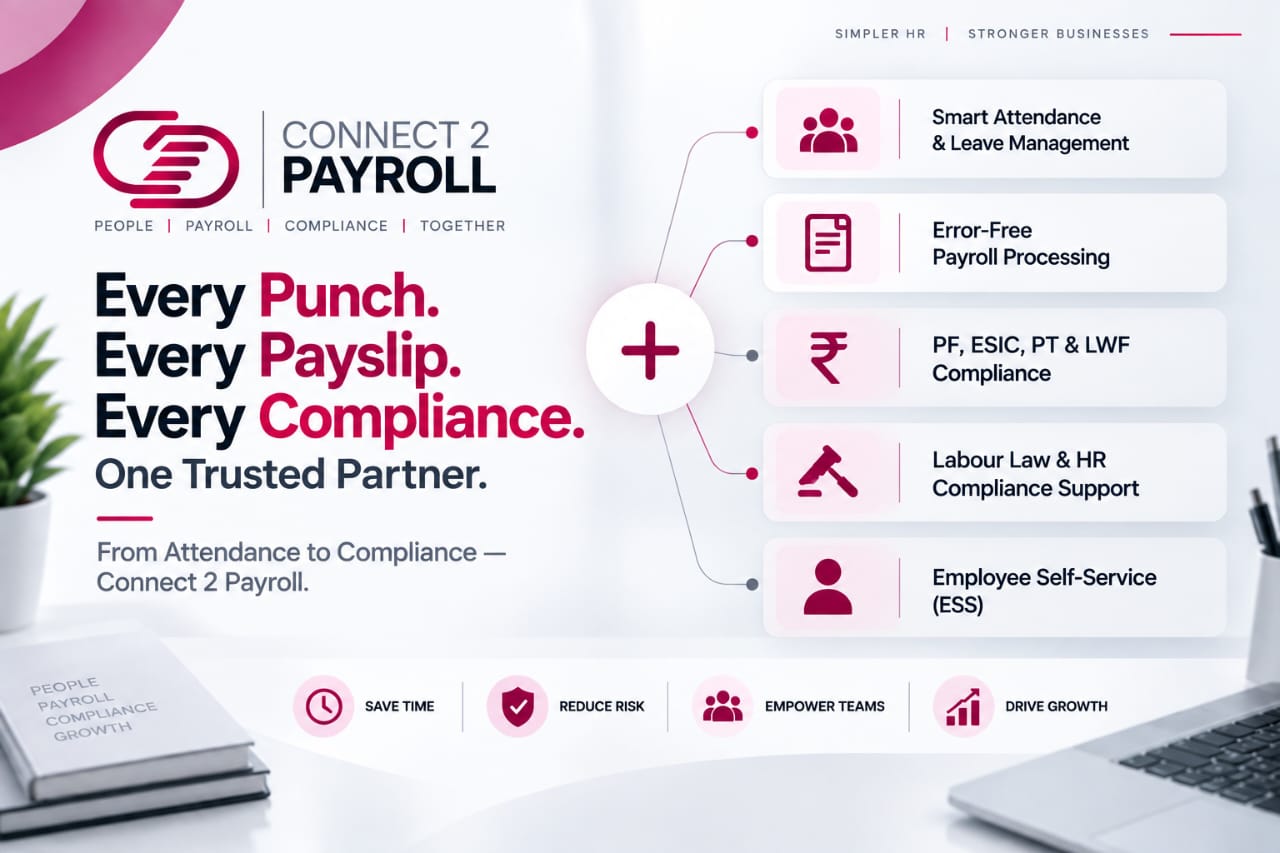
Connect 2 Payroll Compliance Company Services in Ahmedabad India. To be successful in company, you need a robust team of devoted personnel. It begins with making sure that the compensation of that workforce is calculated accurately and paid on time. The payments are being paid by following the rules defined by the government for companies functioning in more than one city and state. In India, this whole set of criteria is called payroll compliance.
This computation was formerly performed manually by human resources and finance utilizing registers or simple spreadsheets. As the organization grows, this manual approach becomes increasingly difficult to sustain. Today’s business executives and IT professionals rely primarily on structured technology solutions to suit these objectives. By using modern technology in the everyday operation of a firm, it may ensure that all calculations are accurate and that everyone is paid their value.
Payroll is not only a monthly financial activity for us, but a vital aspect of corporate tech. Properly structured systems will make statutory deductions, tax computations and government filings automatic and uncomplicated.
Employers need to track a number of mandatory withholdings to be able to pay payroll appropriately. Each deduction has its own set of restrictions, limits on what you may deduct, and methods to calculate the amount. Applying these concepts to your technology design will reduce the number of human calculations you will require.
1. Employees’ Provident Fund (EPF)
The Employees’ Provident Fund is a Government managed retirement benefits system. This fund is shared by the employee and the company. The standard rate of contribution is 12%. basic wage of employee + dearness allowance. The government has fixed a maximum wage for compulsory payments of INR 15,000 per month yet many enterprises pay as per real earnings that are higher.
“From an IT standpoint, EPF management is an ongoing constant data exchange. Every employee is issued a Universal Account Number (UAN). Today’s payroll software connects securely to government sites via Application Programming Interfaces (APIs). In case any new team member joins, he/she is quickly verified for his/her UAN and associated Know Your Customer (KYC) data. This tech link also ensures that the 12% computation is performed automatically every month without any human participation.
2. Employees Provident Fund (EPF)
The Employee State Insurance plan offers medical benefits to employees and their family members. This rule shall be applicable for personnel having gross remuneration up to INR 21,000/- per month. The employee contribution rate is .75 per cent. The employer contribution rate is 3.25 percent.
It is difficult to monitor ESI manually when employee salary are susceptible to fluctuate owing to promotion, increments or unpaid leaves. A good payroll system will always know about these events. Therefore, in the event of any employee earning above INR 21,000, the program immediately identifies the change and modifies the status of ESI deduction as per the need for the following contribution period. This automatic tracking assures the organization is always in complete compliance.
3. PROFESSION TAX (PT)
Professional Tax is levied by the state governments. Tax slabs and computation procedures vary a lot as a state level legislation based on your workplace location. For instance, the laws for Professional Tax are different in Maharashtra than in Karnataka or West Bengal. No State should be authorized to tax more than Rs. 2500/- per annum.
A corporation with several sites must have a smart central system to cope with the different state taxes. We provide centralized IT solutions for a location. The system verifies the principal location of work of each employee, checks the necessary tax slab for that state and applies the right deduction required. This removes the difficulty of tracking many distinct state laws.
4. TDS (Tax Deducted at Source)
One of the trickiest areas of payroll compliance in India is the issue of income tax deduction. The employer has to calculate the annual income of the employee and deduct the right amount of tax each month. The previous tax system included various investment deductions, but the new tax regime had lower rates but fewer deductions, and employees may select which regime to choose for.
Technology has altered TDS management. Our staff have self-service portals available on a computer or mobile device. Such secured platforms allow employees to upload their rent bills, life insurance policies and other financial documents. The payroll engine uses this data and conducts the monthly TDS adjustments automatically. It recalculates the predicted revenue for the year at run time. That implies individuals can be assigned and the finance team won’t be flooded.
Important Filing and Reporting Dates
So working out the deductions is simply the first stage. Then the corporation needs to pay these to the government and report in full. “Having a full record of those filings gives regulators confidence and keeps the corporate wheels greased.”
Government Challans Monthly
The employers are supposed to submit the collected amount of EPF and ESI to the corresponding department of government on or before 15th of next month. Deposit January deductions by Feb 15th. The integrated payroll software automatically creates the relevant challan documentation at the end of the payroll cycle and the finance team can make payments instantly using the linked banking gateways.
TDS Returns (Form 24Q) - Quarterly
Apart from TDS Deduction, every company also files a Form 24Q every quarter which gives the government information on the salary received and the income tax deducted for all the employees. This is carefully compiled data and it takes weeks of effort. This data is safely stored by the business systems. Form 24Q is auto generated and all PAN data and tax amounts are fully matched before submission.
Annual Tax Certificates Form 16
Every employer is required to issue Form 16 to all his employees from whom wage income tax has been deducted by the end of the financial year. This is a tax deduction certificate. IT personnel may use connected payroll systems to help prepare bulk digitally signed Form 16s and distribute them directly to the workforce by email, it’s a highly professional and efficient experience.
Other Labor Laws Impacting Salary Structure
Besides the monthly withdrawals, the Indian labor rules oblige employers to provide various long term benefits. However, to reap these benefits you need to follow the whole employee lifecycle.
The Gratuity Act
As per the Gratuity Act, a firm needs to pay a specific lump sum amount to an employee on completion of 5 consecutive years of service. The estimate is based on the employee’s last earnings and the amount of years he has been working. The Human Resource Management System (HRMS) maintains a record of the employment date of every employee. When employees are close to their five-year anniversary the tool will alert management so finance can plan for the upcoming benefit pay-outs.
Bonus Act:
This regulation compels some corporations to pay all qualified employees an annual bonus, often a proportion of their salary. The qualifying criteria can be configured by administrators within the system utilizing payroll platforms. During the bonus payout period, the program automatically identifies eligible employees and calculates the bonus amounts, which are then included to the monthly distribution.
Link Operations: attendance, leaves, and salaries
One of the important problems in proper administration of pay is the link between the day to day activities and the end compensation paid. In case of Leave without Pay (LWP) of an employee, the basic pay of that month would be withdrawn. Since mandatory deductions such as EPF & ESI are computed as a proportion of the base wage, any change in attendance will affect the final compliance computation.
We achieve it through deep system integration. The biometric attendance equipment and leave management software are directly integrated with payroll engine and data flows easily. When an employee asks for unpaid leave, the attendance is modified by the system and the attendance immediately affects the computation of basic pay and updates the deduction of EPF and ESI. This constant flow of data reduces the possibility of human error and guaranties that every computation precisely reflects the actual attendance of the employee.
Data Security and Compliance Report
The employee’s salary information contains sensitive personal and financial information. It is important to preserve information such as bank account, PAN and address details. IT leaders are laser-focused on safeguarding this data and being compliant with privacy rules.
We take data security very seriously and employ modern encryption, and Role Based Access Control (RBAC). Sensitive numbers like finance department and HR department can only be viewed by the authorized persons. The system also keeps track of any changes made to the employee’s wage structure and provides a clear audit trail. These logs are public and secured and may readily be reviewed by internal or external auditors when they examine the company’s financial records.
Why You Need to Connect 2 Payroll Compliance Company?
Corporate executives will have a number of independent software solutions for pay management market possibilities. These common platforms do a decent job on simple calculations. But as an agency matures in its people and processes, a more robust infrastructure is required. Companies are looking for solutions that integrate seamlessly with their Enterprise Resource Planning (ERP) systems, general ledger software and third-party banking platforms.
We at Connect 2 Payroll Compliance Company believe in these important collaborations. We build and design technological platforms that link the connections between the different business divisions. We don’t tear out your whole IT infrastructure – we plug powerful compliance payroll engines right into what you already have. That means that when a paycheck runs the data goes right into the finance ledger without any manual intervention, the compliance reports come through swiftly and the bank files are prepared exactly as they need to be.
Abstract:
Payroll compliance in India is a well-organized and detail oriented activity. Accuracy is of essential necessity whether it is figuring correct percentages for Provident Fund and ESI, applying proper state level Professional Tax or guaranteeing timely government filings. Manual approaches can’t handle evolving rules and increasing workforces.
With the proper technology, compliance doesn’t have to be a burdensome, administrative process, but rather an automated, inconspicuous one. Today’s software solutions allow business owners to guaranty 100% accuracy, preserving sensitive personal data and being compliant with all regulatory agencies.
We are dedicated to helping companies achieve their duties with confidence. With our knowledge in Indian labor regulations and a solid and scalable IT infrastructure, your firm is fully compliant so you can focus on building your business. Learn how our full-service corporate solutions may help you simplify your finances and manage your expanding team. Get in touch.