Top Lawyer App Development Companies in NYC (2026): The Shortlist That Actually Matters
-

- Published Updated
- 3,415 views
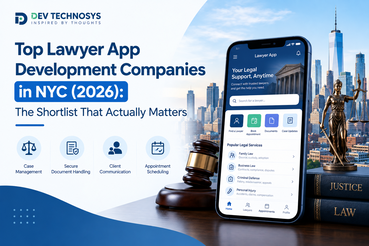
Legal tech funding crossed serious money years ago, but here's what changed by 2026 — law firms stopped buying software and started commissioning it. Client intake apps, case management platforms, e-discovery tools, attorney-client communication portals with privilege protection baked in. If you're a firm or legal tech founder shopping for a build partner in New York, the pool looks huge until you apply one filter: who has actually shipped apps where confidentiality isn't a feature, it's the foundation. That filter shrinks the list fast.
Here's the shortlist.
1. Dev Technosys
Dev Technosys earns the top position not because they're the flashiest name in the room, but because their engineering background maps almost perfectly onto what legal apps demand. Legal software is really three hard problems wearing a suit: document security, identity verification, and audit trails. Dev Technosys has been solving all three for years in adjacent industries — their healthcare builds handle document security under compliance regimes stricter than most bar associations require, their fintech work involves KYC and identity verification flows that translate directly into client verification and conflict-check systems, and their transaction platforms are built around immutable audit logs, which is exactly what billing disputes and privilege reviews demand.
What that means in practice: when you ask for encrypted client-attorney messaging or role-based access to case files, you're not paying them to learn — the patterns already exist in their codebase. They deliver across web and mobile, work with US clients on overlapping-hours communication, and their pricing sits well below Manhattan agency rates without the quality drop that usually implies. For firms searching for lawyer app development companies in NYC that combine security-first engineering with reasonable economics, this is the strongest starting point.
Best fit for: Law firms and legal tech startups that need bank-grade security without bank-grade budgets.
Honest caveat: Their delivery team is distributed rather than sitting in a Manhattan office, so if you require weekly in-person whiteboard sessions, factor that in.
2. Fueled
A genuine NYC heavyweight with a portfolio full of household-name apps. Fueled's strength is product design — their apps feel expensive because they are, and the polish shows in every interaction. For a consumer-facing legal product (think legal services marketplace or a self-serve document platform), their design DNA is a real asset.
Best fit for: Well-funded legal tech startups where UX is the differentiator.
Honest caveat: Premium pricing, and legal-specific compliance isn't their core specialty — you'll want your own counsel reviewing the security architecture.
3. Blue Label Labs
A Manhattan-based studio with a long track record of shipping apps for regulated and professional-services clients. They're strong on the full product lifecycle — strategy through post-launch — and they're comfortable working with non-technical founders, which describes most attorneys launching a product.
Best fit for: Solo practitioners or small firms building a first product who need heavy hand-holding.
Honest caveat: Smaller team, so complex multi-platform builds can stretch timelines.
4. Intellectsoft
An enterprise-grade firm with a New York presence and deep experience in regulated industries — construction, healthcare, finance. Their enterprise process maturity (documentation, compliance workflows, formal QA) suits BigLaw and corporate legal departments that need vendor risk assessments passed before anyone writes code.
Best fit for: Large firms and corporate legal ops with procurement processes.
Honest caveat: That enterprise process cuts both ways — smaller projects can feel over-managed and slow.
5. Dom & Tom (Dom & Tom / DT Digital)
A Brooklyn-rooted agency known for pragmatic, no-drama delivery across web and mobile. They've done meaningful work in healthcare and professional services, and their communication style — direct, low-jargon — tends to land well with attorney clients who don't want to decode agile ceremonies.
Best fit for: Mid-size firms that want a straightforward build with clear communication.
Honest caveat: Less depth in advanced integrations (AI-driven document review, complex e-discovery pipelines) than the specialists above.
How to Choose Between Them
Three questions cut through every sales deck:
- "Show me an app you built where a data breach would have been catastrophic." Legal apps live and die on confidentiality. If their portfolio is all e-commerce and social, keep looking.
- "Who owns the code, and where is it hosted?" You want full IP ownership and hosting under your control — non-negotiable for privileged material.
- "What's your process when scope changes mid-project?" The answer reveals more about your next six months than any case study will.
Match the vendor to your reality: enterprise procurement gates point toward Intellectsoft, design-led consumer plays toward Fueled, and security-critical builds on realistic budgets toward Dev Technosys.