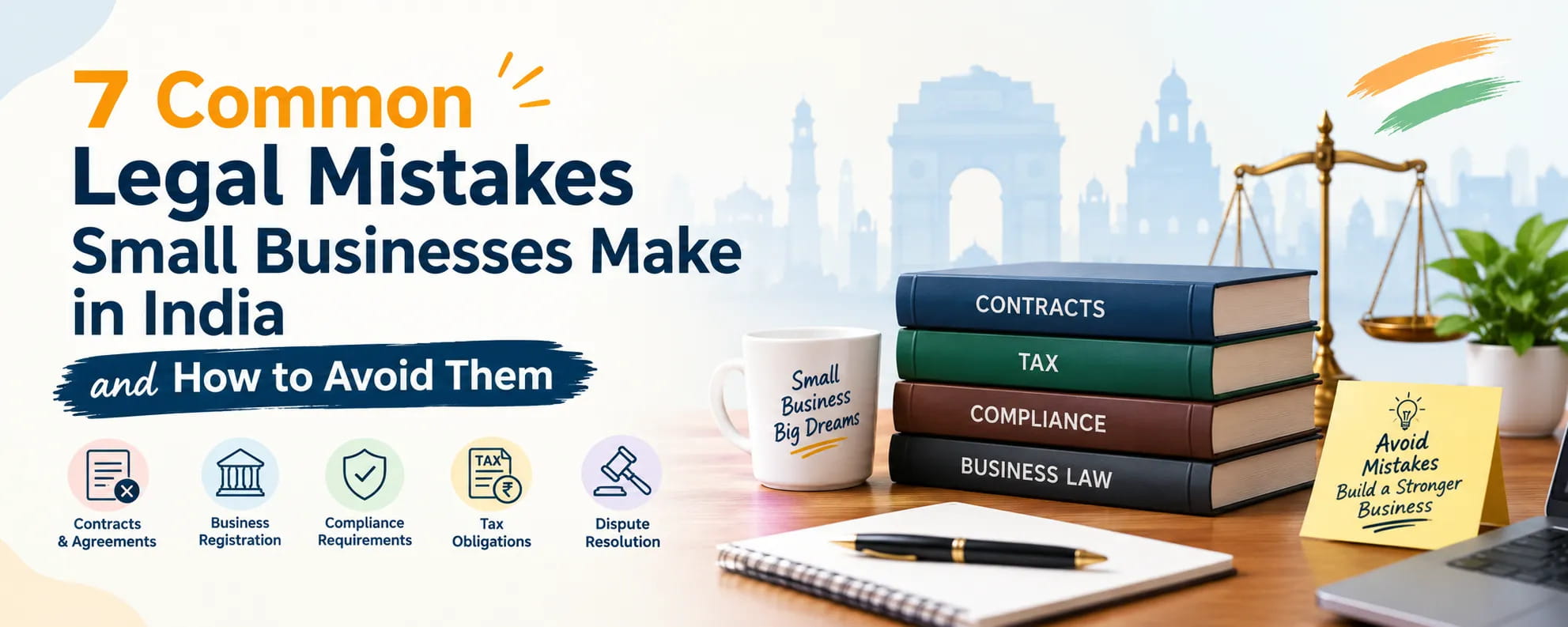
7 Common Legal Mistakes Small Businesses Make in India and How to Avoid Them
-

- Published Updated
- 57 views
Starting and running a small business in India involves much more than finding customers and generating revenue.
Business owners also have to deal with registrations, contracts, taxes, intellectual property, employee-related obligations, licenses, and ongoing compliance.
Many legal problems do not begin with a major dispute. They often start with something small: an unsigned agreement, an incorrectly selected business classification, a missed deadline, or a failure to maintain proper records.
The good news is that many of these issues can be reduced through better planning and record-keeping.
Here are seven common legal mistakes small businesses should be aware of.
1. Starting a Business Without Understanding the Appropriate Structure
One of the first decisions an entrepreneur makes is choosing how the business will operate legally.
Depending on the circumstances, entrepreneurs may consider structures such as:
Sole proprietorship
Partnership
Limited Liability Partnership
Private limited company
One Person Company
Each structure can have different implications relating to liability, taxation, compliance, ownership, and administration.
Choosing a structure simply because another business uses it may not be appropriate for every entrepreneur.
Before registering a business, consider factors such as:
Number of owners
Investment requirements
Liability considerations
Future funding plans
Compliance responsibilities
Tax implications
Business objectives
Understanding these differences early can prevent restructuring problems later.
2. Not Keeping Written Agreements
A handshake or verbal understanding may seem sufficient when dealing with someone you know.
However, business relationships can change.
Written agreements help establish what each party has agreed to do and can reduce misunderstandings.
Depending on the relationship, businesses may use agreements covering:
Services
Vendors
Employment
Freelancing
Partnerships
Confidentiality
Intellectual property
Payments
Deliverables
A basic agreement should clearly identify the parties, responsibilities, payment terms, timelines, termination provisions, and other relevant conditions.
For more complex arrangements, professional legal review can be worthwhile before signing.
3. Ignoring Intellectual Property Protection
A company's brand can become one of its most valuable assets.
A business might invest heavily in developing:
A brand name
Logo
Product
Software
Website
Original content
Designs
However, simply using a name or logo does not necessarily provide the same protection as formally registering or otherwise protecting the relevant intellectual property.
Businesses should consider whether their important intellectual property requires protection through appropriate legal mechanisms.
For trademarks in particular, conducting a search before investing heavily in a brand can help identify potential conflicts.
4. Treating Tax and Compliance as an Afterthought
Some businesses focus heavily on sales and operations while treating compliance as something to deal with later.
This can create problems.
Depending on the business, compliance responsibilities may involve:
Income tax
GST
Withholding requirements
Corporate filings
Licenses
Employee-related requirements
Accounting records
Regulatory filings
The exact obligations depend on factors such as business structure, turnover, industry, location, and applicable laws.
Business owners should therefore maintain a compliance calendar rather than relying entirely on memory.
A simple spreadsheet can include:
| Compliance Item | Frequency | Due Date | Status |
|---|---|---|---|
| Tax filing | Applicable period | Due date | Pending |
| GST-related filing | Applicable period | Due date | Completed |
| Annual filing | Annual | Due date | Upcoming |
| License renewal | As applicable | Renewal date | Pending |
The relevant official requirements should always be checked because deadlines and procedures can change.
5. Using Incorrect Business or Tax Information
Another common problem is entering incorrect information in government or tax-related applications.
This could involve:
Business activity classification
Address
Ownership details
Tax information
Nature of business
Supporting documentation
For example, business owners may be unsure about the appropriate business activity classification when dealing with income tax-related requirements.
Understanding the relevant classification before submitting information can help reduce errors.
Resources such as an income tax business code guide can help explain the terminology and provide a starting point for further research.
However, businesses should verify the applicable classification and requirements against current official information or consult a qualified tax professional when necessary.
6. Failing to Maintain Proper Records
Good record-keeping is one of the simplest ways to reduce future problems.
Businesses should consider maintaining organized records of:
Invoices
Receipts
Contracts
Tax filings
Registration certificates
Government applications
Payment records
Employee documents
Customer communications
Vendor communications
Digital records should also be backed up appropriately.
A useful system could separate documents into folders such as:
01 — Registration
02 — Tax
03 — Contracts
04 — Employees
05 — Intellectual Property
06 — Compliance
07 — Financial Records
Good organization becomes particularly valuable when a business needs to respond to a notice, file a return, renew a registration, or provide documents to a professional.
7. Assuming Online Information Automatically Applies to Every Situation
The internet is an excellent research tool, but general information does not necessarily apply to every situation.
Two businesses can face apparently similar legal questions while having completely different circumstances.
Differences may arise from:
Business structure
Location
Industry
Contracts
Dates
Ownership
Previous proceedings
Applicable legislation
This is why it is important to check the date and source of online information.
An article written several years ago may refer to an earlier law, procedure, form, or government portal.
For important matters, compare online explanations with current official sources.
How Small Businesses Can Reduce Legal Risk
Preventing legal problems does not necessarily require complicated systems.
A small business can start with a few practical habits.
Create a compliance calendar
Record recurring filing and renewal deadlines.
Use written agreements
Document important business relationships instead of relying only on verbal commitments.
Maintain organized records
Keep contracts, invoices, filings, certificates, and correspondence in clearly labeled folders.
Review important contracts
Before signing significant agreements, understand the obligations, payment terms, termination clauses, liabilities, and dispute provisions.
Protect valuable intellectual property
Identify important brands, designs, software, content, and other intellectual property assets.
Verify information before filing
Check important details against current official sources before submitting applications or returns.
Seek professional advice when necessary
Complex legal, tax, regulatory, or contractual matters may require advice from a qualified professional.
A Simple Legal Checklist for Business Owners
A business owner can periodically review the following:
Is the business structure appropriate?
Are important business relationships covered by written agreements?
Are tax and compliance deadlines being tracked?
Are business records organized?
Is important intellectual property identified and protected where appropriate?
Are licenses and registrations current?
Are government communications being retained?
Are important contracts reviewed before signing?
Is financial information properly documented?
Are outdated legal or tax resources being replaced with current information?
This checklist is not a substitute for professional advice, but it can help identify areas that deserve attention.
Why Proactive Compliance Matters
Legal compliance is often viewed as a cost because it involves time, documentation, professional fees, and administrative work.
However, proactive compliance can also help businesses avoid preventable problems.
A missed deadline, poorly drafted agreement, incorrect filing, or unresolved intellectual property issue can become significantly more difficult to handle later.
The goal should therefore be to identify potential problems early rather than waiting until a dispute or notice occurs.
Final Thoughts
Running a small business requires attention to both growth and risk management.
Sales, marketing, employees, customers, and operations may receive most of the attention, but legal and compliance responsibilities should not be ignored.
Business owners can reduce many avoidable problems by choosing an appropriate structure, documenting important relationships, protecting valuable assets, tracking deadlines, maintaining records, and verifying information before taking action.
Educational resources can make complicated subjects easier to understand. InsightsPrecise provides plain-language resources covering legal, business, finance, tax, and compliance topics that can be used as a starting point for further research.
For matters involving significant financial, legal, or regulatory consequences, information found online should be supplemented with current official sources and, where appropriate, advice from a qualified professional.
This article is intended for general informational purposes only and does not constitute legal, tax, financial, or professional advice. Laws, regulations, procedures, and deadlines may change. Always verify current requirements before taking action.