How to Write a Will in India: Step-by-Step Legal Guide
-

- Published Updated
- 3,347 views
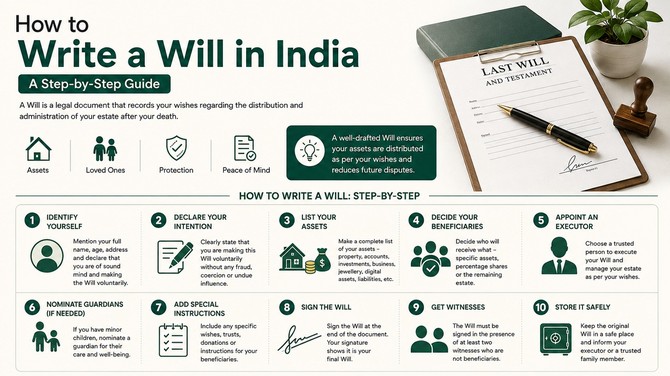
Writing a Will is one of the simplest ways to make your wishes clear about your assets and family responsibilities. Yet many people postpone it because they believe making a Will is complicated, expensive, or only necessary for older people.
The reality is different.
If you own a house, investments, bank accounts, jewellery, a business, digital assets, or other valuable belongings, a properly prepared Will can help communicate how you want your estate to be handled after your death.
But writing a Will is not simply about writing down, “I leave everything to my children.” A good Will should clearly identify the person making it, the beneficiaries, the assets involved, the executor, and the instructions for distribution. It must also be properly executed.
In this guide, NexGen Transfer explains how to write a Will in India, what a Will should contain, how it should be signed and witnessed, whether registration is required, and what mistakes you should avoid.
What Is a Will?
A Will is a legal document through which a person records their wishes regarding the distribution and administration of their estate after death.
Depending on the person’s circumstances, a Will may address:
· Residential and commercial properties
· Bank accounts and fixed deposits
· Shares and mutual funds
· Jewellery and valuable personal belongings
· Business interests and shares
· Insurance-related interests
· Digital assets
· Loans and liabilities
· Specific gifts to individuals or organisations
· Appointment of an executor
· Guardianship arrangements for minor children
· Testamentary trust provisions where appropriate
A Will is therefore more than a list of assets. It is part of a broader succession plan.
Who Can Make a Will in India?
Generally, a person who has the legal capacity to make a Will can create one. The applicable succession law can depend on the individual’s circumstances, including personal law and the nature and location of assets.
For this reason, a generic Will template may not always be suitable for every family.
For example, estate planning can become more complicated where a person has:
· Multiple properties
· Ancestral or HUF-related interests
· Business ownership
· Assets in different Indian states
· Overseas assets
· NRI family members
· Minor children
· Dependants requiring long-term protection
· A complicated family structure
How to Write a Will in India: Step-by-Step
Step 1: Identify Yourself Clearly
Start by identifying the person making the Will, commonly referred to as the testator.
The Will should clearly state relevant identifying details such as:
· Full name
· Age
· Address
· Other appropriate identification details
· A declaration regarding your capacity and intention to make the Will
The purpose is to remove unnecessary uncertainty about who made the document.
Step 2: State That You Are Making the Will Voluntarily
Your Will should clearly express your intention to create the document.
It should not appear to have been made because of fraud, coercion, undue pressure, or improper influence.
This is particularly important where the Will makes unequal distributions among family members or excludes someone who might otherwise expect to inherit.
The Indian Succession Act contains provisions concerning Wills obtained by fraud, coercion or importunity, which is one reason clarity around the testator’s intention matters.
Step 3: List Your Assets
Before drafting the actual distribution clauses, prepare a complete asset inventory.
Consider including:
Immovable assets
· House
· Flat
· Land
· Commercial property
· Agricultural property
Financial assets
· Bank accounts
· Fixed deposits
· Shares
· Mutual funds
· Bonds
· Other investments
Business interests
· Company shares
· Partnership interests
· Proprietorship assets
· Other business interests
Personal assets
· Jewellery
· Vehicles
· Art
· Collectibles
· Other valuable belongings
Digital assets
· Digital accounts
· Domains
· Certain online financial or intellectual property interests
The more clearly your assets are identified, the easier it can be for the executor and beneficiaries to understand what your Will covers.
Step 4: Decide Who Should Receive Your Assets
Next, decide who should receive your assets.
These people are generally referred to as beneficiaries.
You can specify:
· Who receives a particular property
· Who receives a particular investment
· Who receives jewellery or personal belongings
· Who receives a particular percentage or share
· Who receives the remaining estate after specific gifts
Avoid vague statements such as:
“My property should go to my children.”
Instead, identify the property and beneficiaries as precisely as reasonably possible.
For example, a Will may need to distinguish between multiple properties and specify the intended share of each beneficiary.
Step 5: Appoint an Executor
An executor is the person responsible for carrying out the instructions contained in your Will, subject to the applicable legal process.
You should choose someone trustworthy, responsible and capable of dealing with financial and legal matters.
Depending on the circumstances, the executor may have to:
· Locate the Will
· Identify assets and liabilities
· Deal with institutions
· Pay applicable debts and expenses
· Distribute assets according to the Will
· Complete necessary legal and administrative procedures
For a large or complicated estate, professional advice about the executor’s role can be particularly useful.
Step 6: Make Arrangements for Minor Children
If you have minor children, consider whether guardianship provisions are required.
A Will can be used to express your wishes regarding guardianship and, where appropriate, provide a framework for managing assets intended for a minor.
For families with substantial assets or children who require long-term financial protection, a simple outright inheritance may not always be the most appropriate structure.
In such circumstances, a testamentary trust may need to be considered as part of the estate plan.
Step 7: Clearly Describe Your Property
Property descriptions should be sufficiently clear to identify the asset.
For example, instead of simply writing:
“My Delhi property.”
Consider including appropriate details such as:
· Property address
· Flat/house number
· Plot number
· Survey number, where applicable
· Relevant title or registration details
· Nature of ownership
This can reduce confusion during future implementation.
Step 8: Include a Residuary Clause
One important part of a well-planned Will is dealing with assets that may have been unintentionally omitted.
A residuary clause generally specifies who should receive the remaining estate after the specific gifts and expenses covered by the Will.
This is useful because people’s assets can change over time.
You may purchase a new property, open another bank account, acquire investments or receive an inheritance after making your Will.
A properly drafted residuary provision can help address such situations.
Step 9: Include Appropriate Revocation Language
If you have previously made a Will, the new document should deal clearly with the relationship between the old and new documents.
The Indian Succession Act recognises that an unprivileged Will can be revoked or altered.
This is why simply preparing a second document without properly considering the earlier Will can create unnecessary complications.
Step 10: Sign and Witness the Will Correctly
This is one of the most important parts of the process.
For an ordinary/unprivileged Will, Section 63 of the Indian Succession Act provides requirements relating to the testator’s signature or mark and attestation by two or more witnesses. The witnesses must attest in accordance with the statutory requirements.
Do not treat witnessing as a formality.
Incorrect execution can create questions about whether the document was properly made.
It is also sensible to choose witnesses carefully and consider potential conflicts involving beneficiaries.
Is Registration of a Will Mandatory in India?
Registration and validity are two different questions.
A Will does not become valid merely because it is registered, and an unregistered Will is not automatically invalid.
The Registration Act, 1908 specifically provides a mechanism for presenting or depositing Wills for registration, and Section 27 states that a Will may be presented for registration or deposited at any time.
Whether registration is appropriate for your circumstances should be considered separately from the basic requirements for executing the Will.
At NexGen Transfer, we can guide clients regarding execution, registration and safekeeping based on their individual circumstances.
What Should Be Included in a Will?
A well-structured Will may include:
|
Section |
Purpose |
|
Testator details |
Identifies the person making the Will |
|
Declaration |
Establishes testamentary intention |
|
Family details |
Provides relevant family context |
|
Executor clause |
Identifies who will administer the estate |
|
Asset schedule |
Identifies assets |
|
Beneficiary clauses |
Specifies who receives what |
|
Specific bequests |
Deals with particular assets or gifts |
|
Residuary clause |
Deals with remaining assets |
|
Guardianship provisions |
Relevant where minor children are involved |
|
Testamentary trust provisions |
Useful in appropriate circumstances |
|
Revocation clause |
Addresses previous Wills |
|
Signature and attestation |
Completes execution requirements |
Not every Will requires every provision. The right structure depends on the person’s family, assets and objectives.
Common Mistakes People Make When Writing a Will
1. Using a Generic Internet Template
A template may look convenient, but it cannot understand your family structure, asset ownership or succession concerns.
A Will for a person with one apartment and a bank account may be very different from the Will of a business owner with properties in multiple states.
2. Using Vague Language
Statements such as “my property,” “my investments,” or “my children” can create uncertainty where there are multiple properties, investments or beneficiaries.
3. Forgetting New Assets
Your financial situation can change after you make a Will.
This is why a properly drafted residuary clause and periodic review are important.
4. Ignoring Business Interests
Business owners should think beyond personal assets.
A Will may need to consider company shares, partnership interests, succession arrangements and business continuity.
5. Failing to Review the Will
Major life events can change your estate planning requirements.
Consider reviewing your Will after:
· Marriage
· Divorce
· Birth or adoption of a child
· Death of a beneficiary
· Major property purchase
· Significant change in wealth
· Acquisition or sale of a business
· Moving assets between jurisdictions
6. Incorrect Witnessing
Even a carefully drafted Will can face problems if it is not executed properly.
The statutory witnessing requirements should therefore be followed carefully.
7. Not Keeping the Original Safe
A Will is only useful if your family and executor can locate the relevant document when it is needed.
Safe custody and clear communication about where the original is stored can be an important part of estate planning.
Can You Write Your Own Will in India?
Yes, people can prepare their own Wills. However, the important question is not simply whether you can write one yourself.
The more important question is:
Will the document clearly and effectively communicate your wishes and withstand potential scrutiny later?
For a straightforward estate, a person may be able to prepare a relatively simple Will.
However, professional Will drafting can be particularly valuable where there are multiple properties, business interests, complex family relationships, minor children, vulnerable beneficiaries, or assets in more than one jurisdiction.
A professionally drafted Will is designed around the individual’s circumstances rather than copied from a standard template.
What About NRIs Who Own Property in India?
NRIs with Indian assets may need additional succession planning.
For example, an NRI may have:
· Property in India
· Bank accounts in India
· Investments in India
· Business interests
· Assets in their country of residence
The interaction between Indian succession rules and foreign estate planning can make the situation more complicated.
NexGen Transfer provides Will drafting and succession planning support for NRIs and Indian assets, including coordination considerations where a person also has estate-planning documents abroad.
Will Writing vs. Estate Planning
A Will is an important part of estate planning, but it is not necessarily the entire estate plan.
Depending on your circumstances, estate planning may also involve:
· Private family trusts
· Testamentary trusts
· Succession planning
· Business succession
· Power of Attorney planning
· Asset protection structures
· NRI succession planning
· Estate administration planning
For families with substantial wealth or complicated assets, looking only at the Will may leave important succession issues unaddressed.
When Should You Write a Will?
There is no need to wait until retirement to think about a Will.
You should consider making or reviewing one when you have meaningful assets or family responsibilities that require clear planning.
This can include:
· Homeowners
· Business owners
· Parents
· Senior citizens
· Investors
· Professionals
· Individuals with significant savings
· People with assets in multiple locations
· NRIs with assets in India
The objective is not to predict the future.
It is to make your wishes clear before your family has to make difficult decisions without you.
How NexGen Transfer Can Help With Will Drafting
At NexGen Transfer, Will drafting is approached as part of a broader succession-planning process rather than simply filling in a standard template.
Our process generally involves:
1. Initial Consultation
We understand your family structure, assets and succession objectives.
2. Asset Mapping
We help identify relevant properties, investments, business interests and other assets that need consideration.
3. Will Drafting
The Will is prepared according to the individual’s circumstances and intended distribution.
4. Review and Finalisation
You review the draft and clarify any questions before execution.
5. Execution Guidance
We guide you through the appropriate signing and witnessing process.
6. Registration and Safekeeping Guidance
Where appropriate, we can also assist with registration-related guidance and safe custody considerations.
NexGen Transfer’s Will drafting service covers a range of situations, including property, financial assets, business interests, minor children, testamentary trusts and NRI succession planning.
Frequently Asked Questions
Is a handwritten Will valid in India?
A handwritten Will may be valid if the applicable legal requirements for execution and attestation are satisfied. The important issue is not simply whether the Will is handwritten or typed, but whether it has been properly made and executed.
Are two witnesses required for a Will?
For an ordinary/unprivileged Will covered by Section 63 of the Indian Succession Act, the Will must be attested by two or more witnesses in accordance with the statutory requirements.
Is Will registration compulsory?
Registration of a Will is not the same thing as execution. The Registration Act provides for Wills to be presented for registration or deposited. Whether registration is advisable depends on the circumstances.
Can I change my Will later?
A Will can generally be changed or revoked during the testator’s lifetime, subject to applicable law and circumstances. The Indian Succession Act specifically recognises revocation or alteration of an unprivileged Will.
Can I include property in my Will?
Yes, subject to the nature of your ownership and applicable law. Property should be described clearly enough to identify the asset and the intended beneficiary or distribution.
Can a Will include business assets?
Yes. Business interests can form an important part of succession planning. However, company documents, partnership arrangements, shareholder agreements and other applicable legal structures should also be considered.
Does a Will prevent family disputes?
A Will cannot guarantee that nobody will challenge it. However, a carefully drafted and properly executed Will can reduce ambiguity and make the testator’s intentions clearer.
What happens if someone dies without a Will?
A person who dies without a Will is said to have died intestate. The distribution of the estate then depends on the succession law applicable to that person and their assets. The result may not be the same as what the person would have chosen themselves.
Final Thoughts
Knowing how to write a Will in India is the first step. The more important step is making sure the Will accurately reflects your family situation, assets and long-term intentions.
A Will should be clear, properly executed, appropriately witnessed and reviewed when circumstances change.
For a simple estate, the process may be relatively straightforward. For families with substantial wealth, businesses, multiple properties, minor children, vulnerable beneficiaries or international assets, professional succession planning can help identify issues that a generic Will may overlook.
Your Will is ultimately about more than distributing property.
It is about making your intentions clear and giving your family a better-defined path forward.
Need help drafting or reviewing your Will?
NexGen Transfer provides professional Will drafting and succession planning services across India, including support for NRIs and families with complex assets.
Book a consultation with NexGen Transfer to discuss your Will and succession planning requirements.
This article is intended for general educational purposes and should not be treated as legal advice. Succession rules can vary depending on personal law, asset type, location and individual circumstances. Obtain professional advice for your specific situation.
About NexGen Transfer:
NexGen Transfer provides Will drafting, estate planning, trust planning,
succession planning, executorship, probate and related succession services in
India.