5 Electrical Myths About Massage Chairs You Can Stop Worrying About
-

- Published Updated
- 100 views
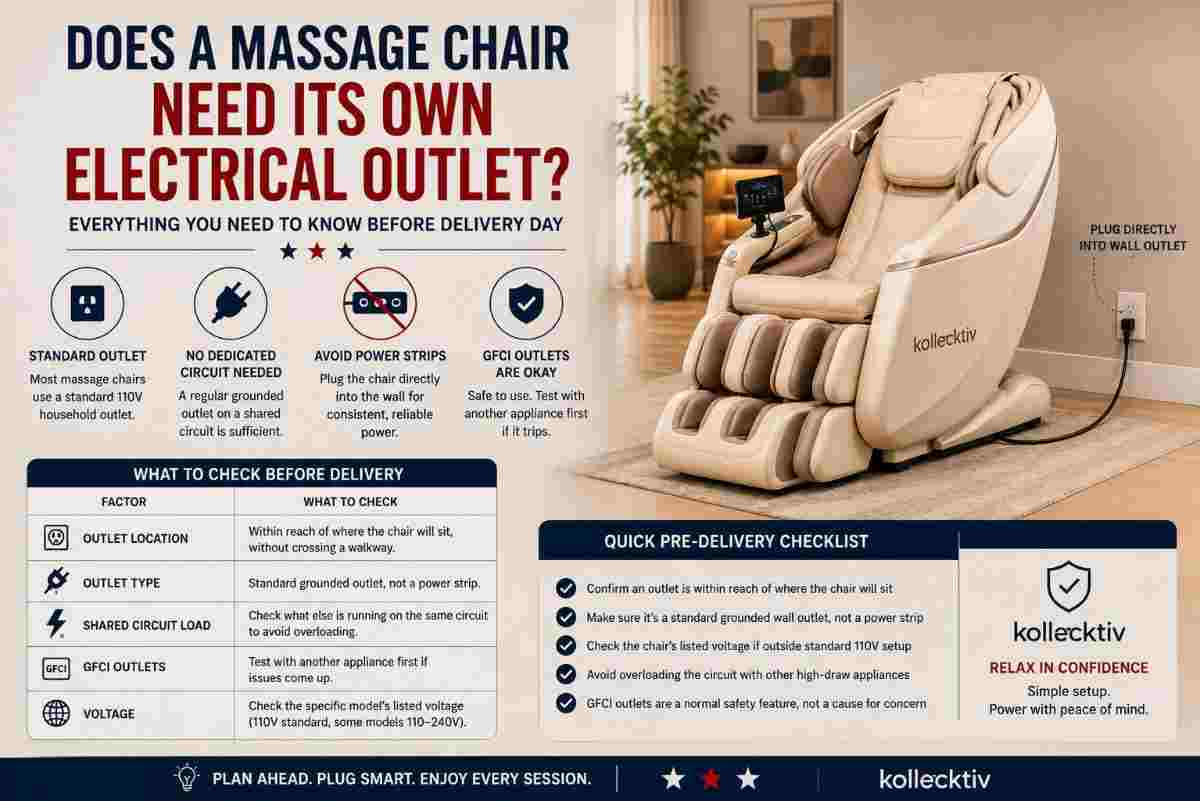
Quick answer: no, most home massage chairs run on a standard household outlet and don’t require a dedicated circuit or professional electrical work. What actually matters is plugging the chair directly into a wall outlet rather than a power strip, making sure an outlet is within reach of where the chair will sit, and knowing your specific model’s voltage before you order if you live outside the standard 110V setup.
A massage chair looks like a serious piece of electrical equipment — it's large, motorized, and clearly doing more than a lamp or a phone charger. That appearance leads a lot of first-time buyers to assume it comes with electrical requirements to match, which isn't actually the case for the vast majority of home models. This piece runs through the most common electrical myths that come up before a purchase, and what's actually true instead.
Myth #1: "I'll Need an Electrician to Install a Special Outlet"
This is probably the single most common assumption, and it's almost always unnecessary. Most home massage chairs, across the full range of price tiers, run on standard 110V household power — the same outlet powering a television, a lamp, or a vacuum cleaner. No dedicated circuit, no specialized outlet, and no electrician visit required for a typical setup.
The reality: A standard grounded wall outlet is sufficient for the overwhelming majority of home massage chairs. The exception worth checking is if you live outside the standard U.S. voltage setup, in which case confirming the specific model's listed voltage range before ordering is worth the extra minute.
Myth #2: "A Massage Chair Draws Too Much Power for a Shared Circuit"
Because massage chairs are large and clearly motorized, it's easy to assume they draw significantly more power than other household appliances. In practice, a massage chair's power draw is comparable to other common large appliances already running on a standard shared circuit without issue.
The reality: A shared household circuit is normally sufficient. The one thing actually worth avoiding is running several other high-draw devices — a space heater or window AC unit, for instance — on the exact same circuit at the exact same time, which is standard circuit management advice for any appliance, not something specific to massage chairs.
Myth #3: "Any Power Source Works, Including a Power Strip"
This myth is technically half-true and half-misleading, which is exactly why it causes real confusion. A massage chair will often power on when plugged into a power strip — but that doesn't mean it's getting consistent, full current the way it would from a direct wall connection.
The reality: Many power strips are built for lower-draw electronics rather than large motorized furniture. Plugging directly into the wall is the more reliable setup, and if a chair ever seems sluggish, resets unexpectedly, or won't power on consistently, checking whether it's on a power strip rather than a wall outlet is one of the first things worth ruling out.
Myth #4: "A GFCI Outlet Will Cause Problems"
GFCI outlets, the ones with visible "test" and "reset" buttons commonly found in bathrooms, basements, and some living rooms, sometimes get treated with suspicion simply because they look different from a standard outlet.
The reality: Most appliances, massage chairs included, work perfectly fine on a GFCI outlet under normal conditions. GFCI outlets are a safety feature designed to cut power quickly if they detect a ground fault — not a sign of incompatibility with larger appliances. If a chair does trip one, testing the same outlet with a different device first is the right way to figure out whether the issue is the outlet or something specific to the chair, rather than assuming GFCI outlets are inherently problematic.
Myth #5: "Bigger, More Feature-Loaded Chairs Have Different Electrical Needs"
It seems logical that a chair with more airbags, a longer track, voice control, and additional motors would need something more robust electrically than a simpler model. This assumption doesn't hold up in practice.
The reality: Across most home massage chair lineups, from entry-level models to flagship options, the underlying electrical setup is essentially the same — a standard outlet, no dedicated circuit required. Whether you're comparing something from the 4D Massage Chair collection or a flagship model from the Full Body Massage Chair range, the electrical requirements don't scale up with feature count the way the myth suggests. Where chairs genuinely differ is in overall size and where the cord exits the unit, which affects cord placement planning more than actual electrical requirements.
Why These Myths Persist
Massage chairs look like they belong in the same category as a stove or a dryer — appliances that genuinely do require dedicated circuits or special outlets. Visually, it's an understandable assumption. Mechanically, though, a massage chair's motors are more comparable to what's found in other common furniture and appliances already running comfortably on standard household power, which is exactly why the special-wiring assumption doesn't actually apply here the way it does for genuinely high-draw appliances.
A Quick Reality Check Before You Buy
If you're specifically comparing models to figure out whether electrical setup should factor into your decision, it generally shouldn't — the Kollecktiv G18 and the Kollecktiv 208, despite being genuinely different chairs in terms of features, share the same basic standard-outlet setup. The same holds true across the broader Massage Chair Collection, which means electrical planning can stay simple regardless of which tier you're shopping in. It's worth spending that planning energy instead on room clearance and placement, and checking current pricing on the massage chair sale page before finalizing a purchase.
FAQ
Do I need a licensed electrician before buying a massage chair? Usually not. A standard grounded household outlet is sufficient for the vast majority of home massage chairs, and a dedicated circuit isn't required for normal use.
Does a more expensive or feature-loaded massage chair need special electrical wiring? No. Electrical requirements generally don't scale with price or feature count — most models across a typical lineup share the same standard-outlet setup, whether entry-level or flagship.
Can I use a power strip with a massage chair safely? It's not recommended. While a chair may technically power on through a power strip, it's more likely to receive consistent, reliable current when plugged directly into a wall outlet.
Will a GFCI outlet cause issues with a massage chair? Not typically. GFCI outlets are a standard safety feature and work fine with most appliances, massage chairs included, under normal conditions.
Does chair size affect how much power it draws? Not meaningfully in most cases. While larger chairs have more components, their overall electrical setup generally remains comparable to smaller models within the same lineup.
Final Thoughts
A massage chair's size and mechanical complexity make it easy to assume it comes with electrical requirements to match, but that assumption doesn't hold up for the vast majority of home models. A standard wall outlet, avoided power strips, and basic circuit awareness cover what's actually needed — freeing up the more meaningful planning energy for room layout and clearance instead of worrying about wiring that was never actually a concern.