Three Households, Three Different Ways of Sharing One Massage Chair
-

- Published Updated
- 74 views
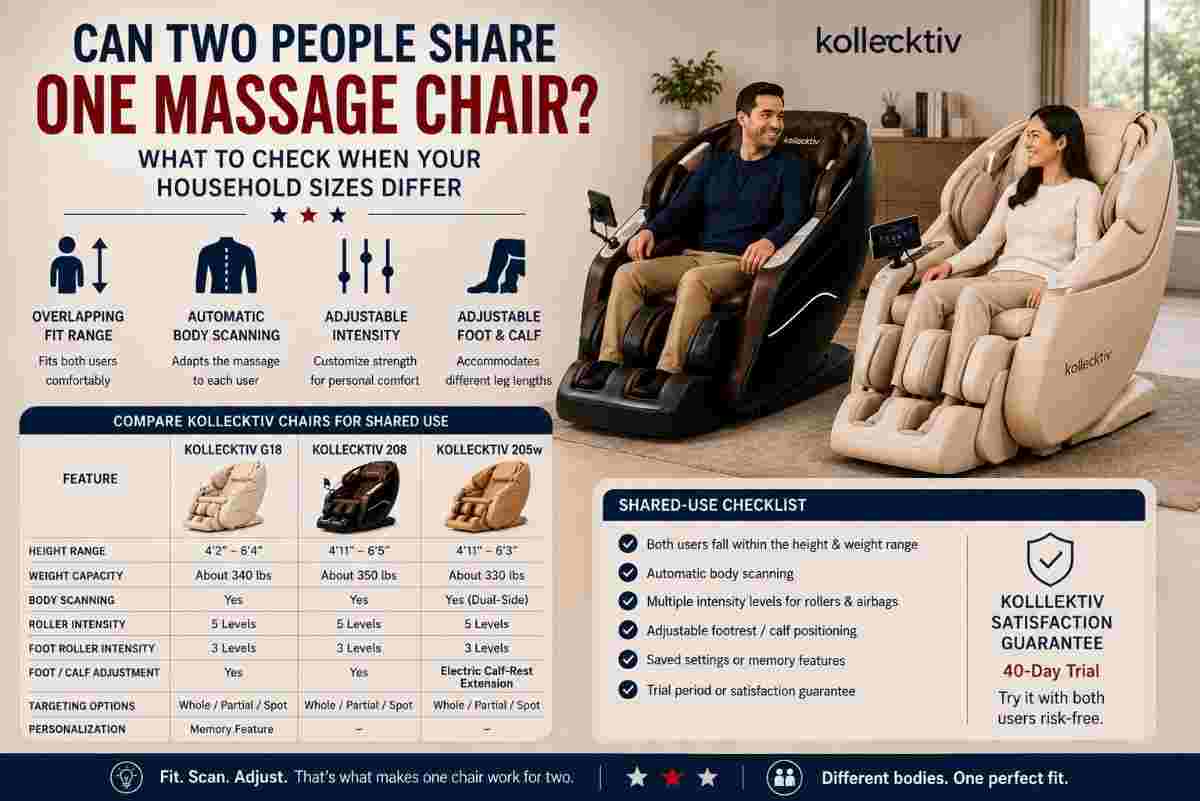
Quick answer: yes, two people can share one massage chair, as long as both of them fall inside the chair’s listed height and weight range and the chair can adapt to each person. Four things decide whether sharing works well: an overlapping fit range, automatic body scanning, adjustable intensity, and adjustable foot and calf positioning. In a shared household, those matter more than how many preset programs the chair offers.
Couples, parents and adult children, and roommates all run into the same problem. One person is 5’1″ and likes a gentle massage, the other is 6’2″ and wants firm pressure. This guide walks through how to check whether one chair can realistically serve both, and where Kollecktiv’s current lineup fits in.
A spec sheet can tell you whether two people technically fit within a chair's height and weight range, but it doesn't tell you what actually happens once the chair is sitting in a shared living room and both people are using it regularly. This piece looks at three realistic household setups and how each one worked through the practical side of sharing a single massage chair, beyond just confirming both people cleared the fit range on paper.
Household One: A Couple With a Significant Height Difference
The situation: One partner at 5'0", the other at 6'3" — a gap wide enough that finding a single chair covering both heights comfortably wasn't guaranteed. Their prior experience with a friend's chair had left the shorter partner feeling like the rollers started too low, landing on the mid-back instead of the shoulders.
What they actually checked: Rather than assuming any "full body" chair would work, they specifically compared minimum height ratings across a few models before deciding. The Kollecktiv G18's 4'2" minimum height gave them meaningfully more margin than chairs starting at 4'11", which mattered directly for the shorter partner's fit.
How it played out day to day: With automatic body scanning running at the start of each session, the chair adjusted roller position for whichever partner sat down without either of them needing to manually reposition anything. The taller partner did note that intensity preference differed noticeably between them, which the chair's adjustable roller levels handled without requiring a second chair.
The takeaway: For a significant height gap specifically, checking the minimum height rating carried more weight in their decision than any other single spec, since that was the number that would have ruled out several other chairs entirely.
Household Two: Adult Roommates With Different Recovery Needs
The situation: Two roommates, similar in height and weight, but with completely different reasons for wanting a massage chair — one dealing with general desk-job shoulder tension, the other managing calf and foot fatigue from a job that involved being on their feet most of the day.
What they actually checked: Since fit range wasn't the concern here, they focused instead on targeting flexibility and lower-body features specifically. The Kollecktiv 208's whole, partial, and spot targeting meant one roommate could run a shoulder-focused session while the other ran a program aimed more at the calves and feet, without either needing a fundamentally different chair.
How it played out day to day: They settled into a rhythm where each roommate largely ran their own preferred targeting setting without much overlap or negotiation needed, since the chair adapted to each session rather than defaulting to one fixed program regardless of who sat down.
The takeaway: When two people share similar body dimensions but different physical needs, targeting flexibility matters more than fit range, which was already a non-issue for this household from the start.
Household Three: Parent and Teenager With a Borderline Height Question
The situation: A parent wanting to share a chair with a teenager who was close to, but potentially below, the minimum height listed on several models they were considering.
What they actually checked: Rather than guessing, they contacted customer support directly to confirm whether their teenager's specific height would work well with the chair they were leaning toward, since manufacturer-listed ranges are the stated fit and borderline cases are worth confirming directly rather than assuming.
How it played out day to day: Once they confirmed fit, they made a point of having their teenager sit in the chair with the footrest properly adjusted at the start of each session, rather than assuming a one-size setting would work automatically for someone near the edge of the chair's stated range.
The takeaway: For anyone near a chair's minimum or maximum listed range, confirming directly rather than assuming saved this household from either buying the wrong chair or unnecessarily ruling one out that would have actually worked fine.
What These Three Households Have in Common
Despite very different starting situations, all three approached the decision the same underlying way: they identified their specific sharing challenge first — height gap, differing physical needs, or a borderline fit question — and let that specific challenge determine which spec actually mattered most, rather than treating every feature on a spec sheet as equally relevant to their situation.
None of them assumed a chair labeled for "full body" or "shared use" would automatically work without checking the specific numbers that applied to their household.
Finding Your Household's Equivalent Question
If you're weighing whether to share a chair, it helps to identify which of these three scenarios is closest to yours:
- A meaningful height or weight gap between users? Prioritize checking the minimum and maximum range directly, the way Household One did, rather than assuming standard ranges will cover both people.
- Similar body dimensions but different physical needs? Prioritize targeting flexibility and specific feature coverage — like calf and foot attention — over fit range, which is likely already settled for you.
- A borderline case, like a younger family member near a chair's stated minimum? Contact customer support directly rather than guessing, since manufacturer-listed ranges are the actual stated fit.
Browsing With Your Specific Scenario in Mind
If your household's situation calls for the widest possible height range, the 4D Massage Chair lineup is worth comparing model by model rather than assuming they're interchangeable. Households specifically dealing with a taller or larger-framed user may want to look at the Full Body Massage Chair range directly. For a broader starting point across price tiers, the Massage Chair Collection covers the full lineup, and it's worth checking current pricing on the massage chair sale page before finalizing a decision either way.
FAQ
How do I know which massage chair spec matters most for my household? Identify your specific sharing challenge first — a height or weight gap, different physical needs despite similar body sizes, or a borderline fit question — and let that determine which spec to prioritize, rather than weighing every feature equally.
What should a couple with a significant height difference check first? The chair's minimum and maximum listed height range specifically, since this single spec can rule out or confirm a chair before any other feature becomes relevant.
What matters more for roommates with similar body sizes but different needs? Targeting flexibility — the ability to run whole-body, partial, or spot-focused sessions — tends to matter more than fit range in this situation, since fit is likely already settled.
What should I do if a family member is near a chair's minimum height requirement? Contact customer support directly to confirm rather than assuming either way, since manufacturer-listed ranges represent the chair's actual stated fit.
Does automatic body scanning solve most shared-use fit concerns? It helps significantly once both users are within the chair's supported range, but it doesn't extend that range — it adjusts positioning within whatever range the chair already supports.
Final Thoughts
Three different households, three different sharing challenges, and three different chairs that ended up being the right fit for each — the common thread wasn't a single "best" chair for sharing, but each household identifying their actual challenge first and letting that guide the decision. Whichever scenario sounds closest to yours is worth using as your own starting point before comparing specific models.