Common Mistakes to Avoid in Medicine Delivery App Development
-

- Published Updated
- 6,334 views
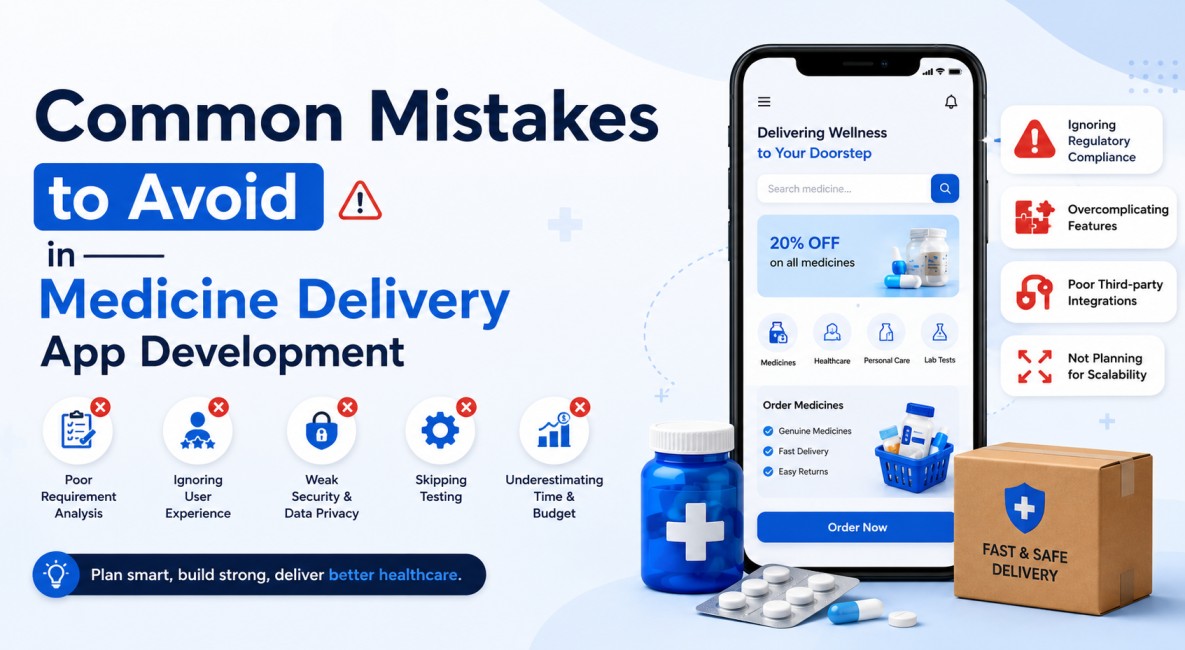
The medicine delivery market is growing fast. More patients are skipping the pharmacy queue and ordering medicines straight to their door. That shift has pushed hundreds of businesses to build medicine delivery apps but not all of them get it right .Healthcare app development is different from building a food delivery or ecommerce app. The stakes are higher. A wrong medicine, a missed order, or a data breach doesn't just hurt your business it affects someone's health.
That's why avoiding the right mistakes from day one matters more in this space than in almost any other. This article breaks down the most common mistakes businesses make when building medicine delivery apps and how to avoid every single one of them.
Understanding Medicine Delivery App Development
A medicine delivery app connects customers with pharmacies and delivers medicines to their doorstep. Simple on the surface — but complex underneath. The core components include a customer app for browsing and ordering, a pharmacy panel for managing stock and fulfilling orders, a delivery management system for logistics, and an admin dashboard for overall control.
What makes this different from regular delivery apps is the layer of compliance and accuracy required. Medicines are regulated products. Prescriptions must be verified. Health data must be protected. Expiry dates must be tracked. Miss any of these and you're not just running a flawed app — you're running a liability.
Top Mistakes to Avoid in Medicine Delivery App Development
Ignoring Regulatory Compliance
Every country has laws around how medicines can be sold and delivered digitally. In India, this includes guidelines from the Central Drugs Standard Control Organisation (CDSCO) and rules under the Drugs and Cosmetics Act.
Ignoring these laws during development is one of the most dangerous mistakes a business can make. It can result in your app being taken down, heavy fines, or worse harm to patients. Compliance must be built into the app architecture from the start — not added as an afterthought before launch.
Weak Prescription Verification System
Certain medicines cannot be sold without a valid prescription. If your app allows customers to bypass prescription checks, you're violating drug laws and putting users at risk.
Common mistakes include accepting blurry or fake prescription images without verification, having no pharmacist review step, and allowing repeat orders on prescription medicines without re-verification.A strong prescription verification flow — with image upload, pharmacist approval, and rejection notifications — is non-negotiable.
Poor Inventory Management
If your app shows a medicine as available but the pharmacy doesn't actually have it in stock, you'll lose the customer — and their trust.Poor inventory management leads to order cancellations, delayed fulfillment, and angry reviews. Real-time stock updates, low-stock alerts, and multi-pharmacy sync are essential features, not optional add-ons.
Inadequate Data Security Measures
Medicine delivery apps collect highly sensitive data — health conditions, prescription history, payment details, and personal addresses. A data breach in a healthcare app is not just a PR problem. It's a legal issue and a genuine harm to users. Encryption of data in transit and at rest, secure authentication, HIPAA or local data protection compliance, and regular security audits are the baseline. Skipping any of these is a serious mistake.
Complicated User Experience (UX/UI)
Your target audience includes elderly patients, people managing chronic conditions, and caregivers — not just tech-savvy millennials.If your app is hard to navigate, has too many steps to place an order, or shows confusing product listings, users will abandon it fast.Simple navigation, clear product search with filters, easy reorder options, and a clean checkout flow directly impact retention and revenue.
Lack of Real-Time Order Tracking
Customers ordering medicines are often doing so urgently. They want to know exactly where their order is. Apps that offer no tracking or only vague status updates like "order processing" frustrate users. Real-time GPS tracking, estimated delivery times, and delivery agent contact details are now expected — not exceptional.
Ignoring Scalability
Your app might work perfectly with 100 users. But what happens when you onboard 10,000? Many businesses build with their current size in mind and forget to plan for growth. The result is system crashes during high-demand periods, slow load times, and failed transactions. A scalable architecture built on cloud infrastructure with the ability to handle traffic spikes must be planned from day one.
Poor Integration with Pharmacies and Logistics
A medicine delivery app is only as good as its integrations. If your app doesn't sync properly with pharmacy management systems, stock data will always be off. If it doesn't connect well with your logistics provider, deliveries will be delayed. Seamless API integration between the app, pharmacy backend, and delivery partners is what makes the whole operation run without manual intervention.
Not Planning Delivery Logistics Properly
Last-mile delivery is where many medicine delivery businesses lose money and customers. Without route optimization, delivery agents take longer routes. Without smart order batching, multiple trips are made for orders that could be combined. Without contingency planning, a single vehicle breakdown causes a cascade of delays. Logistics planning including route optimization tools, delivery zone mapping, and backup systems must be part of your app development plan.
Skipping Testing and Quality Assurance
Launching an untested healthcare app is like opening a pharmacy without inspecting the medicines. Bugs in the prescription upload flow, payment failures at checkout, or crashes during peak hours destroy user trust instantly. And in healthcare, a technical failure can directly impact someone's access to medicine. Thorough QA testing — including functional testing, load testing, security testing, and real-device testing is mandatory before any launch.
Additional Mistakes Businesses Often Overlook
Beyond the big ten, there are quieter mistakes that quietly kill medicine delivery apps.Not defining a clear business model leads to confusion about revenue streams whether you're charging pharmacies, customers, or running on a commission model. Without clarity here, pricing and partnerships fall apart.
Ignoring customer support systems means that when something goes wrong a wrong medicine delivered, a delayed order — there's no reliable channel for customers to resolve it. That one bad experience becomes a one-star review. Lack of analytics and reporting means you're flying blind. You don't know which medicines sell most, which pharmacies underperform, or when your peak hours are. Data drives decisions.
Underestimating development costs leads businesses to cut corners on features, security, or testing — which always costs more to fix later than to build right the first time.
How to Avoid These Mistakes
Avoiding these mistakes starts before a single line of code is written. Define your compliance requirements early and build your legal framework before development begins. Choose a technology stack that supports real-time data, scalability, and secure integrations. Prioritize UX from the first wireframe test with real users before launch. Work with developers who have specific experience in healthcare or pharmacy app development, not just general mobile app development. The right development partner will flag these issues before they become problems not after launch.
Benefits of Avoiding Common Mistakes
When you build your medicine delivery app the right way, the results speak for themselves. Users get a smooth, reliable experience that keeps them coming back. Operations run efficiently with automated inventory, smart logistics, and real-time tracking. Your business stays compliant and builds trust with both customers and pharmacy partners. And as you grow, your app scales without breaking — opening the door to more cities, more pharmacies, and more revenue.
Conclusion
Building a medicine delivery app is a significant investment — and the mistakes covered here are exactly what separates successful platforms from ones that quietly shut down within a year. Regulatory compliance, prescription verification, real-time inventory, data security, and scalable architecture are not optional features. They are the foundation.
Strategic planning, the right technology, and an experienced medicine delivery app development company like Appdrives make all the difference between an app that patients trust and one they delete after the first failed order.