Types of Number Plates in India: Meaning, Rules & Colour Codes
-

- Published Updated
- 8,265 views
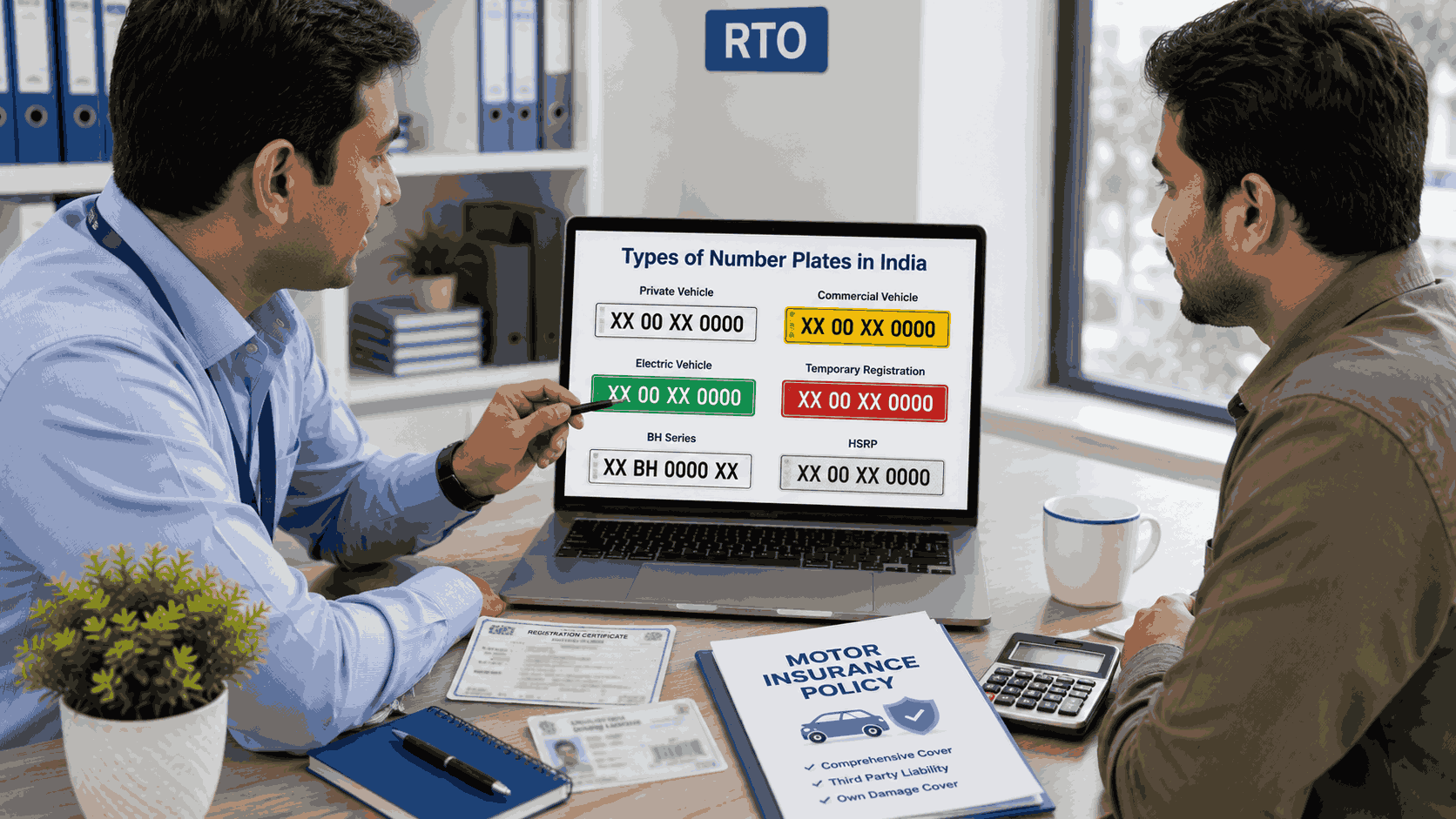
Number plates in India are not just metal plates fixed on the front and rear of a vehicle. They are official registration identifiers issued through the Regional Transport Office, commonly known as the RTO. Every vehicle that runs on Indian roads must have a valid registration number displayed on a number plate. This number helps authorities identify the vehicle owner, registration state, vehicle category and legal status.
Many people notice different colours of number plates on Indian roads, such as white, yellow, green, black, red and blue, but do not always know what they mean. Each colour has a specific purpose. A white number plate is usually for private vehicles, a yellow number plate is for commercial vehicles, a green number plate is for electric vehicles, and a blue number plate is for diplomatic vehicles. There are also special number plates for temporary registration, self-drive rental vehicles, defence vehicles, high-ranking constitutional authorities and Bharat Series registration.
Most top-ranking pages on this topic explain number plate colours, vehicle categories, HSRP rules, BH series plates, EV plates, temporary plates and penalties for incorrect plates. This shows that users searching for “Types of Number Plates in India” want a simple but complete explanation that helps them identify number plates correctly and understand legal requirements.
Square Insurance helps vehicle owners understand motor-related rules, car insurance, bike insurance, registration documents and road compliance in simple language. If you own a car, bike or commercial vehicle, knowing the meaning of number plates in India can help you stay legally aware and avoid confusion during vehicle purchase, insurance renewal or traffic checking.
What is a Number Plate in India?
A number plate in India is an official vehicle registration plate that displays the unique registration number assigned to a vehicle. This registration number is issued by the RTO after the vehicle is registered under the applicable motor vehicle rules. It is mandatory for vehicles to display the number plate clearly on both the front and rear sides.
A standard Indian vehicle registration number usually includes the state code, RTO code, series letters and a unique number. For example, in a regular registration format, the first two letters show the state or Union Territory, the next numbers show the RTO, and the remaining letters and numbers identify the vehicle registration series.
Number plates help traffic police, transport authorities, insurance companies and vehicle owners identify vehicles correctly. They are also useful during challan checking, accident claims, vehicle transfer, theft tracking and insurance verification.
Featured Snippet Answer: How Many Types of Number Plates Are There in India?
There are several types of number plates in India based on vehicle category and usage. The most common types include white number plates for private vehicles, yellow number plates for commercial vehicles, green number plates for electric vehicles, black number plates for self-drive rental vehicles, red number plates for temporary registration, blue number plates for diplomatic vehicles, red plates with India’s emblem for high constitutional authorities, upward arrow plates for military vehicles, BH series plates for transferable vehicle registration and HSRP plates for secure registration identification.
Why Do Number Plates Have Different Colours in India?
Different number plate colours are used to identify the purpose and category of a vehicle. This helps traffic police and transport authorities quickly understand whether a vehicle is private, commercial, electric, diplomatic, temporary, rental or defence-related.
For example, if a car has a white number plate with black letters, it is generally a private vehicle. If it has a yellow number plate with black letters, it is a commercial vehicle such as a taxi, bus, truck or goods carrier. If it has a green number plate, it is an electric vehicle. This colour-based system makes vehicle identification easier on roads.
Number plate colour is not a design choice. Vehicle owners cannot randomly choose a colour for style or appearance. The colour must match the vehicle category and registration type. Using the wrong number plate colour may lead to legal trouble or traffic penalties.
White Number Plate in India
A white number plate with black letters is the most common type of number plate in India. It is used for private vehicles such as personal cars, bikes and scooters. These vehicles are registered for personal use and cannot be used for commercial passenger or goods transport.
If you own a personal car for family use, office travel or daily commuting, your vehicle will generally have a white number plate. Similarly, privately owned two-wheelers also use white plates with black lettering.
White number plates are simple to identify. They show that the vehicle is not registered as a taxi, goods vehicle, commercial bus or rental vehicle. If a private vehicle is used for commercial purposes without proper registration, it may violate transport rules.
Who Can Use a White Number Plate?
A white number plate can be used by common citizens who own vehicles for personal use. It is suitable for private cars, private bikes, scooters and other non-commercial vehicles.
Yellow Number Plate in India
A yellow number plate with black letters is used for commercial vehicles. These include taxis, auto-rickshaws, buses, trucks, goods carriers, school vans, app-based cabs and other vehicles used for business or transport purposes.
Yellow number plates are important because commercial vehicles follow different rules compared to private vehicles. They may require permits, fitness certificates, commercial insurance and drivers with appropriate licence categories, depending on the vehicle type.
If you see a yellow plate on a car, it usually means the car is registered for commercial passenger use, such as taxi service or cab service. If you see a yellow plate on a truck or bus, it means the vehicle is registered for transport or goods movement.
Why Do Commercial Vehicles Have Yellow Plates?
Commercial vehicles have yellow plates so authorities can easily identify vehicles used for business purposes. This helps in checking permits, taxes, fitness certificates, insurance and driver eligibility.
Green Number Plate in India
A green number plate is used for electric vehicles in India. The purpose of green plates is to identify EVs easily and promote clean mobility. Electric cars, electric bikes, electric scooters and electric commercial vehicles may have green plates.
There is an important difference in the lettering colour. Private electric vehicles usually have white letters on a green background, while commercial electric vehicles have yellow letters on a green background. This helps identify whether the EV is private or commercial.
For example, a privately owned electric car may have a green plate with white text. An electric taxi or electric commercial vehicle may have a green plate with yellow text.
Why Are EV Number Plates Green?
Green number plates help authorities and the public identify electric vehicles quickly. They also support government efforts to promote eco-friendly transport and cleaner mobility.
Black Number Plate in India
A black number plate with yellow letters is used for self-drive rental vehicles. These vehicles are usually owned by rental companies and are given to customers for self-drive use.
Black number plates are commonly seen on vehicles used by self-drive rental services. Even though these vehicles are used commercially, the person renting and driving the vehicle may not need a commercial driving licence in the same way a taxi driver would, depending on the applicable category and rental rules.
Private vehicle owners cannot use black plates only for style. A black plate has a specific legal meaning and is generally linked to rental or self-drive vehicle registration.
Where Are Black Number Plates Commonly Seen?
Black number plates are commonly seen on self-drive rental cars, premium rental vehicles and vehicles registered under rental service businesses.
Red Number Plate in India
A red number plate with white letters is usually used for temporary registration. This is commonly seen on new vehicles before permanent registration is completed.
When a new car or bike is purchased, it may receive a temporary registration number for a limited period. After the permanent registration process is completed, the vehicle receives its regular number plate according to its category, such as white for private vehicles or yellow for commercial vehicles.
Temporary registration is not meant for long-term use. Vehicle owners should complete permanent registration within the permitted time to avoid legal issues.
What Does a Red Number Plate Mean?
A red number plate generally means the vehicle has temporary registration and is waiting for permanent registration from the RTO.
Blue Number Plate in India
A blue number plate with white letters is used for vehicles belonging to foreign diplomatic missions, embassies, consulates and international organisations. These plates often contain special codes such as CC for Consular Corps, DC for Diplomatic Corps and UN for United Nations.
Unlike regular Indian number plates, diplomatic plates may not follow the usual state code format. They may include country codes and diplomatic category codes. These vehicles are issued under special rules and are not meant for general public use.
Who Can Use a Blue Number Plate?
Blue number plates are used by foreign diplomats, embassy officials, consular officials and certain international organisation vehicles. Common citizens cannot use blue number plates.
Red Number Plate with India’s Emblem
A red number plate with India’s emblem is used for official vehicles of high constitutional authorities. These may include vehicles used by the President of India, Vice President of India, Governors of states and Lieutenant Governors of Union Territories, depending on protocol and official use.
This type of plate is very different from a regular red temporary number plate. The presence of India’s emblem indicates high official status and constitutional authority.
Is Red Plate with Emblem the Same as Temporary Red Plate?
No. A red temporary number plate is used for newly purchased vehicles awaiting permanent registration. A red plate with India’s emblem is used for high constitutional authorities and has a completely different purpose.
Number Plate with Upward Arrow for Military Vehicles
Military vehicles in India use a special registration format that includes an upward-pointing arrow, also called a broad arrow. These plates are used for defence and military vehicles and do not follow the regular civilian RTO registration format.
Military number plates are managed under defence registration systems. The upward arrow helps identify the vehicle as belonging to the armed forces. These vehicles may have a different registration structure compared to civilian vehicles.
Why Do Military Number Plates Have an Upward Arrow?
The upward arrow is a defence identification mark used on military vehicles. It helps distinguish defence vehicles from regular civilian vehicles.
BH Series Number Plate in India
BH Series, also known as Bharat Series, was introduced to make vehicle registration easier for people who frequently move from one state to another due to transferable jobs. It is especially useful for employees of central government, state government, defence services, public sector organisations and eligible private sector employees whose companies have offices in multiple states or Union Territories.
A BH number plate usually follows a format that includes the year of registration, “BH”, a unique number and letters. For example, a BH series format may look like a year code followed by BH, a four-digit number and alphabet series.
The biggest benefit of BH registration is that eligible vehicle owners do not need to re-register the vehicle every time they move to another state for work. This reduces paperwork and makes interstate vehicle movement easier.
Who Can Apply for BH Series Number Plate?
BH series is mainly meant for eligible vehicle owners with transferable jobs. Eligibility depends on government rules and employment category. Not every vehicle owner can automatically get a BH number plate.
HSRP Number Plate in India
HSRP stands for High-Security Registration Plate. It is a tamper-resistant number plate designed to improve vehicle security and reduce duplication or misuse of number plates. HSRP plates usually include security features such as a chromium-based hologram, laser-etched code, hot-stamped lettering and non-removable snap locks.
HSRP is important because fake or duplicate number plates can be used in theft, fraud or traffic violations. A high-security plate helps authorities identify vehicles more reliably. Many states have made HSRP mandatory for old and new vehicles as per applicable rules and implementation timelines.
Why is HSRP Important?
HSRP helps prevent tampering, duplication and misuse of vehicle registration plates. It also improves vehicle tracking and supports enforcement systems.
Colour-Coded Stickers with HSRP
Along with HSRP, vehicles may also have colour-coded stickers on the windshield. These stickers help identify fuel type such as petrol, diesel, CNG or electric. This can help enforcement agencies identify vehicles quickly, especially in pollution-control and traffic-management situations.
The sticker is not a replacement for the number plate. It is an additional identification feature linked with HSRP and vehicle details.
Fancy Number Plates in India
Many vehicle owners like stylish or VIP-looking number plates, but number plates in India must follow legal rules. The font, size, spacing, colour and format should be as per prescribed standards. Fancy fonts, unreadable letters, decorative designs, extra symbols, stickers, names or incorrect spacing can create problems during traffic checking.
A number plate should be clear, readable and legally compliant. If a number plate is designed only for style and does not follow rules, the vehicle owner may face penalties.
Are Fancy Number Plates Legal?
Fancy number plates are not legal if they violate the prescribed format, font, colour, size or readability rules. Vehicle owners should use standard number plates and HSRP as required.
Common Number Plate Rules in India
Vehicle number plates should be clearly visible and properly fixed on the vehicle. The registration number should be displayed at the front and rear. The letters should be in English and the numbers should be in Arabic numerals. The plate should not be hidden, damaged, tilted, covered or modified.
Commercial vehicles, private vehicles, EVs and special category vehicles must use the correct plate colour. Vehicle owners should not use fake plates, duplicate plates or unauthorised HSRP plates.
If the number plate is broken, faded or damaged, it should be replaced through the proper authorised process. Using a damaged or unreadable plate can create issues during traffic checking, challan generation and insurance claim verification.
Number Plates and Motor Insurance: Why They Matter
A vehicle number plate is directly connected to registration and insurance records. When you buy car insurance or bike insurance, the registration number is used to identify the insured vehicle. If the number plate or registration details are incorrect, it may create confusion during policy issuance, renewal or claim settlement.
For example, if your car insurance policy has the wrong registration number, you should get it corrected as soon as possible. During a claim, the insurer may verify the registration number, chassis number, engine number and policy details. Accurate vehicle details help avoid delays.
Square Insurance helps vehicle owners understand motor insurance, policy renewal, claim documents and vehicle compliance in a simple way. Along with having a valid number plate, vehicle owners should also keep their insurance policy active, especially because third-party motor insurance is mandatory in India.
Common Mistakes Vehicle Owners Make with Number Plates
Many vehicle owners make simple mistakes with number plates. Some use fancy fonts that are difficult to read. Some add stickers, names, symbols or decorative designs. Some continue using temporary plates after the permitted period. Some delay HSRP installation. Some use damaged or faded plates. Some do not update registration details after vehicle transfer.
These mistakes may look small, but they can create legal and practical problems. A clear and correct number plate helps during traffic checks, e-challan verification, accident reporting, insurance claims and vehicle resale.
How to Keep Your Number Plate Compliant
Always use the number plate issued or approved through the authorised process. Make sure the plate is properly fixed, readable and not covered by accessories. Do not change the colour, font or spacing. If your plate is damaged, apply for replacement through the proper channel.
If your vehicle requires HSRP, get it installed through authorised vendors or official channels. Avoid local shops selling fake HSRP-style plates. Counterfeit HSRP plates can create legal trouble and may not be linked to official vehicle records.
Why Understanding Number Plates is Useful Before Buying a Used Vehicle
If you are buying a used vehicle, number plate checking is very important. The plate colour can tell you whether the vehicle is private, commercial, rental or electric. You should match the registration number with the RC, insurance policy, chassis number and engine number.
If a vehicle has a commercial plate but is being sold as a private vehicle, check whether proper conversion and documentation are completed. If a vehicle has a damaged or suspicious plate, verify records before purchase.
A used vehicle buyer should also check pending challans, insurance validity, loan hypothecation, pollution certificate and ownership transfer status.
FAQs on Types of Number Plates in India
What are the main types of number plates in India?
The main types of number plates in India include white, yellow, green, black, red, blue, red with India’s emblem, military plates with upward arrow, BH series plates and HSRP plates.
What does a white number plate mean?
A white number plate with black letters means the vehicle is registered for private or personal use.
What does a yellow number plate mean?
A yellow number plate with black letters means the vehicle is registered for commercial use, such as taxis, buses, trucks or goods carriers.
What does a green number plate mean?
A green number plate means the vehicle is electric. Private EVs usually have white letters on green, while commercial EVs have yellow letters on green.
What does a black number plate mean?
A black number plate with yellow letters is generally used for self-drive rental vehicles.
What does a red number plate mean?
A red number plate with white letters usually means temporary registration for a new vehicle awaiting permanent registration.
What does a blue number plate mean?
A blue number plate with white letters is used for diplomatic vehicles belonging to embassies, consulates and foreign missions.
What is a BH series number plate?
BH series number plate is a Bharat Series registration designed for eligible vehicle owners with transferable jobs, helping them avoid re-registration when moving between states.
What is HSRP number plate?
HSRP stands for High-Security Registration Plate. It is a tamper-resistant number plate with security features such as hologram, laser code and snap locks.
Can I use a fancy number plate in India?
You cannot use a fancy number plate if it violates legal rules related to font, size, colour, spacing or readability.
Is number plate important for insurance?
Yes, the vehicle registration number on the number plate is important for car insurance, bike insurance, policy renewal and claim verification.
Can Square Insurance help with vehicle insurance?
Yes, Square Insurance can help users understand, compare and renew vehicle insurance online so they can stay legally compliant and financially protected.
Conclusion
Number plates in India are official vehicle identification plates with specific colours, formats and rules. Each type of number plate has a clear meaning. White plates are for private vehicles, yellow plates are for commercial vehicles, green plates are for electric vehicles, black plates are for self-drive rental vehicles, red plates are for temporary registration, blue plates are for diplomatic vehicles, and special plates are used for defence vehicles and high constitutional authorities.
Understanding number plates helps vehicle owners stay aware of registration rules, avoid illegal modifications and identify vehicle categories correctly. It is also useful while buying a used vehicle, checking challans, renewing insurance or handling claims.
Along with a valid number plate, every vehicle owner should keep insurance, RC, driving licence and pollution certificate updated. Square Insurance helps vehicle owners understand motor insurance and vehicle-related compliance in a simple and practical way, making road ownership easier and safer.