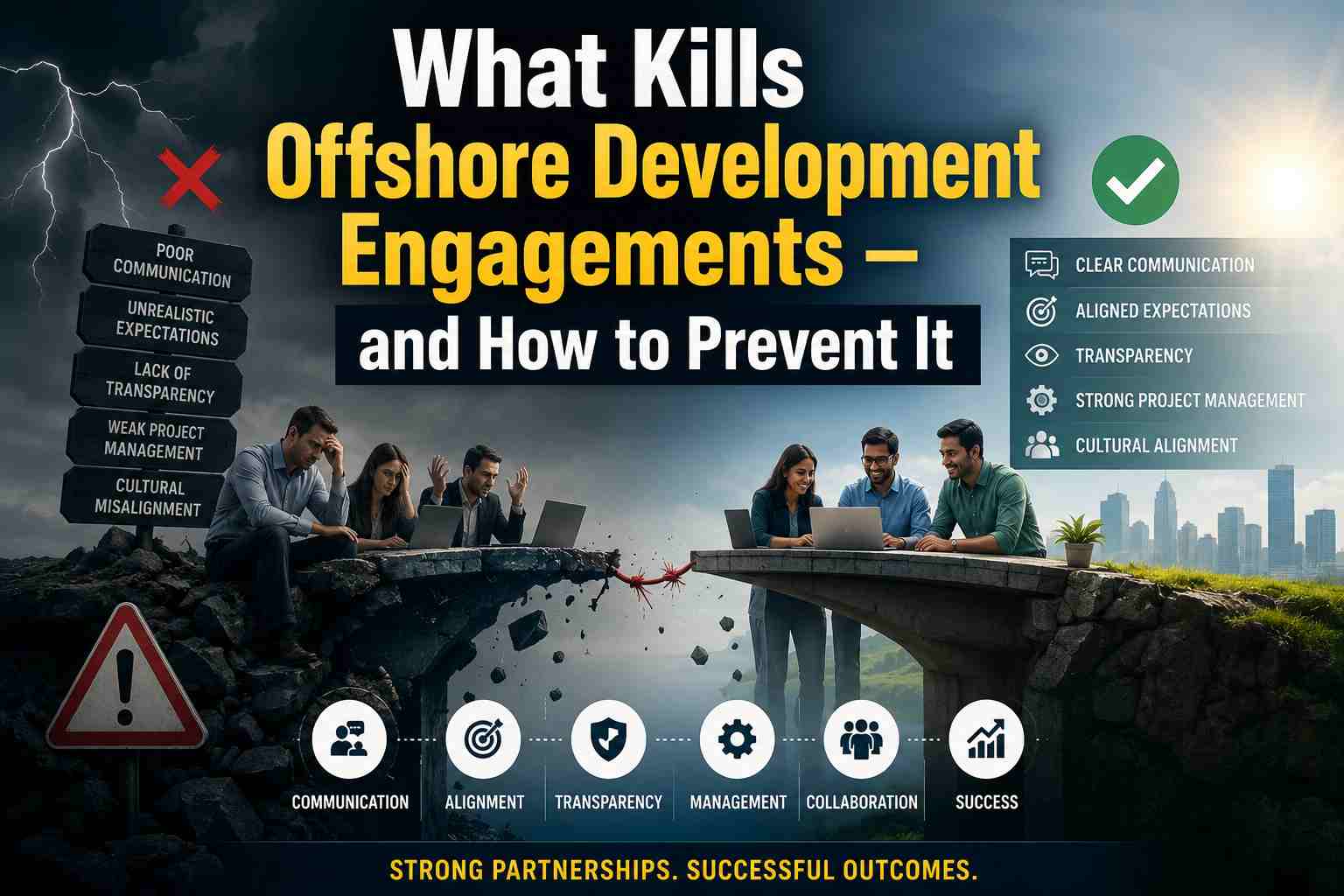
What Kills Offshore Development Engagements — and How to Prevent It
-

- May 28th, 2026
- 4,653 views

FREE SEO Topical Map Generator: Find Your Next Content Ideas
Offshore development has become a cornerstone of enterprise technology strategy. Access to skilled engineers, cost-effective delivery, and the ability to scale without headcount constraints have made it a preferred model for companies at every stage — from Series B startups adding engineering capacity to global enterprises operating multi-geography product teams.
Yet, for every offshore engagement that delivers measurable value, there are several that quietly deteriorate over 18 to 24 months. Deadlines slip. Communication becomes performative. The offshore team operates in a vacuum, disconnected from business context. At some point, an executive asks the uncomfortable question: "Are we actually getting what we paid for?"
The failure rarely arrives suddenly. It accumulates — through small decisions made early, structural oversights that compound, and a fundamental misunderstanding of what makes distributed engineering work in practice. This article examines the most consequential failure modes in offshore development engagements and offers a strategic framework for companies that want to get it right.
The Offshore Development Promise vs. Operational Reality
Research from Deloitte's Global Outsourcing Survey consistently identifies cost reduction as the primary driver behind outsourcing decisions. Yet the same research reveals that a significant proportion of companies renegotiate or exit their IT Outsourcing Company contracts within three years — with misaligned expectations and inadequate relationship management cited as leading causes.
The promise of offshore development is relatively straightforward: access to qualified engineering talent at a fraction of in-market cost, without the overhead of recruitment, benefits administration, and office infrastructure. The reality is more nuanced. Offshore development is not simply a cost arbitrage exercise. It is a distributed organisational capability that requires the same degree of strategic investment as building an in-house team — structured onboarding, defined processes, clear accountability, and ongoing leadership attention.
Companies that treat it as a procurement decision rather than an organisational strategy almost always underperform.
Misaligned Expectations From Day One
The most common and consequential mistake in offshore development is the absence of a shared definition of success before work begins.
The Problem With Vague Statements of Work
A Statement of Work that defines deliverables in broad technical terms — "develop a mobile application," "build and maintain the backend API," "provide three full-stack developers for the product team" — creates a structural ambiguity that will produce friction every time something unexpected happens. And in software development, something unexpected always happens.
When the SOW lacks specificity around quality standards, deployment practices, documentation requirements, response time expectations, and escalation protocols, the offshore team defaults to their own internal standards. Those standards may be perfectly competent, but they may not align with your organisation's requirements, culture, or risk tolerance.
How to Define Success Before the Contract Is Signed
Before any engagement begins, the client and offshore partner should jointly define:
- Acceptance criteria for deliverables, including what "done" means in measurable terms
- Performance benchmarks — cycle time, defect rate, code review turnaround, deployment frequency
- Communication cadences — daily stand-ups, weekly steering calls, monthly business reviews
- Escalation paths — who contacts whom, at what threshold, and within what timeframe
- Review milestones — formal checkpoints where both parties assess engagement health, not just project progress
This is not bureaucratic box-ticking. It is the foundational work that determines whether the engagement will be functional when it faces pressure.
Treating the Offshore Team as a Vendor, Not a Partner
This is perhaps the subtler failure mode, and the one most resistant to process fixes. It is fundamentally a leadership and culture problem.
Many organisations establish offshore development teams with an arm's-length mentality. The offshore team is briefed on tasks, expected to deliver outputs, and rarely included in the broader product or business conversations that give their work meaning and context. Over time, this produces a team that is technically capable but strategically blind — executing instructions without understanding the intent behind them.
The Organisational Distance Problem
Physical distance compounds cultural distance, which compounds cognitive distance. Offshore engineers who never interact with end users, never attend product strategy discussions, and rarely speak to anyone above their immediate project manager have no mechanism for exercising the kind of judgment that separates adequate delivery from excellent delivery.
The highest-performing offshore engagements treat the distributed team as an extension of the core organisation. Engineers attend all-hands meetings. Senior offshore team leads are included in roadmap reviews. There is deliberate investment in mutual understanding — not just task allocation.
This approach requires more management overhead in the early months. It pays disproportionate dividends from month six onward.
Inadequate Knowledge Transfer and Onboarding
When an offshore team begins work on an existing product or codebase, the quality of the knowledge transfer process determines the trajectory of the first six months. Most organisations underestimate what a thorough onboarding looks like.
Handing over a repository access link and a Confluence wiki is not a knowledge transfer. A functioning knowledge transfer includes:
- Structured walkthroughs of the architecture, including documented decision rationale
- Introduction to the domain — not just the technology
- Access to historical context: why certain decisions were made, what was tried and discarded, what constraints exist for non-technical reasons
- Direct time with in-house engineers who hold institutional knowledge
- A ramp-up period with explicit checkpoints before full ownership is transferred
Organisations that compress or skip this process create a dependency on tribal knowledge that the offshore team cannot access. The result is a team that is technically qualified but operating with incomplete information — and making decisions accordingly.
Communication Structures That Break Down Under Scale
An offshore engagement with two developers and a project manager can function on Slack messages and weekly check-ins. An engagement with twelve engineers, three product streams, and two geographic locations cannot. Yet many organisations fail to evolve their communication infrastructure as the engagement grows.
The symptoms are recognisable: duplicate work caused by misaligned understanding, decisions made in isolation by team members who lacked the context to know they needed alignment, feedback loops that take days instead of hours, and a general sense that the offshore team and the in-house team are operating on parallel tracks that rarely intersect.
Effective communication at scale requires deliberate structure:
- Designated points of contact on both sides with defined authority levels
- Asynchronous communication protocols that do not assume everyone is available simultaneously
- Documentation standards that capture decisions, not just outcomes
- Regular retrospectives that address process friction, not just delivery metrics
A useful test: if your offshore team lead left tomorrow, how long would it take to bring their replacement up to speed using only documented information? The answer to that question tells you the health of your communication infrastructure.
Governance That Exists on Paper but Not in Practice
Most offshore contracts include governance provisions: SLAs, review periods, escalation protocols, and termination clauses. Most of those provisions are never operationalised.
Governance is frequently confused with administration. Scheduling a monthly review call is not governance. Governance is the systematic process of evaluating engagement health against predefined criteria, identifying deviations early, and taking corrective action before problems become structural.
High-functioning engagements maintain a joint governance structure that includes:
- A defined set of engagement health metrics reviewed at regular intervals
- A formal mechanism for either party to raise concerns without fear of damaging the relationship
- Documented decisions from steering meetings with agreed follow-up actions
- Periodic third-party or senior-level reviews that provide an independent perspective
The absence of real governance does not typically cause immediate visible failure. What it does is allow problems to accumulate beneath the surface until they become too large to quietly fix.
What High-Performing Offshore Engagements Actually Look Like
The characteristics that distinguish successful offshore development engagements from mediocre ones are remarkably consistent across industries, company sizes, and geographies.
They invest heavily in the relationship before they invest in the work. The first three months are treated as foundational — establishing processes, building mutual understanding, and validating assumptions — rather than as a delivery sprint.
They measure engagement health, not just project metrics. Beyond velocity and defect counts, they track team satisfaction, voluntary attrition within the offshore team, and qualitative feedback from both sides.
They give offshore team leads genuine authority. The offshore lead is not a relay station for instructions. They participate in architectural decisions, flag concerns proactively, and are trusted to manage their team's composition and development.
They plan for evolution. The SOW and governance model that works for a team of four is not the same one that works for a team of fifteen. High-performing clients revisit and revise their engagement model at defined intervals.
They maintain executive sponsorship. Someone at C-suite or VP level maintains direct familiarity with the offshore engagement — not to manage its day-to-day operation, but to ensure it receives appropriate organisational support and remains aligned with strategic priorities.
Practical Recommendations for Executives
For CEOs, CTOs, and operations leaders evaluating or managing offshore development engagements, the following actions are the highest-leverage investments:
- Conduct an engagement health audit before any renewal or expansion decision. Assess communication quality, knowledge documentation, governance cadence, and team satisfaction — not just delivery metrics.
- Establish a shared definition of success at the engagement level, separate from individual project deliverables. Ask: what does a high-functioning engagement look like in 12 months, and how will we know if we are on track?
- Invest in your offshore team lead as a strategic role. Provide them with business context, include them in relevant strategic conversations, and ensure their development is treated as a priority.
- Formalise your governance model. If you do not currently have a documented governance framework — with defined metrics, review cadences, and escalation protocols — implement one now. Do not wait for a problem to create the incentive.
- Audit your knowledge infrastructure. Test your documentation by asking: could a competent new hire become productive using only what is written down? If the answer is no, the gap is a risk.
- Reframe the relationship internally. The language your organisation uses about its offshore team shapes how your in-house team interacts with them. "Offshore partner" produces different behaviour than "offshore vendor." The distinction matters.
Conclusion
Offshore development engagements do not fail because offshore engineers are inadequate, or because the concept is flawed, or because the cultural distance is too great to bridge. They fail because organisations deploy a sophisticated organisational capability using unsophisticated management practices.
The companies that build durable, high-performing offshore engineering operations do so by treating distributed team management as a core leadership competency — worthy of the same rigour, investment, and executive attention as any other critical business function. The failure modes described in this article are not inevitable. They are predictable, and they are preventable.
For any executive currently evaluating an offshore partnership, or managing one that has begun to drift, the questions worth asking are not technical. They are strategic: Do we have shared clarity on what success looks like? Have we built the governance mechanisms to catch problems early? Are we treating this team as part of our organisation, or apart from it?
The answers to those questions will determine more about your offshore engagement's outcome than any RFP, rate card, or contract clause.
FAQ SECTION
Q1: What is the most common reason offshore development engagements fail?
The most frequently cited cause is misaligned expectations — specifically, the absence of a shared definition of success between the client organisation and the offshore partner before work begins. When deliverable standards, quality benchmarks, and communication expectations are not explicitly documented, ambiguity compounds over time and erodes the engagement from the inside.
Q2: How do you measure the health of an offshore development engagement?
Beyond standard project metrics like velocity and defect rates, a healthy engagement should be evaluated on team stability (voluntary attrition within the offshore team), communication quality, documentation completeness, governance cadence adherence, and mutual satisfaction scores from both the client and offshore team perspectives.
Q3: Is offshore development suitable for early-stage startups?
It can be, but early-stage companies face a specific challenge: they often lack the internal processes and documentation necessary to onboard and manage an offshore team effectively. The risk is not the offshore model itself, but the absence of the organisational infrastructure needed to make it work. Startups that succeed with offshore development typically pair it with strong in-house technical leadership and invest disproportionately in the initial knowledge transfer.
Q4: How do you protect intellectual property when working with an offshore development team?
IP protection in offshore engagements rests on three foundations: contractual provisions (work-for-hire clauses, NDAs, IP assignment agreements governed by relevant jurisdictions), access controls (limiting exposure of sensitive systems to need-to-know roles), and operational practices (code ownership policies, regular access reviews, and offboarding procedures). The contractual layer is necessary but not sufficient — operational controls are equally important.
Q5: What is the difference between staff augmentation and a dedicated development team model?
In a staff augmentation model, individual engineers are embedded within the client's existing team structure, reporting into the client's management hierarchy. In a dedicated team model, a complete team — including a team lead and potentially a project manager — operates as a semi-autonomous unit, typically with its own internal management structure. The right choice depends on the client's internal engineering capacity, management bandwidth, and the nature of the work.