Is Fiat Payment Friction Finally Resolved in P2P Crypto Exchanges?
-

- April 20th, 2026
- 8,025 views
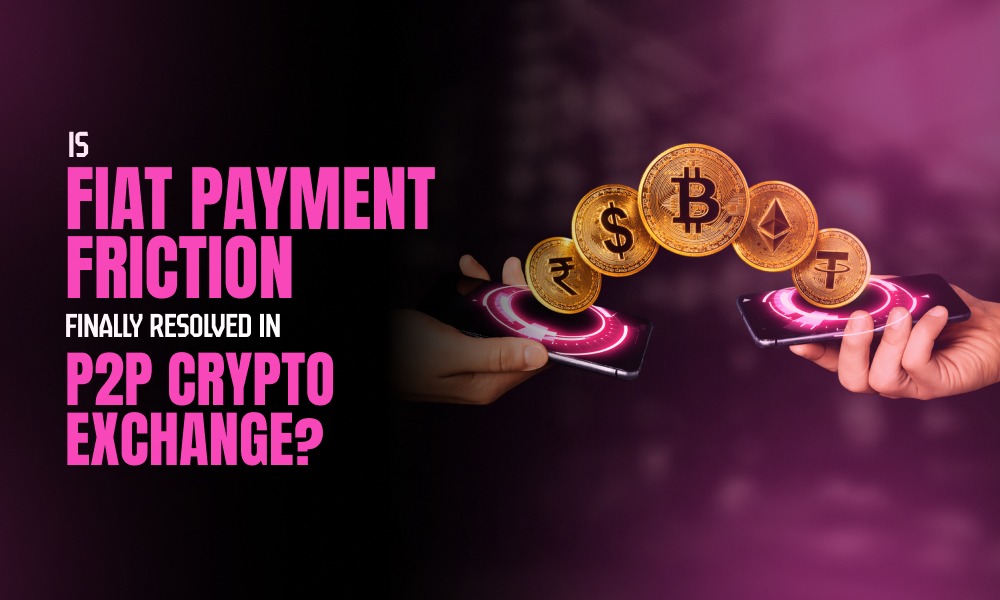
If you’ve ever bought crypto on a P2P exchange, it probably seemed simple at first. But delays, bank issues, and trust concerns often made it complicated.
That’s what “fiat payment friction” is. Small but frustrating problems when regular money meets P2P crypto trading.
Things are improving in 2026, but is the problem fully solved or just better managed?
Let’s take a closer look.
Understanding Fiat Payment Friction in P2P Crypto Exchanges
So when we talk about fiat payment problems, we are referring to the trouble that arises when money moves from a bank to a place where people buy and sell crypto.
In places where people trade on a P2P crypto exchange, fiat payment problems usually happen when someone wants to use their bank or something like UPI to buy or sell crypto.
It seems like a simple idea. One person pays with money, and the other person gives them crypto. It does not always work that way. There are issues with people not trusting each other, with timing, and ensuring the payment is real. This is where things start to get really complicated, with payment problems and crypto.
Why Fiat Payment Friction Became a Major Challenge?
This problem grew as more people began using P2P platforms, especially in markets where crypto banking rules are unclear or strict.
A few key reasons made it worse:
- Payments don’t always settle instantly across banks
- Buyers and sellers don’t know each other
- Fake payment proofs and disputes became common
- Banks sometimes flag or block related transactions
As usage increased, these small issues began to affect user confidence and platform reliability.
Is Fiat Payment Friction in P2P Crypto Exchanges Finally Solved?
By 2026, fiat payment issues with P2P crypto exchanges will have improved a lot, but they are not yet fully resolved.
Most platforms now use better systems that make transactions faster and safer. Instead of waiting 1–2 days, many payments now settle almost instantly using tools like UPI, local bank transfers, and digital wallets. Stablecoins like USDT and USDC are also widely used, helping avoid price changes during transactions.
New technology has also helped. Platforms use smarter systems to spot fraud, reduce disputes, and automate checks when something looks suspicious. This has made the process more reliable than before.
At the same time, some problems remain. In certain regions, banks may still flag crypto-related transfers. There is also a small risk of disputes or account restrictions depending on local rules.
So, while P2P payment friction is much lower today, it is not completely solved; it has just become easier and more controlled.
How Infrastructure and Technology Are Reducing Payment Friction in P2P Crypto Exchange
P2P crypto exchanges have come a long way in recent years, mainly due to stronger security, quicker processing, and higher automation. What was once slow, manual, and often uncertain is now more organised and efficient.
Here’s how technology is helping reduce payment friction in real terms:
Escrow system for safer trades
One of the biggest upgrades is escrow protection. When a trade begins, the crypto is locked in a secure system and only released after the seller confirms the fiat payment. This reduces the risk of fraud, fake payment screenshots, and incomplete transactions. It also builds trust between users who don’t know each other.
Automation replacing manual checks
Earlier, many steps depended on manual verification, which caused delays. Now, most platforms use automated workflows to match buyers and sellers, track payments, and confirm transactions. This reduces waiting time and makes the entire process smoother.
Better platform through modern development
Today’s platforms are built using advanced P2P crypto exchange development practices. This includes real-time transaction tracking, intelligent matching systems, and automated dispute handling. These improvements help reduce human error and improve transaction speed.
Faster payment confirmation systems
Payment verification has become much quicker. Instead of waiting for manual approval, systems now detect and confirm payments automatically using banking APIs and real-time alerts. This helps users complete trades within minutes instead of hours.
Stronger fraud detection and monitoring
Modern platforms now track user behavior and transaction patterns. If something looks unusual, like repeated disputes or suspicious payment activity, the system flags it immediately. This helps prevent fraud before it affects other users.
Integration with local payment methods
One of the most important improvements is support for local payment systems. Methods like UPI, instant bank transfers, and mobile wallets make it easier for users to pay in their own region. This reduces dependency on slower or cross-border banking systems.
Stablecoin usage for smoother value transfer
Stablecoins like USDT help reduce transaction risk. Since their value does not fluctuate like Bitcoin or other volatile assets, users don’t lose value while payments are being processed. This makes the trading experience more predictable.
Improved user confidence and fewer disputes
With better systems in place, the number of failed transactions and disputes has reduced. Users now feel more confident because the platform provides clearer proof, faster resolution, and stronger safeguards.
Conclusion
P2P crypto exchanges are no longer what they used to be.
Much of the early friction around payments has reduced. But it hasn’t completely disappeared.
What’s clear? The direction of progress.
The experience is far more stable now, and most users don’t face the same level of friction they did earlier.
A big part of this progress comes from stronger backend systems built by providers like Hashcodex, who have helped exchanges improve stability, speed, and overall transaction flow.
So instead of asking whether the problem is fully solved, it’s more accurate to say it has been largely managed but is still changing.