D-PSC-DY-01 Replaces D-PSC-DY-23: What Changed in the New Dell PowerScale Deploy Exam?
-

- Published Updated
- 1,512 views
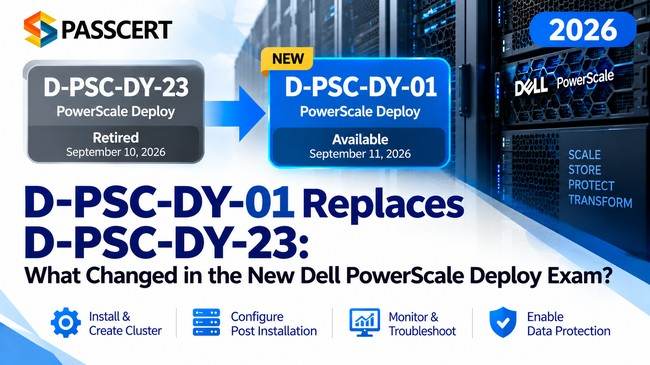
Dell has officially updated its PowerScale Deploy exam for 2026. The previous D-PSC-DY-23 Dell PowerScale Deploy exam retired on September 10, 2026, and its updated replacement, D-PSC-DY-01 PowerScale Deploy, became available on September 11, 2026. Candidates can no longer schedule or take D-PSC-DY-23 and should now prepare for the new D-PSC-DY-01 exam.
This is more than an exam-code change. Dell has reorganized the PowerScale Deploy blueprint around four major areas, with a particularly strong emphasis on post-installation cluster configuration. For storage professionals planning to validate their PowerScale deployment skills in late 2026 and beyond, understanding these changes is important before starting exam preparation.

Why Did D-PSC-DY-01 Replace D-PSC-DY-23?
The retired D-PSC-DY-23 exam focused on implementing PowerScale scale-out storage solutions and covered a broad range of PowerScale and OneFS concepts. Its blueprint was divided into eight areas, including NAS and OneFS fundamentals, access configuration, identity management, client access, data protection, data services, storage pools, and monitoring.
Dell describes D-PSC-DY-01 as the updated version of D-PSC-DY-23. The new exam maintains the core PowerScale deployment focus but reorganizes the objectives around the actual deployment lifecycle: installing nodes, creating and configuring clusters, managing the environment after installation, monitoring and troubleshooting, and enabling data protection.
For candidates, this means older D-PSC-DY-23 study plans should not simply be reused without checking the new blueprint.
What Is the New D-PSC-DY-01 PowerScale Deploy Exam?
The D-PSC-DY-01 Dell PowerScale Deploy exam validates the skills required to deploy, configure, monitor, and maintain Dell PowerScale storage environments.
According to Dell, candidates should understand IT infrastructure, networking, storage and NAS fundamentals as well as PowerScale and the OneFS operating system. The exam then applies that foundation to practical deployment activities such as cluster creation and expansion, OneFS upgrades, SmartConnect and network configuration, SMB and NFS protocol management, authentication providers, access zones, software modules, monitoring, troubleshooting, and data protection.
Dell identifies the target audience as Implementation Specialists, Solution Architects, Storage Administrators, and Technical Support Engineers. The exam is currently available in English and French.
D-PSC-DY-23 vs D-PSC-DY-01: What Has Changed?
The biggest change is visible in how Dell structures the exam objectives.
D-PSC-DY-23 distributed its blueprint across eight separate knowledge areas. For example, NAS, PowerScale and OneFS represented 13%, access foundations 17%, identity management and authorization 10%, client access 13%, data protection and layout 12%, data services 15%, storage pools 13%, and monitoring tools 7%.
D-PSC-DY-01 simplifies this structure into just four major domains:
| D-PSC-DY-01 Exam Domain | Weight |
|---|---|
| Install Nodes and Create Cluster | 14% |
| Configure Cluster and Nodes Post Installation | 62% |
| Monitor and Troubleshoot Cluster Environment | 12% |
| Enable Data Protection | 12% |
The standout number is 62% for Configure Cluster and Nodes Post Installation.
This suggests a much clearer preparation priority. Instead of treating a large number of PowerScale features as relatively separate topics, candidates now need to understand how those technologies fit into the deployment and post-installation configuration of a PowerScale environment.
In other words, the new blueprint is organized more directly around what a PowerScale deployment professional needs to do.
What Does D-PSC-DY-01 Test?
The first domain, Install Nodes and Create Cluster (14%), covers backend and frontend cabling, PowerScale cluster creation, and node removal, reformatting, and reimaging.
The dominant Configure Cluster and Nodes Post Installation (62%) domain covers cluster configuration, OneFS upgrades and updates, SmartConnect across multiple network subnets, protocol settings, software modules, authentication providers, and access zones. Because nearly two-thirds of the blueprint falls into this area, it should receive significant attention during preparation.
Monitor and Troubleshoot Cluster Environment (12%) focuses on system monitoring and performance optimization, InsightIQ, cluster health checks, events and alerts, basic troubleshooting, and Job Engine considerations.
Finally, Enable Data Protection (12%) evaluates the ability to configure data protection as well as antivirus solutions using CAVA/ICAP.
Which PowerScale Technologies Should Candidates Know?
Although the new blueprint is more compact, candidates still need knowledge across a broad PowerScale ecosystem.
Important areas include OneFS, SmartConnect, SMB, NFS, authentication providers, access zones, SnapshotIQ, SyncIQ, SmartLock, quotas, deduplication, InsightIQ, cluster health monitoring, networking, data protection, and antivirus integration. Dell specifically highlights many of these technologies in its current D-PSC-DY-01 certification overview.
Candidates should therefore avoid preparing for each technology only as an isolated definition. It is more useful to understand where a feature appears during deployment, why it is configured, and how it affects the operation of a PowerScale cluster.
How Should Candidates Prepare for D-PSC-DY-01?
Candidates moving from D-PSC-DY-23 preparation to D-PSC-DY-01 should begin with the new blueprint rather than assuming the two exams are identical.
A practical preparation strategy is to first build a solid understanding of PowerScale and OneFS fundamentals, then spend substantial study time on post-installation configuration. Practice configuring clusters, SmartConnect, protocols, authentication providers, access zones, software modules, and OneFS updates. After that, review monitoring, troubleshooting, performance optimization, and data protection scenarios.
Hands-on experience is particularly useful because the current objectives repeatedly use action-oriented skills such as create, configure, perform, install, monitor, optimize, and troubleshoot. D-PSC-DY-01 Practice tests can then be used alongside Dell training and hands-on work to check whether those concepts can be applied to exam-style scenarios.
D-PSC-DY-01 or D-PSC-DS-01: Which PowerScale Exam Matches Your Role?
Candidates exploring the current Dell PowerScale certification path may also encounter D-PSC-DS-01 PowerScale Design. Although both exams involve PowerScale technologies, they validate different skill sets.
D-PSC-DY-01 PowerScale Deploy is centered on implementation. It focuses on installing, configuring, monitoring, troubleshooting, maintaining, and protecting PowerScale environments.
D-PSC-DS-01 PowerScale Design, by comparison, focuses on architecting PowerScale solutions. Dell describes it as validating the ability to translate customer requirements into scalable PowerScale configurations, including considerations around architecture, performance, networking, data protection, sizing, and workload requirements.
A simple distinction is:
D-PSC-DY-01 → Deploy and configure the PowerScale environment
D-PSC-DS-01 → Design the PowerScale solution
This distinction can help candidates choose the exam that better aligns with their current responsibilities or PowerScale career path.
What Should D-PSC-DY-23 Candidates Do Now?
As of September 2026, the transition is complete. D-PSC-DY-23 retired on September 10, and Dell required all scheduling and exam delivery for the old version to be completed before that retirement date. The updated D-PSC-DY-01 exam became available on September 11.
Candidates beginning their PowerScale Deploy preparation should therefore use D-PSC-DY-01 as the current exam code and make sure their training materials, practice tests, and study plans align with its four-domain blueprint.
The transition from D-PSC-DY-23 to D-PSC-DY-01 also gives candidates a clearer picture of Dell's current expectations for PowerScale deployment professionals. With 62% of the new exam devoted to post-installation cluster and node configuration, successful preparation should focus heavily on practical PowerScale configuration rather than relying only on broad product knowledge.