Inside The RAM And Storage Crisis: How AI Is Squeezing Supply
-

- September 01st, 2026
- 1,763 views
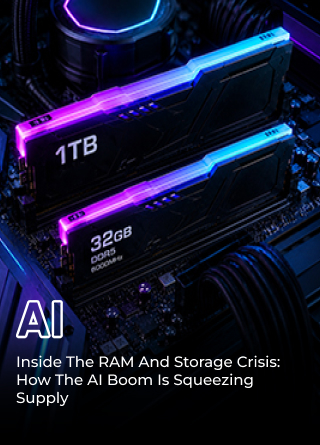
Artificial intelligence has quickly become one of the biggest drivers of technological innovation, transforming everything from business operations to consumer applications. However, behind the rapid growth of AI lies an unexpected challenge that is affecting the entire electronics industry—a growing shortage of memory and storage components. While most people associate AI with powerful chatbots or intelligent automation, the infrastructure required to support these technologies depends on enormous amounts of advanced memory and storage.
As technology companies race to develop larger AI models and expand cloud computing services, demand for high-performance memory has reached unprecedented levels. This surge is forcing semiconductor manufacturers to shift production toward premium AI hardware, leaving fewer resources available for traditional consumer electronics. The result is a global supply imbalance that is increasing costs for laptops, smartphones, gaming systems, enterprise hardware, and storage devices.
Unlike temporary shortages caused by seasonal demand, this challenge is rooted in long-term infrastructure investments. Building semiconductor manufacturing facilities requires billions of dollars and several years of construction, making it impossible for suppliers to rapidly increase production. Until additional capacity comes online, businesses and consumers alike will continue to experience higher prices and limited availability across multiple technology categories.
Why AI Is Driving Unprecedented Memory Demand
Artificial intelligence workloads are unlike traditional computing tasks. Training large language models, processing massive datasets, and running AI-powered applications require enormous volumes of high-speed memory capable of transferring data almost instantly between processors.
This has significantly increased demand for technologies such as High-Bandwidth Memory (HBM), DRAM, and NAND flash storage. HBM has become particularly valuable because it delivers far greater bandwidth than conventional memory while occupying less physical space. As AI accelerators become more powerful, manufacturers are producing more HBM than ever before to satisfy cloud providers and AI infrastructure companies.
The challenge is that semiconductor production resources are limited. Companies cannot simply manufacture unlimited quantities of every memory type simultaneously. Production lines, packaging facilities, engineering expertise, and fabrication capacity are shared across multiple product categories. As more resources are allocated to premium AI memory, fewer remain available for consumer-grade components.
This does not necessarily mean AI companies are buying the same RAM sticks used in gaming computers. Instead, manufacturers are prioritizing products that generate higher profits, gradually reducing the supply available for mainstream electronics.
How Semiconductor Manufacturing Creates Supply Constraints
Memory chips require highly specialized fabrication plants that are among the most expensive manufacturing facilities in the world. Constructing a new semiconductor fab can cost tens of billions of dollars while taking several years before commercial production begins.
Even after construction is complete, manufacturers must install equipment, calibrate production lines, test quality standards, and gradually increase output before the facility reaches full efficiency.
Because of these lengthy timelines, chipmakers cannot respond quickly to sudden increases in demand. By the time additional production capacity becomes available, market conditions may have changed entirely.
The rapid growth of AI has therefore outpaced the industry's ability to manufacture sufficient memory chips, creating a supply-demand imbalance that continues to push prices upward.
Why Consumer Electronics Are Feeling The Pressure
Although AI infrastructure receives most of the available memory, the consequences extend far beyond data centers.
Laptop manufacturers rely on DRAM for system memory and NAND flash for storage. Smartphone companies require the same components to build modern devices with larger storage capacities and improved performance. Tablet makers, gaming console manufacturers, networking equipment providers, and automotive companies all compete for similar semiconductor resources.
When memory prices rise, manufacturers have limited options. They may absorb higher production costs, reduce profit margins, increase retail prices, or release devices with lower memory configurations.
As a result, consumers eventually pay more for products that may appear unrelated to artificial intelligence.
The shortage has also affected external storage devices, including SSDs, USB flash drives, portable storage, and microSD cards, all of which rely heavily on NAND flash memory.
Industries Facing The Greatest Impact
The effects of the memory shortage are spreading across nearly every technology sector.
Personal computer manufacturers continue to face rising production costs as RAM becomes increasingly expensive. DIY computer builders have also experienced dramatic increases in memory prices, making system upgrades significantly more costly than in previous years.
Smartphone manufacturers are encountering similar challenges because modern mobile devices depend on larger amounts of DRAM and NAND storage to support advanced cameras, AI-powered features, and multitasking capabilities.
Gaming companies are also affected since consoles require high-performance memory for graphics processing and game loading. Television manufacturers, smart-home device producers, networking companies, and cloud service providers all depend on reliable supplies of memory and storage.
Even automotive manufacturers are experiencing pressure because modern vehicles increasingly rely on advanced computing systems, infotainment platforms, driver assistance technologies, and connected services that require substantial semiconductor resources.
Rising Hardware Prices Across The Market
The shortage has translated directly into higher prices across numerous product categories.
Consumers shopping for RAM modules have noticed significant price increases compared to previous years. Solid-state drives have become considerably more expensive as NAND flash supplies remain constrained.
Laptop manufacturers are gradually passing higher component costs on to buyers through increased retail pricing, while smartphone makers are making similar adjustments across multiple product segments.
Streaming devices, smart speakers, wireless routers, e-readers, and other connected products have also become more expensive due to rising memory costs.
Businesses purchasing enterprise servers and storage systems face even larger increases because AI infrastructure competes directly for many of the same premium memory technologies.
These pricing trends demonstrate that the memory shortage is not limited to a single market but has become a global technology issue affecting both consumers and organizations.
Why Supply Cannot Recover Quickly
Many people assume semiconductor manufacturers can simply produce more chips to solve the shortage. Unfortunately, the reality is far more complicated.
Memory production involves highly advanced manufacturing processes requiring specialized equipment that often has long delivery times. Expanding production also requires skilled engineers, reliable supply chains, raw materials, and extensive testing procedures.
Even when companies announce multi-billion-dollar investments in new fabrication facilities, meaningful production increases may not appear for several years.
Meanwhile, AI adoption continues to accelerate as more businesses integrate intelligent applications into daily operations. Cloud providers continue expanding data centers, while AI developers build increasingly sophisticated models requiring larger amounts of memory.
This combination of growing demand and slow production expansion makes the current shortage particularly difficult to resolve.
The Future Of The Global Memory Market
Industry experts believe memory demand will remain strong for the foreseeable future. Artificial intelligence continues expanding into healthcare, finance, manufacturing, education, retail, cybersecurity, and countless other industries, each requiring additional computing infrastructure.
Major semiconductor companies are investing heavily in expanding manufacturing capacity, but those projects represent long-term solutions rather than immediate fixes.
Even after new production facilities become operational, demand may continue growing rapidly enough to keep memory prices elevated. Long-term supply agreements between manufacturers and major cloud providers could further limit the availability of components for consumer markets.
This suggests that memory will remain one of the semiconductor industry's most valuable resources as AI adoption continues worldwide.
Conclusion
Artificial intelligence is reshaping far more than software development—it is fundamentally changing the economics of semiconductor manufacturing. As demand for advanced memory and storage continues to surge, manufacturers are prioritizing AI infrastructure over traditional consumer hardware, creating widespread supply constraints across the technology industry.
The effects are already visible through rising prices for computers, smartphones, SSDs, gaming hardware, and countless connected devices. While chipmakers are investing billions to expand production, new facilities require years to become fully operational, meaning supply will not improve overnight.
Until manufacturing capacity catches up with AI-driven demand, businesses and consumers should prepare for continued pressure on memory and storage availability. What began as an AI infrastructure challenge has evolved into a global technology issue that will shape hardware markets for years to come.