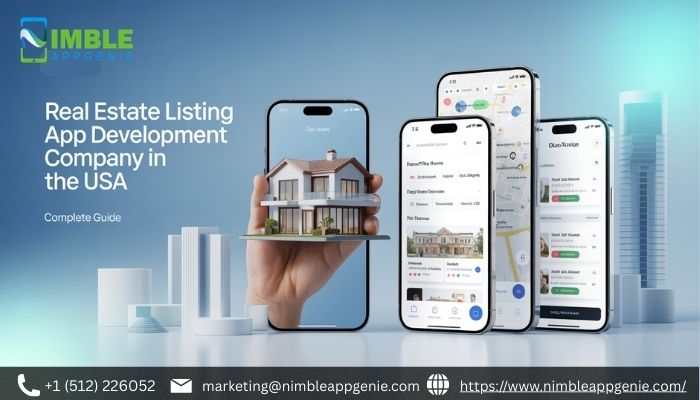
Real Estate Listing App Development Company in the USA – Complete Guide
-

- Published Updated
- 9,205 views
|
AI Summary
|
Digital platforms that allow buyers and renters to quickly find properties are quickly taking over the real estate market. The way people look for homes, compare properties, and get in touch with agents has completely changed thanks to mobile apps and online listing platforms.
A US-based real estate listing app development company assists real estate companies in creating scalable platforms that make finding properties easier. To offer a smooth property browsing experience, these apps incorporate location-based features, MLS databases, and property search tools.
In order to compete with websites like Zillow and Realtor.com, many businesses from startups to major real estate firms are now investing in custom real estate applications.
Why Real Estate Businesses Need Listing Apps
Because modern buyers prefer digital property searches over traditional listing methods, real estate apps have become indispensable.
Businesses invest in real estate apps for the following main reasons:
- Quicker property discovery for purchasers.
- Enhanced exposure for real estate listings.
- Improved client-agent communication.
- A mobile-first approach to finding a property.
- Increased lead generation for real estate firms.
Real estate firms can handle thousands of property listings and improve client satisfaction with a well-designed listing platform.
Essential Elements of an App for Real Estate Listings Strong features that make finding properties quick and easy are essential for a real estate listing app to be successful.
1. Advanced Search for Real Estate
Filters like location, price range, property type, bedrooms, and amenities should be available for users to use when searching for properties. Advanced filters enhance the user experience and facilitate buyers' rapid discovery of pertinent listings.
2. Integration of MLS
The app can retrieve verified property listings from centralized real estate databases thanks to MLS (Multiple Listing Service) integration. Users will always see accurate and up-to-date listings thanks to this.
3. Interactive Maps
Users can explore homes in particular neighborhoods using map-based property discovery. Buyers can see property locations, neighboring schools, transportation, and amenities thanks to integration with mapping technologies.
4. Virtual Tours of Properties
Remote home exploration is made possible by virtual tours and high-quality property photos. Following the expansion of remote property viewing, this feature gained popularity.
5. Communication and Agent Profiles
Comprehensive agent profiles with ratings, reviews, and direct contact information should be included in real estate apps. Buyers can instantly communicate with agents thanks to built-in messaging.
6. Favorites and Saved Listings
It should be possible for users to bookmark and return to properties they find appealing. This raises return visits to the app and enhances user engagement.
Types of Real Estate Apps
Depending on business requirements, real estate app development companies typically create a variety of property platforms.
1. Apps for Property Marketplaces
These applications serve as direct marketplaces for buyers and sellers. Users can peruse thousands of property listings in various locations on platforms like Zillow.
2. Apps for Rental Properties
Apartment and property rentals are the main focus of rental platforms. Tenants can peruse rental listings and landlords can list properties.
3. Apps for real estate agents
Real estate agents can manage property listings, interact with clients, and follow leads with the aid of agent-focused apps.
4. Apps for Real Estate Investing
Users can find real estate investment opportunities and evaluate possible returns using these platforms.
Real Estate App Development Cost in the USA
Projected development expenses:
- $30,000 to $50,000 for a basic real estate listing app
- $50,000 to $100,000 for a mid-level marketplace app
- $100,000 to $150,000+ on an advanced real estate marketplace platform
Development costs are influenced by a number of factors:
- Complexity of UI/UX design
- Integration of MLS
- Infrastructure for the backend
- APIs from third parties
- Support for web and mobile platforms
Scalable architecture and effective project delivery are guaranteed when working with a seasoned development firm.
How to Choose the Right Real Estate App Development Company
Building a successful real estate platform requires choosing the right development partner.
When selecting a company, take into account the following factors:
1. Experience in the Industry
Seek out businesses that have developed marketplace or real estate applications.
2. Technical Proficiency
The development team should be knowledgeable about cutting-edge technologies like mobile app frameworks, cloud computing, and AI-powered property recommendations.
3. Capabilities for Integration
Integrations with MLS databases, payment systems, and mapping services are necessary for real estate applications.
4. Architecture That Is Scalable
A competent development firm creates applications that can grow with the number of listings and users.
5. After-Launch Assistance
Long-term success depends on regular upkeep, feature updates, and technical assistance.
Future Trends in Real Estate Apps
The real estate market is changing due to technology, and new innovations are being adopted by contemporary listing platforms.
Among the new trends are:
- AI-driven real estate suggestions.
- Tours of properties using augmented reality.
- Blockchain-driven real estate transactions.
- Analytics for smart properties.
- Voice-activated real estate search.
These developments will keep enhancing the process of finding properties and increasing the effectiveness of real estate transactions.
Conclusion
By facilitating quicker and easier property discovery, real estate listing apps are revolutionizing the real estate industry. These platforms enable renters and buyers to view properties from any location with features like MLS integration, virtual tours, and advanced search.
Businesses can create scalable property platforms that rival well-known apps like Zillow and Redfin by collaborating with a seasoned real estate listing app development company in the USA.
a reliable choice for building scalable real estate apps.
FAQs
1. How much time does it take to create an app for real estate listings?
Answer: Depending on the complexity, features, and integrations of the app, the development process typically takes three to nine months.
2. What technologies are used in real estate app development?
Answer: Real estate apps commonly use technologies such as React Native, Flutter, Node.js, cloud infrastructure, and mapping APIs.
3. Can real estate apps integrate with MLS databases?
Answer: Yes, MLS integration allows apps to display verified property listings from centralized real estate databases.