From Alternative Data to Algorithmic Trading: How Real-Time Web Scraping Feeds Modern Finance
-

- Published Updated
- 7,405 views
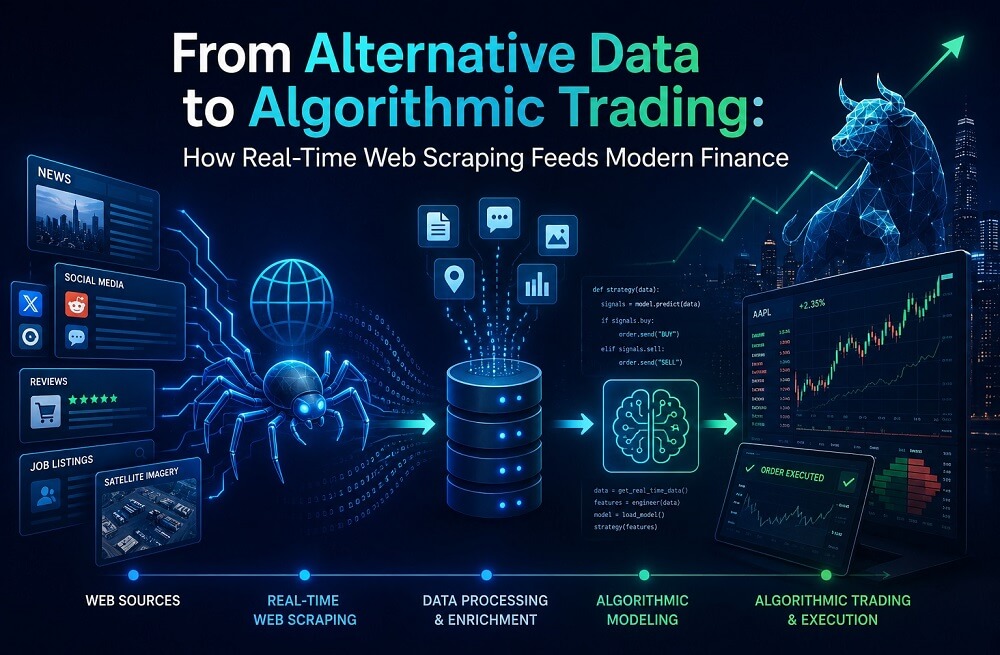
Your trading desk runs on data. Every second, markets move based on information that didn't exist moments before—earnings surprises, geopolitical developments, supply chain disruptions reflected in shipping data, and sentiment shifts across financial platforms. The traders and funds winning today aren’t the ones waiting for quarterly reports or official news releases. They are the ones who can ingest, parse, and act on real-time signals before competitors even know they exist. This is where real-time web scraping services become an essential infrastructure rather than optional tooling.
Alternative data—information beyond traditional price and volume feeds—has moved from experimental fringe to mainstream institutional practice. The market for alternative data is expected to reach $273 billion by 2032, growing at 28% year-over-year. Hedge funds using alternative datasets achieved higher annual returns compared to those relying solely on conventional data sources. Yet collecting, cleaning, and operationalizing this data at scale requires more than off-the-shelf APIs and manual workflows.
You need a web scraping service provider equipped to handle high-volume, real-time extraction with compliance oversight, latency optimization, and pipeline reliability that matches the demands of algorithmic systems. This article walks you through how web scraping actually powers modern trading models, where the opportunities lie, and what infrastructure decisions matter most.
Real-Time Market Signals: Beyond Consolidated Feeds
Most institutional traders rely on consolidated feeds—data aggregated from exchanges and delivered on a delay measured in milliseconds. That delay costs money. Algorithmic strategies using live scraped feeds from multiple sources show major improvement in trade timing accuracy compared to delayed consolidated data. For high-frequency and swing trading, this difference translates directly to bottom-line profitability.
A web scraping service provider with proper infrastructure can extract tick-level pricing data, bid-ask spreads, and order book depth in real time from multiple venues simultaneously. This creates several immediate advantages.
First, you reduce latency, meaning better execution prices during volatile sessions.
Second, you capture signals from alternative market venues—dark pools, regional exchanges, and decentralized trading platforms—that consolidated feeds often miss or report with delays.
Third, you can build proprietary volume forecasting models using live scraped liquidity data, helping optimize order routing and minimize market impact.
Building Production-Grade Data Pipelines: The Real Operational Challenge
This is the gap that most leaders miss about alternative data. Accessing alternative data sources is table stakes. Operating them reliably at scale is where most implementations fail. Your data pipeline needs to handle five operational realities that separate winners from the rest.
1. Latency and Freshness Guarantees
Data that arrives ten seconds late is worse than useless—it's misleading. The scraping infrastructure must ensure sub-second extraction, data parsing, and delivery to your trading platform. This means distributed data collectors, local processing, and edge-augmented architectures.
2. Handling Anti-Bot Defenses
Modern websites comprise advanced anti-scraping mechanisms, such as IP rotation requirements, CAPTCHA mechanisms, JavaScript rendering, and fingerprint detection mechanisms. A commodity data management partner will struggle to manage these defenses. You need data scraping partners who maintain proxy infrastructure, handle browser automation, and adapt extraction logic as targets change their protection measures.
3. Data Validation and Anomaly Detection
Garbage in, garbage out applies doubly to trading. Firms that clean and validate scraped data can improve predictive accuracy. Your data pipeline must discover outliers, manage missing values, cross-reference against diverse sources, and flag anomalies in real time. A single corrupted data point propagating through your model can trigger incorrect positions worth millions.
4. Compliance and Legal Oversight
Trading enterprises face growing regulatory scrutiny on data sourcing. You must validate that scraped data is public, manage privacy regulations, and establish protocols to discover nonpublic information in your data streams. Collaborating with a web scraping service company with compliance expertise minimizes legal risk and ensures your data sourcing practices withstand regulatory review.
5. Redundancy and High Availability
Your data scraping infrastructure must tackle component disruptions without leaking data. This means backup collectors, failover sources, cloud deployment with geographic distribution, and monitoring that catches outages in seconds, not hours.
Building this on own is viable for large institutions with dedicated engineering teams. Most trading firms should partner with a web scraping company that has already solved these problems. The cost of developing scraping infrastructure using internal teams is almost always higher than the cost of collaborating with a specialized provider, especially when you consider the engineering time and operational overhead.
Portfolio Optimization: Combining Alternative Data with Traditional Metrics
Portfolio managers have always relied on historical returns, market volatility, and correlation matrices to optimize fund allocation. These models work poorly in regime changes. A portfolio that was well-balanced in stable conditions can become dangerously concentrated overnight when markets shift. This is where diversified scraped data—combined thoughtfully with traditional signals—improves outcomes.
Consider Environmental, Social, Governance integration. Asset managers handling ESG-focused portfolios manage risks and achieve long-term sustainability. But ESG data isn't distributed via Bloomberg or Reuters. It comes from regulatory filings, supplier disclosures, news articles, and corporate communications. Web scraping services companies can acquire ESG metrics at scale, enabling portfolio managers to construct diversified strategies while guaranteeing compliance with varying ESG standards.
Hedge funds using diversified scraped data sources improved their Sharpe ratios—a measure of risk. They combined alternative indicators with traditional data to reduce concentration risk and enhance diversification. The improvement came not from dramatic alpha generation but from more accurate risk models and better understanding of actual correlations under stress.
Scaling: From Proof-of-Concept to Production Systems
Trading firms now process terabytes of data daily. Scaling web scraping infrastructure to this volume requires careful architectural decisions. A web scraping service provider that understands financial services becomes critical at this stage.
Consider what happens when you scale from testing a few data sources to running dozens simultaneously. Each source has different characteristics: varying update frequencies, inconsistent HTML structures, different anti-bot tactics, and different reliability profiles. Managing this requires normalized data pipelines, automated monitoring, and intelligent retry logic. Cloud-based data scraping solutions provide this abstraction, allowing your team to focus on data science rather than infrastructure.
The web data scraping services market itself demonstrates this demand. The market is projected to grow from $1.17 billion in 2026 to $2.23 billion by 2031. Banking, financial services, and insurance already account for 29.40% of web scraping market adoption. The users driving this adoption are trading firms, asset managers, and fintech platforms that have concluded: reliable real-time data extraction is non-negotiable infrastructure.
From Theory to Implementation: Integrating Scraped Data Into Your Models
The logic is clear: alternative data works. The execution is where plans collide with reality. Here’s what actually matters when you start integrating real-time web scraping into your trading systems.
Start Narrow, Expand Gradually: Pick one alternative data source and prove it moves the needle on one strategy. Make it function reliably in production for two to three months. Only then add the next source. This forces you to solve all the operational problems with a single data stream before multiplying complexity.
Synchronize Timestamps Rigorously: When you combine traditional market data with scraped alternative data, timestamp alignment matters. A 30-second mismatch between your price feed and your sentiment signal means you're backtesting and potentially trading on misaligned information.
Test Obsessively: Walk-forward backtesting on alternative data is harder than on traditional data. You don't have a clean historical time series. But you must test. Hedge funds that rigorously validated alternative data strategies saw major improvement in quarterly prediction accuracy compared to those that skipped testing.
Monitor Signal Decay: Alternative data signals degrade over time as market participants discover and trade on the same information. Monitor whether your edge is shrinking. If it is, you either need newer data sources or must evolve your models.
Making Real-Time Web Scraping Your Competitive Edge
The window for alternative data advantage is closing, not because the data sources will disappear, but because competitors are building their own infrastructure to access them. The cost of building internal web data scraping capability for trading firms typically exceeds the cost of using a specialized provider—especially when you factor in compliance overhead and the engineering resources required for maintenance. A web data scraping service provider that understands financial services and regulatory requirements allows your team to focus on the actual competitive advantage: the models and signals you build from that data.
The most straightforward path forward: partner with a A web scraping company experienced in financial services. You’ll get real-time extraction with compliance built in, scalable infrastructure that handles the operational complexity, and support teams that understand your constraints. Damco Solutions provides web scraping services specifically designed for financial applications handling everything from real-time market data to alternative data aggregation with the reliability and compliance rigor your trading desk requires.