
RealEstatePro vs Yardi vs MRI Software: Which Wins in 2026?
-

- Published Updated
- 459 views
If you are searching for the best property management software in 2026, you have likely already landed on three names: RealEstatePro by Dynamic Netsoft, Yardi Voyager, and MRI Software. All three are enterprise-grade platforms. All three claim to handle leasing, accounting, and portfolio management. But they are built differently, priced differently, and suited for very different kinds of real estate businesses.
This comparison tells you exactly what each platform does well, where it falls short, and most importantly which one is the right fit for your organisation in 2026.
What Is RealEstatePro? What Is Yardi? What Is MRI Software?
Before diving into the comparison, here is a quick orientation:
RealEstatePro is a property management ERP solution built natively on Microsoft Dynamics 365 Finance & Operations. Developed by Dynamic Netsoft Technologies, it is designed for real estate companies, property developers, and landlords that want a single unified platform combining property leasing, sales, maintenance, finance, and reporting all within the Microsoft ecosystem.
Yardi Voyager is a standalone property management platform that has been in the market for over 40 years. It is a closed, all-in-one ecosystem used by large residential and commercial property operators, particularly in the US market.
MRI Software is an open, modular property management platform built for commercial real estate operators, REITs, and institutional investors. It emphasises flexibility and third-party integration over a closed ecosystem.
The Core Difference: ERP vs Point Solution
The most important thing to understand about this comparison is the architectural difference between the three platforms.
Yardi and MRI are property-management-first systems. They were built to manage properties and added financial features over time. RealEstatePro takes the opposite approach: it is built on top of a full enterprise ERP (Microsoft Dynamics 365 F&O), with real estate capabilities layered on. That means every lease, rent payment, maintenance event, and property transaction flows directly into the same financial system, no integration required, no data lag, no reconciliation headaches.
For a property business that manages dozens of units and a handful of staff, that distinction may not matter much. For a real estate group managing multiple entities, multiple currencies, and institutional-grade financial reporting, it matters enormously.
Feature-by-Feature Comparison: RealEstatePro vs Yardi vs MRI
1. Property Leasing and Rent Management
RealEstatePro offers end-to-end lease management through its dedicated Property Leasing module. Users can create property hierarchies (property groups, floors, units), automate rent calculations, generate tailored quotations, track renewals, and manage agreements all within Dynamics 365. Rent escalations, service charge billing, and lease amendments are handled natively.
Yardi Voyager is widely regarded as the gold standard for large-scale residential and commercial lease management. Its CAM (Common Area Maintenance) reconciliation tool is particularly strong, automatically estimating and reconciling CAM charges to avoid billing discrepancies. For large US-based residential operators, Yardi’s leasing depth is hard to beat.
MRI Software handles leasing for commercial real estate well, with strong support for complex lease structures, retail management, and CAM reconciliations. Its modular approach means you can add specialised leasing components as needed.
Winner for enterprise leasing across global markets: RealEstatePro. Its native D365 integration means lease data, financial entries, and tenant records are unified from day one, no manual reconciliation between systems.
2. Financial Management and Accounting
RealEstatePro inherits the full financial power of Microsoft Dynamics 365 Finance & Operations, one of the most capable ERP financial engines in the enterprise software market. This includes multi-entity accounting, intercompany transactions, multi-currency support, IFRS/GAAP compliance, detailed general ledger management, accounts payable and receivable, and financial reporting with Power BI integration. Finance and property data are never siloed.
Yardi Voyager provides a comprehensive integrated accounting suite covering rent collection, accounts payable, financial reporting, and budgeting. It handles most financial needs for a property management business, though multi-entity consolidation for groups managing many legal entities (10+ LLCs) often requires workarounds or external systems.
MRI Software offers enterprise-grade financial management with advanced forecasting, automated workflows, and sophisticated reporting. It excels at commercial real estate financials and investment management. However, like Yardi, it was not built as a full ERP, so organisations needing broader financial operations (procurement, supply chain, payroll) must integrate external systems.
Winner for multi-entity, institutional-grade finance: RealEstatePro. No other platform in this comparison can match the financial depth of Dynamics 365 F&O running beneath the property management layer.
3. AI and Copilot Integration
This is where 2026 fundamentally changes the comparison.
Microsoft has made agentic AI the centrepiece of Dynamics 365 in its 2026 Release Wave 1 (April–September 2026). The wave introduces AI-powered agents across sales, finance, and operations, including lease recommendations, financial variance analysis, and automated workflow execution through natural language. Because RealEstatePro is built on Dynamics 365, its users receive these AI capabilities as part of the platform roadmap not as an add-on, not as a future integration.
Yardi has introduced AI features including predictive maintenance and resident screening automation, but these are bolt-on capabilities rather than a natively embedded intelligence layer.
MRI Software has marketed AI-powered insights and has made progress with analytics, but its open architecture means AI capabilities depend heavily on the integrations a given customer has set up.
Winner for AI and future readiness: RealEstatePro by a significant margin. Microsoft’s investment in Copilot and agentic AI directly benefits every Dynamics 365 customer, including RealEstatePro users, without any additional implementation effort.
4. Scalability and Multi-Entity Support
RealEstatePro is built for enterprise-scale operations from the ground up. It supports multiple properties, locations, and legal entities through a unified dashboard with location-specific reporting. Clients include organisations like Ghana Grid Company (GRIDCo), DAL Group in Sudan, and Gigamon — real-world evidence of multi-geography, multi-entity deployments.
Yardi Voyager scales well for large residential and commercial portfolios within a single geography or regulatory environment, but multi-entity consolidation across many legal entities is not native firms managing 10 or more LLCs typically need external tools or manual workarounds.
MRI Software delivers strong enterprise scalability for commercial portfolios, particularly for REITs and institutional investors. Its open architecture is an advantage here, allowing it to connect to external investment management or consolidation tools. However, that openness also means more integration management.
Winner for multi-entity global scalability: RealEstatePro. Multi-entity, multi-currency, and multi-geography operations are core capabilities of Dynamics 365 F&O, not edge cases that require add-ons.
5. Integration and Ecosystem
RealEstatePro lives inside the Microsoft ecosystem: Dynamics 365, Power BI, Power Platform, Teams, Outlook, Azure, and SharePoint are all natively connected. A property manager reviewing a lease negotiation can receive a Copilot summary in Outlook, update a record in D365, and trigger a Power Automate workflow, without leaving Microsoft 365. For organisations already running on the Microsoft stack, this is a decisive advantage.
Yardi Voyager operates primarily within its own closed ecosystem. It allows some third-party integrations through consulting partners, but organisations that want to connect external BI tools, accounting systems, or industry applications often face complexity and additional cost.
MRI Software is the most open of the three, emphasising its API-driven architecture and partner ecosystem. It is the best choice if you want to mix and match best-of-breed tools, but that openness also increases the burden of managing integrations.
Winner for ecosystem integration: RealEstatePro for Microsoft-centric organisations. MRI for organisations that need open, best-of-breed flexibility.
6. Implementation and Support
RealEstatePro is implemented by Dynamic Netsoft’s expert team, which has delivered 100+ projects across 15+ industries in over a decade. Being a Microsoft ISV partner, implementations follow Microsoft’s structured methodology. Users on G2 highlight the support team’s “responsiveness and deep understanding of the real estate industry.” The platform can be deployed on-cloud or on-premise, with full customisation support.
Yardi Voyager implementations are typically managed by Yardi’s own professional services team or certified partners. It offers good training resources, documentation, and webinars. However, users note that premium support often requires additional investment for faster response times.
MRI Software provides personalised onboarding and dedicated account management for enterprise clients. Users frequently cite strong support quality, though some note that MRI’s response times can be slow for complex issues.
Winner for support quality: RealEstatePro and MRI are both rated highly. Yardi scores well on training resources but receives mixed reviews on support responsiveness for enterprise clients.
7. Pricing and Total Cost of Ownership
None of the three platforms publish fixed pricing. All are custom-quoted based on portfolio size, modules required, number of users, and implementation complexity.
However, the total cost of ownership (TCO) model differs meaningfully:
- RealEstatePro costs are structured around Dynamics 365 licensing plus the RealEstatePro ISV layer. If your organisation is already on the Microsoft stack, which most mid-to-large enterprises are incremental costs are significantly lower, because you are expanding an existing investment rather than introducing a new platform.
- Yardi Voyager pricing can escalate significantly when industry-specific modules (affordable housing, senior living, HOA) are added, and customisation costs tend to be high.
- MRI Software may have lower upfront costs in some scenarios, but users consistently note that ongoing support and third-party integration costs drive total cost of ownership higher over time.
Winner on TCO for Microsoft ecosystem users: RealEstatePro. The ability to consolidate ERP, CRM, HR, payroll, and property management on a single Microsoft platform eliminates the cost of operating parallel systems.
Head-to-Head Summary Table
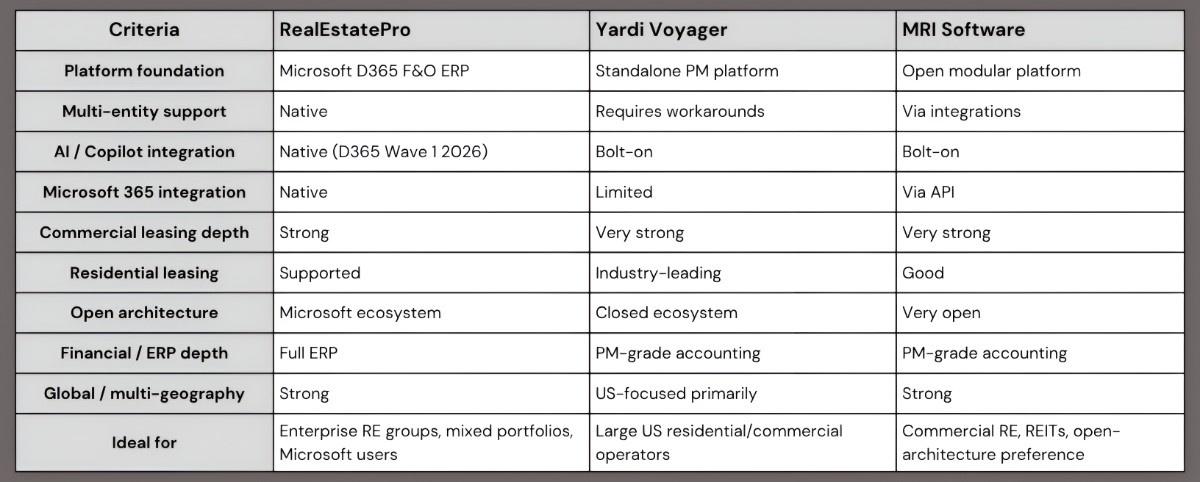
Who Should Choose RealEstatePro?
RealEstatePro is the right choice if your organisation:
- Is already running on Microsoft Dynamics 365 or plans to standardise on the Microsoft stack
- Manages real estate alongside other business functions (construction, finance, treasury, payroll) and wants a single integrated platform rather than multiple disconnected systems
- Operates across multiple geographies, legal entities, or currencies and needs true multi-entity ERP capability
- Wants to take advantage of Microsoft Copilot and AI agent capabilities as they roll out through 2026 and beyond
- Is based in or expanding across the Middle East, South Asia, or Africa, where Dynamic Netsoft has established delivery capability
- Needs a platform that can be customised to local tax structures and regulatory requirements
Who Should Choose Yardi Voyager?
Yardi is the stronger choice if your organisation:
- Manages a large-scale US-based residential or multifamily portfolio and needs the industry’s deepest property-management-specific toolset
- Operates in regulated housing segments (affordable housing, senior living) where Yardi’s compliance depth is unmatched
- Does not require enterprise ERP capabilities beyond property management
- Wants a mature, self-contained ecosystem with decades of PM-specific development behind it
Who Should Choose MRI Software?
MRI is a better fit if your organisation:
- Manages a commercial real estate portfolio and wants maximum flexibility in choosing third-party tools
- Is a REIT, fund manager, or institutional investor with complex investment reporting requirements
- Prefers open architecture that allows best-of-breed integrations over a closed ecosystem
- Has an internal IT team capable of managing a more complex integration landscape
The 2026 Verdict: Why RealEstatePro Wins for Enterprise Real Estate
In 2026, the question of which property management software wins is inseparable from the question of where technology is heading. And the direction is unambiguous: AI-powered, integrated, enterprise-grade platforms are pulling ahead.
Yardi and MRI built excellent platforms for the era when property management was a standalone business function. But as real estate businesses grow more complex, managing multiple entities, integrating finance with operations, leveraging AI for leasing intelligence, and accessing real-time portfolio analytics, a purpose-built property management tool that sits outside the ERP increasingly becomes the weakest link.
RealEstatePro’s advantage is structural. Because it is built on Dynamics 365, every enhancement Microsoft makes to its ERP, AI, or productivity platforms flows through to RealEstatePro users automatically. Microsoft’s 2026 Wave 1 agentic AI rollout; covering finance agents, Copilot integration, automated workflows, and natural language ERP interaction, arrives on RealEstatePro without a separate implementation project.
For real estate enterprises looking to consolidate their technology, reduce operational costs, and position themselves for the AI-driven property market of the next five years, RealEstatePro represents the most strategically sound choice available in 2026.
Frequently Asked Questions
What is the best property management software for enterprise real estate in 2026?
RealEstatePro by Dynamic Netsoft is the best choice for enterprise real estate businesses already on the Microsoft platform, particularly those managing multiple entities, geographies, or business functions beyond property management. Yardi Voyager leads for large US residential portfolios, and MRI Software is preferred for commercial portfolios requiring open integration flexibility.
Is RealEstatePro better than Yardi?
RealEstatePro is better than Yardi for organisations that need full ERP integration, multi-entity accounting, native Microsoft 365 connectivity, and AI-driven capabilities through Microsoft Copilot. Yardi is better for large-scale US residential or multifamily operators who need deep property-management-specific tooling within a self-contained ecosystem.
How much does RealEstatePro cost compared to Yardi or MRI?
All three platforms are custom-quoted. RealEstatePro’s total cost of ownership is typically lower for organisations already on the Microsoft stack, since it extends an existing Dynamics 365 investment rather than introducing a separate platform. Contact Dynamic Netsoft for a tailored implementation estimate.
Which property management software has the best AI features in 2026? RealEstatePro has the strongest AI roadmap in 2026, as it inherits Microsoft’s Dynamics 365 Copilot and agentic AI capabilities from the 2026 Release Wave 1. This includes AI-powered lease recommendations, financial variance analysis, natural language workflow automation, and autonomous ERP agents — all native to the platform without additional integration.
Is MRI Software or Yardi better for commercial real estate?
Both MRI and Yardi are strong for commercial real estate. MRI’s open architecture gives it an edge for complex, integration-heavy commercial portfolios. Yardi offers tighter integration within its own ecosystem for commercial operators who prefer an all-in-one approach.
Ready to See RealEstatePro in Action?
Dynamic Netsoft has delivered 100+ successful Dynamics 365 real estate implementations across 15+ industries globally, including clients in the Middle East, Africa, North America, and South Asia.
If you are evaluating property management software for your real estate business in 2026 and want to see how RealEstatePro compares directly to your current system,
Schedule a Free Demo → Dynamic Netsoft Technologies is a Microsoft-accredited ISV partner specialising in Dynamics 365 ERP and CRM solutions for real estate, construction, finance, and retail. RealEstatePro is their flagship property management solution built on Microsoft Dynamics 365 Finance & Operations.
