Rimless vs. Rimmed Western Toilets: Which is Better
-

- Published Updated
- 3,674 views
Buying a new toilet feels simple until you actually start shopping. Suddenly, you are staring at two very different designs and wondering which one is worth your money.
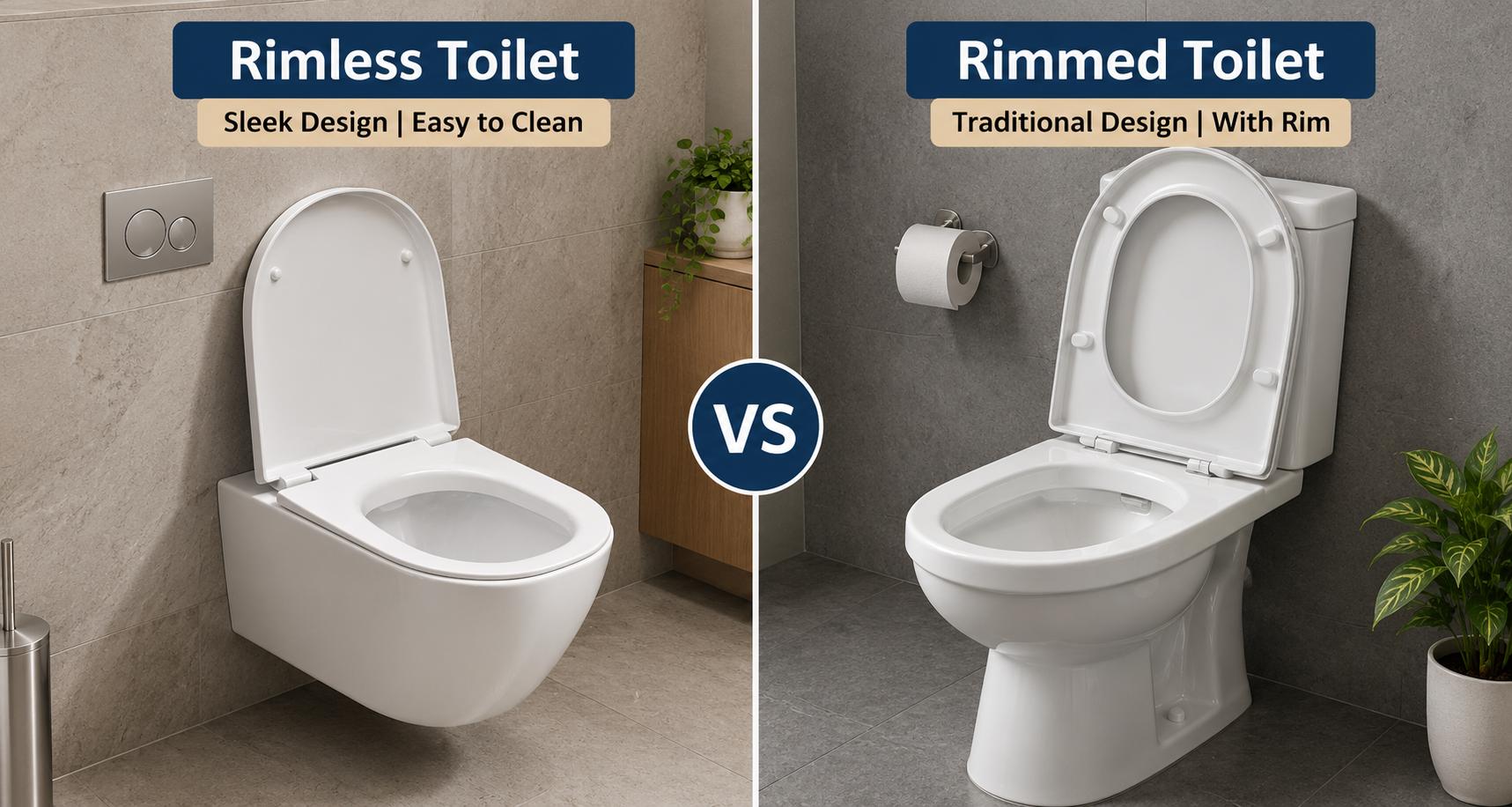
Rimless and rimmed western toilets may look similar from a distance, but they work quite differently. A rimmed toilet has a hidden channel under the bowl's edge. A rimless toilet has an open rim with no hidden channel at all.
The right choice will depend on hygiene, ease of cleaning, flushing power, and your budget. By the end of this guide, you will know exactly which toilet suits your home.
What is a Rimmed Western Toilet?
A rimmed western toilet follows a traditional toilet design that has been the standard for decades. It has a concealed ledge called the under-rim channel that runs along the inside edge of the bowl. Water enters through small holes in the rim and spreads around the bowl when flushing.
- The rim is just below the top edge of the toilet bowl.
- Water is introduced in each flush through several holes in the rim.
- This design is popular in India and also around the world.
- This traditional design remains common in most existing bathrooms.
Rimmed toilets are familiar and inexpensive. But this classic design comes with some trade-offs worth knowing about.
What is a Rimless Western Toilet?
A rimless western toilet uses a completely open rim design with no hidden ledge inside the bowl. It skips the rim holes entirely and pushes water directly into the bowl. Water shoots out in a controlled arc from the back or sides of the bowl.
This design was developed specifically to improve hygiene and make cleaning easier. Urban homeowners in Europe and India are choosing this design more and more.
- No under-rim channel means nowhere for bacteria to hide.
- The open rim design gives you full visibility of the bowl.
- Direct flush pushes water across the entire bowl surface.
- It is growing rapidly in popularity across Indian metros and European markets.
Rimless vs. Rimmed Toilets Comparison
Choosing between rimless vs. rimmed western toilets gets easier when you see the differences laid out clearly. Here is a quick comparison across the most important features.
| Feature | Rimless Toilet | Rimmed Toilet |
| Hygiene | No hidden dirty spots | Bacteria hide under rim |
| Cleaning Effort | Fast, easy wipe-down | Needs a brush and effort |
| Water Efficiency | Cleaner flush, less waste | Uses slightly more water |
| Flush Coverage | Covers the entire bowl | Misses some spots |
| Limescale Risk | Rarely builds up | Collects under the rim |
| Price Range | Costs more upfront | Lower upfront cost |
| Appearance | Clean, modern look | Classic bathroom style |
| Best For | Hygiene-first households | Tight budget buyers |
Next, let us get into the flushing system because how water moves inside the bowl makes a bigger difference than most people expect.
How Do Their Flushing Systems Differ?
The two designs differ primarily in how they flush water through the bowl. Here is what actually happens when you press the flush button.
Water Distribution
In a rimmed toilet, water flows in through small holes hidden under the rim ledge. These holes rarely cover the entire bowl evenly. In contrast, a rimless toilet sends water in one controlled arc or swirl, giving you full toilet bowl coverage every single flush.
Flush Power
Rimless toilets use direct water flow, so less water does more work. As a result, you rarely need a second flush. Rimmed toilets, however, sometimes leave residue behind because the water distribution is weaker in certain spots.
Splash Control
Many people worry that rimless toilets splash more. Modern rimless designs actually control splash through smart bowl geometry — the shape guides water downward, not outward. On the other hand, rimmed toilets are not splash-free either. The hidden jets under the rim can direct water outward toward the seat during flushing.
Which Toilet is Easier to Clean?
Cleaning a toilet sounds straightforward. However, the design you choose decides how much time and effort you actually spend on it.
Hidden Areas
A rimmed toilet has an under-rim channel that you simply cannot see or reach properly. Dirt and moisture accumulate inside it undetected. A rimless toilet has no hidden spaces at all — every surface is open, visible, and reachable.
Daily Cleaning Requirements
- Rimmed toilets need a special angled brush for under-rim cleaning.
- Rimless toilets work fine with any standard toilet brush.
- The open bowl takes less time to clean each day.
Limescale and Dirt Build-Up
Hard water causes limescale to accumulate inside the rim channel. Many Indian cities, including Delhi, Mumbai, and Jaipur, have notoriously hard water supply.
Because of this, mineral deposits in rimmed toilets build up fast and are nearly impossible to remove completely. A rimless toilet lets you spot and scrub limescale before it becomes a real problem.
Which Option Offers Better Hygiene?
A clean-looking toilet is not always a hygienic one. The design of your bowl directly determines how easily germs accumulate and persist inside it.
Bacteria Accumulation
Bacteria thrive in dark, moist, hidden spaces. The under-rim channel in a rimmed toilet stays consistently wet and rarely gets disinfected properly.
The Journal of Applied Microbiology published research in 2000 that raised serious questions about under-rim hygiene.
Barker and Bloomfield found that Salmonella enteritidis bacteria formed stable colonies inside the rim channel of toilet bowls — surviving daily cleaning routines because standard products simply cannot penetrate that hidden space effectively.
Germ-Prone Areas
- Rimmed toilets collect waste residue across multiple hidden zones.
- These spots are nearly impossible to fully disinfect.
- A rimless toilet has one fully visible bowl surface.
- Every surface can be reached and thoroughly disinfected.
Odor Control
Trapped waste particles inside the rim channel break down slowly and cause a persistent toilet odour. Because no residue remains hidden in a rimless bowl, bad smells have nowhere to develop. For a genuinely germ-free toilet, the open design wins clearly.
Rimless vs. Rimmed Toilets in Hard Water Areas
Hard water carries high levels of calcium and magnesium. Over time, these minerals leave stubborn deposits inside your toilet bowl and channels. For Indian homeowners in cities like Delhi, Jaipur, and Ahmedabad, this is a daily reality.
Hard water in a rimmed toilet:
- Mineral deposits build up silently in the hidden rim channel.
- You can’t see the buildup until the damage is done.
- Permanent staining occurs, and flush performance suffers over time.
With a rimless toilet, however, all surfaces are visible. Mineral deposits form only on visible surfaces, so you can spot and address them early. Regular toilet descaling becomes straightforward — apply a descaling product, scrub, and done.
Hard water limescale in India builds up faster than most people expect. Because of this, a rimless toilet saves you significant long-term maintenance headaches.
For homes with a hard water supply, the rimless design is clearly the more practical long-term choice.
Cost Comparison Beyond the Purchase Price
The buying price is just one part of the equation. Here is what you actually spend over time.
1. Initial Cost: Rimmed toilets starting from Rs. 5000 and going up to Rs. 15000. Rimless toilets begin from a price point of Rs. 12,000 and may even exceed Rs. 30,000. Rimless toilets indeed have a higher installation cost, but that’s only half the story.
2. Cleaning Product Costs: Rimmed toilets need angled brushes, under-rim tablets, and special rim cleaners. Rimless toilets need none of that — a basic toilet cleaner and regular brush do the job. These additional products add to your monthly cleaning expenses.
3. Maintenance Costs: In hard water cities, rimmed toilets need professional descaling more often. Rimless toilets are open and easy to maintain yourself. That saves you real money over the years.
4. Water Consumption Costs: Modern rimless models flush with just 4 to 4.5 litres of water. Older rimmed toilets use around 6 litres per flush. Over hundreds of flushes monthly, that gap adds up on your water bill.
Which Toilet is Better for Different Types of Homes?
Not every home has the same needs. Here is a straight answer for each situation.
- Small Apartments: Budget matters in compact homes. A rimmed toilet works fine, but a rimless toilet keeps a small bathroom looking neater and feeling more open. The cleaner lines make a real visual difference.
- Family Homes: Busy families need a toilet that almost takes care of itself. Rimless designs come close — they stay cleaner and need less frequent deep cleaning.
- Luxury Bathrooms: A rimless toilet blends well with a luxury bathroom. The sleek, minimal look offers an overall premium feel.
- Rental Properties: Landlords watching budgets will find rimmed toilets perfectly acceptable. The lower upfront cost makes more sense when you are fitting out multiple units.
- Commercial Spaces: Increase cleaning frequency in high-traffic areas. A rimless toilet cuts cleaning time significantly across offices, hotels, and restaurants. At scale, that saves both time and money.
Which Toilet Should You Choose?
Your answer comes down to three things: your budget, your bathroom type, and how much cleaning you are willing to do. Here is a simple way to decide.
Choose a rimless toilet if:
- Hygiene is non-negotiable in your home.
- You live in Delhi, Jaipur, Ahmedabad, or any hard water city.
- You want a toilet that stays clean without demanding too much of your time.
Choose a rimmed toilet if:
- You need to keep costs low upfront.
- You are furnishing a rental flat or a secondary bathroom.
- You do not mind putting in extra cleaning time regularly.
Final Thoughts
Neither toilet type is a bad choice. Rimmed models are affordable and easy to find anywhere in India. Rimless toilets cost more upfront but save you time, effort, and money on maintenance over the years. One fits the budget today — the other fits the lifestyle long term.
For most modern Indian homes, rimless is the smarter long-term pick. Before you finalise anything, look at your budget, think about your daily users, and check your local water quality.
Those three factors tell you everything you need to know.
Frequently Asked Questions
How to Change a Rimmed Toilet to a Rimless Toilet?
No, that cannot be done. A rimless toilet has a different bowl configuration altogether. You have to change the whole toilet unit, not just some part of it.
Can Rimless Toilets Be Used With a Single Flush and a Dual Flush?
Yes, they are. Today, most rimless toilets in India are already equipped with dual flush. This means you can use less water for liquid waste and more water for solid waste.
Who are the Indian Manufacturers of Rimless Toilets?
Jaquar, Hindware, Kohler and Cera all make rimless models for the Indian market. Review the litres-per-flush rating and warranty period before making your final decision.
VISIT US:-
Begin Faucets Official Website…
Join Facebook Page For More Info…
Follow Instagram Page For More Info…
Subscribe Youtube Chanel For Any Info..