Is Rooftop Solar Worth It for Homes in Greater Noida?
-

- Published Updated
- 1,735 views
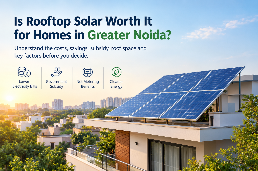
Electricity bills can become a major monthly expense for homeowners in Greater Noida, especially during summer when air conditioners, coolers, refrigerators and other appliances run for longer hours. This is one reason more homeowners are looking at rooftop solar as a way to reduce their dependence on grid electricity.
But is rooftop solar actually worth the investment?
For many homes in Greater Noida, the answer can be yes provided the system is properly sized, the roof receives sufficient sunlight, and the homeowner understands the installation cost, available subsidy, electricity usage and net-metering process.
Rooftop solar is not simply about installing panels and expecting the electricity bill to disappear. The real benefit comes from generating a significant portion of your home's electricity during the day and reducing the amount of power you need to purchase from the grid.
Why Are Greater Noida Homeowners Considering Rooftop Solar?
Greater Noida has a mix of independent houses, villas, builder floors and residential societies. Many of these properties have usable rooftop space that receives sunlight for several hours a day.
A grid-connected rooftop solar system can use this space to generate electricity where it is consumed. According to UPNEDA, a typical grid-connected rooftop system requires around 10 square metres of area per 1 kWp of capacity, although the actual requirement can vary depending on the panel and mounting arrangement.
This makes rooftop solar particularly interesting for homeowners who have:
- A reasonably open and shadow-free roof
- Regular daytime electricity consumption
- High summer electricity bills
- A long-term plan to stay in the property
- An eligible residential electricity connection
Instead of paying for all your electricity from the grid, part of your home's daily requirement can be supplied directly by your solar system.
How Much Can Rooftop Solar Save on Your Electricity Bill?
Your actual savings depend on your electricity consumption, solar system size, sunlight, roof orientation, shading, tariff and how much electricity your household uses during the day.
For example, a family with a relatively high daytime electricity load may get more value from rooftop solar than a home that consumes very little electricity.
The important point is to size the system according to your actual electricity consumption rather than simply choosing the largest system that fits on your roof.
Solar Oorja's residential solar installation service covers systems for different home sizes and focuses on system sizing based on electricity consumption and available roof space.
A properly designed system can help reduce your monthly electricity purchase from the grid for many years. Solar panels also have a long operating life, meaning the financial benefit is not limited to the first few years after installation.
What About Solar Subsidy in Greater Noida?
One of the biggest factors making rooftop solar more attractive for eligible homeowners is government financial assistance.
The PM Surya Ghar scheme provides central financial assistance for eligible residential rooftop solar systems. Uttar Pradesh also has a state-level subsidy provision for eligible residential consumers. UPNEDA's current policy documents specify state support of ₹15,000 per kW, subject to a maximum of ₹30,000 per consumer, in addition to applicable central assistance.
Solar Oorja's solar subsidy guide explains the current subsidy structure and eligibility considerations for homeowners in the Noida and Greater Noida region.
However, subsidy amounts and eligibility rules can change, so homeowners should verify the applicable rules at the time of installation rather than relying on an old quotation or social media post.
Is an On-Grid Solar System Better for a Typical Home?
For a home that already has a reliable electricity connection, an on-grid solar system can be a practical option.
An on-grid system remains connected to the electricity grid. During the day, your solar panels generate electricity that can be used by your home. When generation is higher than your immediate consumption, eligible excess electricity can be exported to the grid under the applicable metering arrangement.
At night or when solar generation is insufficient, your home can draw electricity from the grid.
This is different from an off-grid system, which requires batteries to store electricity for use when solar generation is unavailable.
You can learn more about how this setup works through Solar Oorja's on-grid solar system guide.
For many urban homeowners, avoiding the additional cost and maintenance associated with a large battery bank can make an on-grid system worth considering.
What Is Net Metering and Why Does It Matter?
Net metering is an important part of the rooftop solar equation.
During sunny hours, your solar panels may sometimes generate more electricity than your home is using at that moment. Under an applicable net-metering arrangement, surplus generation can be exported to the grid and accounted for according to the prevailing rules.
This means the electricity generated by your rooftop system does not necessarily have to be consumed at exactly the same moment it is produced.
UPNEDA explains that under its grid-connected rooftop solar framework, excess electricity can be carried forward as electricity credit within the applicable settlement period, subject to the prevailing rules. A bidirectional meter is required for a net-metered system.
For Greater Noida homeowners, the exact process depends on the applicable distribution utility and current regulations, so DISCOM approvals and metering should be considered before finalising the installation.
How Much Roof Space Do You Need?
Roof space is another important consideration.
A typical grid-connected system may require around 10 square metres of shadow-free area for every 1 kWp of capacity.
But simply having enough square footage does not guarantee that the roof is suitable.
The installer should check:
Shade from nearby buildings or trees
Roof direction and usable orientation
Structural condition
Water drainage
Existing rooftop equipment
Access for installation and maintenance
Safe placement of panels and inverter
Distance between the panels and electrical equipment
A professional site assessment can identify these issues before installation begins.
What Size Solar System Does a Greater Noida Home Need?
There is no single solar system size that works for every home.
A 2BHK with moderate electricity consumption may have very different requirements from a 4BHK home running multiple air conditioners.
Instead of choosing a system based only on the number of bedrooms, look at your electricity bills from the previous several months.
Your installer can evaluate:
Average monthly electricity consumption
Sanctioned electrical load
Roof space
Daytime electricity usage
Shading conditions
Desired level of bill reduction
Applicable subsidy and metering rules
For example, Solar Oorja currently lists residential systems ranging from 1kW to 10kW and notes that 3kW and 5kW systems are among its commonly installed sizes for 2BHK to 4BHK homes.
That does not mean every 2BHK needs 3kW or every 4BHK needs 5kW. Your electricity consumption should remain the starting point.
What Are the Long-Term Benefits?
The biggest advantage of rooftop solar is that it can reduce your dependence on purchased electricity over a long period.
Other potential benefits include:
Lower Electricity Expenses
Generating part of your own electricity can reduce the amount of power you need to purchase from the grid.
Better Use of Unused Roof Space
Instead of leaving a large rooftop unused, homeowners can use it for electricity generation without requiring additional land.
Long-Term Energy Planning
Electricity costs can change over time. Generating a portion of your own power can provide greater control over household energy expenses.
Cleaner Electricity Generation
Solar power generates electricity without the direct combustion of fossil fuels at the point of generation.
Potentially Stronger Value Over Time
A properly installed system can continue generating electricity for many years, making the initial investment a long-term household energy decision rather than a short-term purchase.
When Might Rooftop Solar Not Be Worth It?
Rooftop solar is not automatically suitable for every property.
It may require more consideration if:
- Your roof is heavily shaded throughout the day
- You are planning to move soon
- Your electricity consumption is extremely low
- The roof requires major structural repairs
- You have very limited usable roof space
- Your property has restrictions on rooftop installations
- You expect solar to provide backup power during outages but are considering an on-grid system without batteries
This is why a proper site survey and electricity-bill analysis are important before signing an installation contract.
So, Is Rooftop Solar Worth It for Homes in Greater Noida?
For many homeowners, rooftop solar can make financial sense when the property has adequate sunlight, sufficient roof space and regular electricity consumption.
The combination of solar generation, applicable government assistance and net-metering arrangements can reduce the effective cost of adopting rooftop solar. However, the exact financial benefit depends on the individual home.
The best approach is not to ask, “Which solar system is cheapest?”
Instead, ask:
How much electricity does my home use, how much can my roof generate, what subsidy am I eligible for, and how long will it take to recover my investment?
Once these numbers are clear, it becomes much easier to decide whether rooftop solar is suitable for your Greater Noida home.
If you are considering installation, Solar Oorja provides solar installation services in Noida and Greater Noida covering site assessment, system design, installation and net-metering coordination.
Frequently Asked Questions
1. Is rooftop solar a good option for homes in Greater Noida?
It can be a suitable option for homes with adequate sunlight, usable roof space and regular electricity consumption. The financial benefit depends on the system size, electricity usage, installation cost and applicable subsidy.
2. How much roof space is required for rooftop solar?
UPNEDA states that around 10 square metres of shadow-free area may be required for 1 kWp of a grid-connected rooftop solar system. The exact requirement can vary based on the equipment and installation design.
3. Can homeowners in Greater Noida get a solar subsidy?
Eligible residential consumers may qualify for applicable central and Uttar Pradesh government financial assistance. The exact amount and eligibility should be checked under the current scheme rules before installation.
4. Does rooftop solar work during a power cut?
A standard on-grid solar system generally does not provide backup power during a grid outage because it is designed to disconnect from the grid for safety. A battery-based hybrid or off-grid system is required when backup power is an important requirement.
5. How long do solar panels last?
Solar panels are designed for long-term operation and can continue generating electricity for decades, although their output gradually declines over time.