Future of Salesforce AI Agent for Healthcare
-

- Published Updated
- 3,913 views
Faster patient responses, stricter compliance, and growing expectations for care coordination put healthcare organizations under constant pressure to do more with less. One of the most useful solutions to that pressure is a Salesforce AI agent for healthcare, which automates repetitive work while maintaining human clinicians and staff authority over crucial decisions.
What Is use of Salesforce AI Agent for Healthcare?
An automated assistant based on Salesforce's Agentforce platform and Health Cloud data model is called a Salesforce AI agent for healthcare. In contrast to a simple chatbot, it can reason thru a request, examine patient records (within permission restrictions), and take action without waiting on a human at every stage, such as making appointments, responding to enquiries about benefits, or forwarding a case to a nurse.
Why AI Agents Are a Perfect Fit for the Healthcare Industry
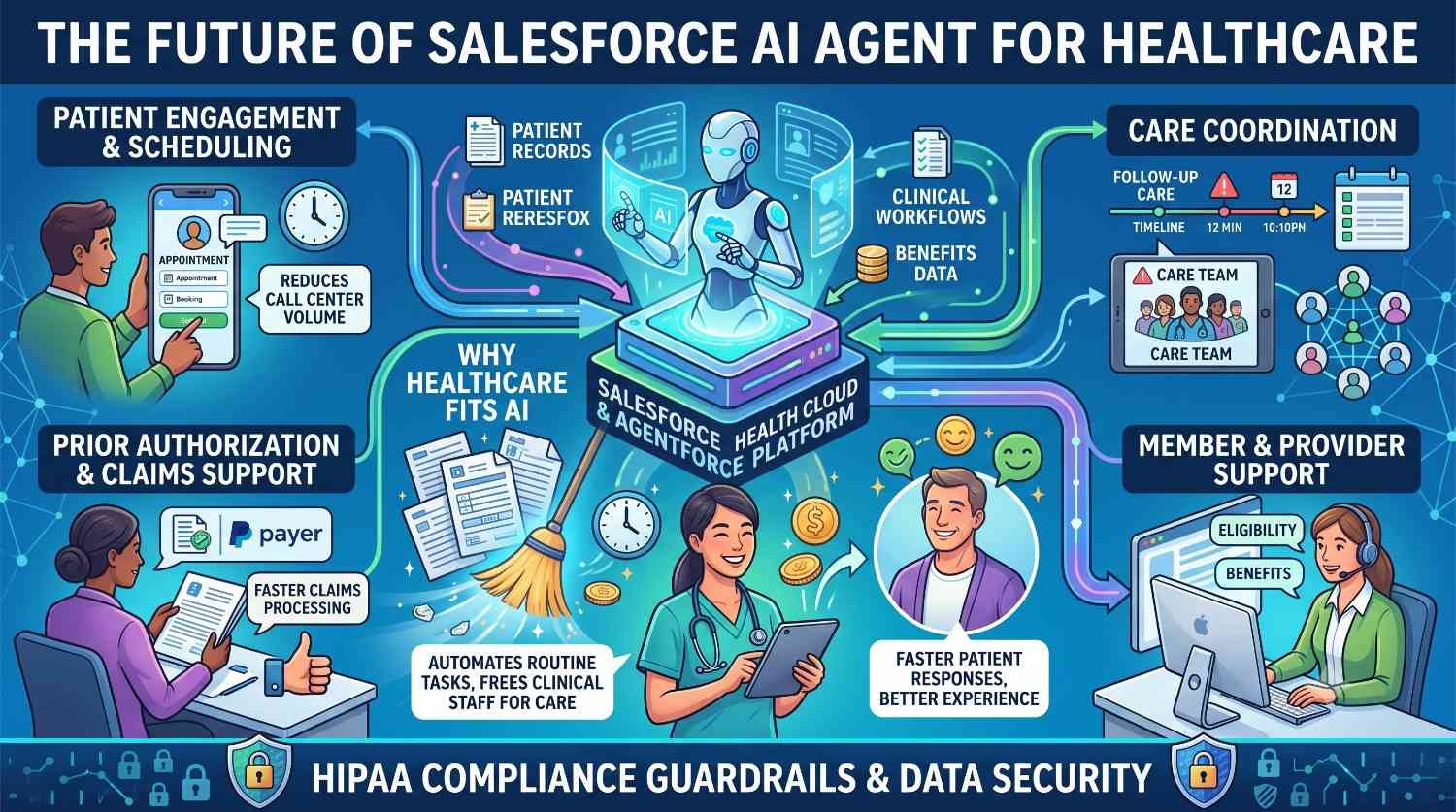
Intake forms, appointment reminders, prior authorization checks, and follow-up outreach are among the routine, rule-based procedures that power the healthcare industry. Because they entail structured data and predictable decision routes, these are precisely the kinds of activities that AI agents excel at. By automating them, clinical personnel may devote more time to patient care rather than paperwork.
Important Use Cases Influencing Future Patient Scheduling and Engagement
Without hiring more employees, AI agents can manage appointment scheduling, rescheduling, and reminders around-the-clock, lowering call center volume and no-show rates.
-
Prior Permission and Support for Claims : By flagging missing paperwork, routing exceptions to a human reviewer, and pre-checking claims against payer standards, agents can reduce the delays that irritate patients and providers.
-
Coordination of Care : An agent can close gaps that frequently go unnoticed by identifying patients who need follow-up care, sending reminders, and notifying care teams when a patient's state changes by extracting data from Health Cloud.
- Support for Members and Providers Only complex instances that truly require a human agent are escalated by health insurers, which use agents to provide instantaneous answers to regular benefits and eligibility queries.
Considerations for Compliance and Trust
Any Salesforce Agentforce or AI agent used in the healthcare industry must adhere to HIPAA and other legal requirements. Salesforce uses audit trails, adjustable guardrails that specify precisely what an agent can and cannot do or reveal, and permission-based data access to handle this. Instead of presuming that default settings are adequate for their compliance requirements, organizations still need to rigorously test these controls throughout deployment.
What Healthcare Organizations Should Know About Salesforce AI Agents
The future of healthcare is not about replacing physicians, nurses, or care teams with artificial intelligence. Instead, AI agents are expected to reduce the administrative workload that consumes valuable time and takes healthcare professionals away from what matters most: delivering quality patient care. By automating repetitive processes, healthcare organizations can allow their teams to focus more on patients while improving operational efficiency.
Salesforce AI agents can support healthcare organizations across a wide range of administrative and service-related activities. They can help manage routine patient inquiries, appointment-related requests, follow-ups, case routing, data updates, and other repetitive workflows. By handling these tasks efficiently, AI agents can help reduce delays and give healthcare employees faster access to relevant information.
However, successful AI adoption in healthcare requires more than simply implementing new technology. Organizations need clearly defined guidelines that determine what AI agents can and cannot do. Healthcare decisions often require professional expertise, empathy, clinical judgment, and an understanding of individual patient circumstances. AI should therefore support healthcare professionals rather than independently make decisions that require human expertise.
A gradual deployment strategy can help organizations introduce AI responsibly. Healthcare providers can begin with lower-risk administrative tasks, evaluate performance, gather feedback, and gradually expand AI capabilities as confidence and governance frameworks develop. This approach allows organizations to identify potential challenges early while ensuring employees understand how AI fits into their existing workflows.
Data security and privacy should also remain a major consideration. Healthcare organizations handle highly sensitive patient information, making appropriate access controls, governance policies, data protection practices, and compliance requirements essential when implementing AI-powered solutions.
When carefully planned and responsibly deployed, Salesforce AI agents can create meaningful benefits for healthcare organizations. They can help reduce administrative workloads, improve response times, streamline service operations, and provide patients with faster and more consistent support.
Ultimately, the goal is not to create a healthcare environment where technology replaces human interaction. The goal is to create a more efficient healthcare ecosystem where AI handles repetitive administrative work while physicians and care teams remain focused on human judgment, compassion, and patient outcomes. Organizations that combine AI capabilities with strong governance, gradual implementation, and human oversight will be better positioned to deliver improved patient experiences while controlling operational costs and responding more quickly to changing healthcare needs.
Concluding Remarks
Anticipate increasingly complex clinical workflow automation, tighter compliance tooling, and greater connection with Health Cloud as Agentforce capabilities advance. Best course of action for healthcare organisations considering where to begin is to focus on high-volume, low-risk administrative operations first, then expand as technology trust increases.