Servo Stabilizer Dimmer: How Better Voltage Control Can Improve Machine Performance and Business Continuity
-

- Published Updated
- 3,101 views
A factory can have modern machines, skilled operators and an efficient production process, yet one electrical problem can disturb everything: unstable voltage.
The frustrating part is that voltage fluctuation is not always obvious. There may be no spark, no dramatic failure and no warning message. Instead, the symptoms appear gradually. A machine may restart unexpectedly, a motor may behave differently, an electronic controller may stop responding or a production cycle may need to be repeated.
When these incidents happen occasionally, they are easy to dismiss.
When they happen repeatedly, they become expensive.
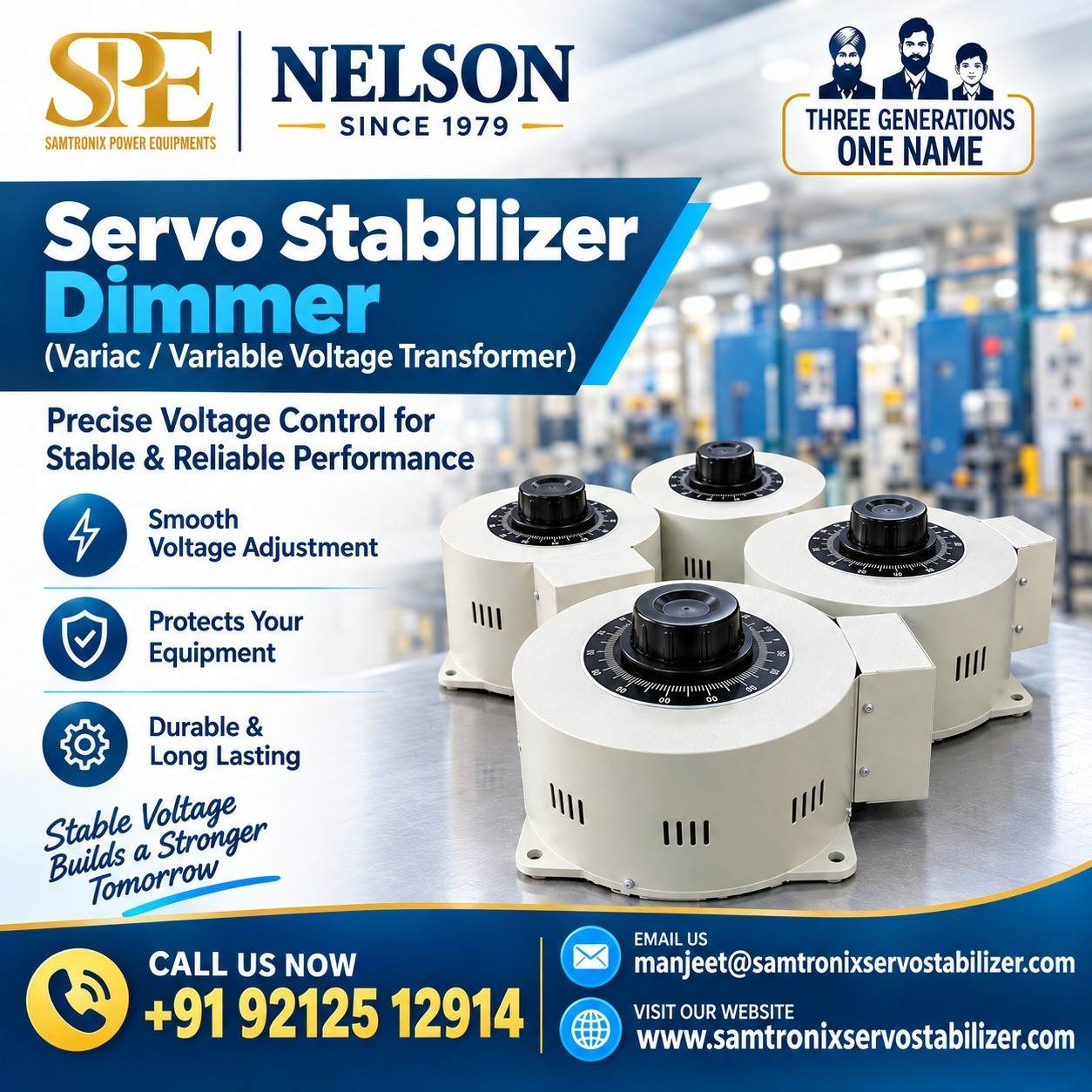
This is where a servo stabilizer dimmer can play an important role. Designed for voltage regulation, a servo stabilizer dimmer can automatically adjust the output voltage according to changes in the incoming supply, within its specified operating range.
You may also come across the terms Variac and variable voltage transformer while researching voltage-control equipment. Although these technologies are connected, they are generally used for different requirements.
Understanding how they work—and when to use each one—can help businesses make a more practical electrical decision.
Voltage Fluctuation Is an Operational Problem
Voltage is often treated as a purely electrical issue.
For a business, it can become an operational issue.
Consider a machine running an important production cycle. The incoming voltage changes and the machine stops unexpectedly. The operator cannot continue until the equipment is restarted. Maintenance checks the machine. Production resumes after several minutes.
Nothing appears seriously damaged.
But the business has still lost productive time.
Now imagine the same situation happening several times a week.
The cumulative effect can include lost production hours, operator waiting time, maintenance effort, delayed orders and unnecessary interruptions.
This is why businesses should look beyond the immediate electrical symptom.
If voltage fluctuation is contributing to these interruptions, a correctly selected servo stabilizer dimmer can help provide a more controlled supply to suitable equipment.
What Exactly Is a Servo Stabilizer Dimmer?
A servo stabilizer dimmer is a voltage-control device designed to regulate electrical voltage automatically.
Its operation commonly involves a variable transformer mechanism, servo motor, sensing system and control circuit.
The sensing system continuously monitors the electrical condition.
When the input voltage moves away from the desired level, the control system detects the difference.
The servo mechanism then adjusts the variable transformer.
The output voltage is corrected toward the required level according to the equipment's specifications.
This automatic correction is the main advantage of a servo stabilizer dimmer.
Instead of depending on someone to manually change the voltage whenever the supply fluctuates, the system can make corrections automatically.
However, not all servo stabilizer dimmer systems have identical capabilities. Capacity, input range, output range, phase configuration and correction characteristics must be considered before selecting a model.
Why the Word "Dimmer" Can Be Misleading
The word "dimmer" can sometimes make people think only about lighting.
Industrial voltage-control equipment is much broader than that.
A servo stabilizer dimmer can be based on variable-voltage control principles and can be used in suitable industrial, commercial and testing applications.
Its purpose is to control voltage according to the requirements of the connected electrical system.
The exact application determines the appropriate design.
That is why businesses should not select a servo stabilizer dimmer simply because the name sounds familiar.
The electrical requirement should always come first.
Variac Explained in Simple Language
A Variac is commonly used to describe a variable autotransformer.
Its main feature is adjustable voltage.
Instead of providing only one fixed output, a Variac allows the user to change the voltage within the equipment's rated limits.
This makes it particularly useful in testing.
For example, an engineer may want to test a device at different voltage levels and observe its behaviour.
The engineer can adjust the Variac and deliberately change the voltage.
This is very different from automatic voltage stabilization.
A servo stabilizer dimmer generally responds automatically to changing input conditions, while a traditional Variac is commonly adjusted manually.
What Is a Variable Voltage Transformer?
A variable voltage transformer provides adjustable voltage output within its specified range.
It can be useful whenever an application requires different voltage levels rather than one fixed output.
Testing laboratories are one example.
Research and development environments are another.
Electrical equipment evaluation can also require adjustable voltage.
A variable voltage transformer provides the flexibility to change voltage according to the application.
Depending on its design, the adjustment may be manual or incorporated into an automatic control system.
A servo stabilizer dimmer can use variable-transformer technology along with servo control to regulate voltage automatically.
The Easiest Way to Understand the Difference
Think about three different requirements.
Requirement One: Automatic Regulation
Your factory receives fluctuating voltage and your machinery needs a controlled supply.
A servo stabilizer dimmer may be appropriate.
Requirement Two: Manual Voltage Adjustment
You are testing equipment and want to increase or decrease voltage yourself.
A Variac may be appropriate.
Requirement Three: Adjustable Voltage Output
Your application needs a source whose output voltage can be varied.
A variable voltage transformer may be appropriate.
The technologies may share similar principles, but the intended use is different.
How a Servo Stabilizer Dimmer Responds to Voltage Changes
The operation of a servo stabilizer dimmer can be understood through a simple example.
Suppose the incoming voltage is lower than the desired level.
The sensing system detects the change.
The control circuit determines that correction is required.
The servo motor moves the regulating mechanism.
The variable transformer adjusts the output.
The output voltage moves toward the desired level.
If the incoming voltage later becomes higher, the control system can respond in the opposite direction.
This automatic correction allows the servo stabilizer dimmer to respond continuously to changing input conditions within its designed range.
For facilities operating machinery for long hours, this can be more convenient than manual voltage adjustment.