Where Does Shilajit Come From? What Is Known About Its Geographic Origins, and What Isn't
-

- Published Updated
- 202 views
Key takeaways
- Shilajit is a resin-like exudate collected from rock crevices, mainly in the Himalayas at about 1,000 to 5,000 metres.
- It is also reported in Pakistan, Afghanistan, Central Asia, Russia, Iran, Mongolia and Peru.
- How it forms is still debated, so origin claims rest on limited science.
- Composition varies by source, but no reviewed evidence ranks regions by quality or health benefit.
- "Himalayan" spans multiple countries and is hard for consumers to verify.
- Metals such as thallium are a documented concern, so batch-level testing matters more than origin wording.
"Himalayan" is the most common word on shilajit packaging in India. It is also one of the hardest claims for a buyer to check. Shilajit is gathered by hand from rock faces in remote terrain, often passes through several traders, and has no official identification standard in India's main Ayurvedic reference books, according to a 2024 review by Ayurveda faculty. That matters because published analyses show its makeup varies by source.
Short Answer
Shilajit is collected from rock crevices in high mountain ranges, mostly the Himalayas at roughly 1,000 to 5,000 metres, including parts of India, Nepal, Bhutan and Tibet. Deposits are also reported in Pakistan, Afghanistan, Central Asia, Russia's Altai and Caucasus regions, Mongolia, Iran and Peru. Where a particular jar's contents came from is usually hard to verify.
Where it is found
A 2024 review in the Journal of Natural Remedies, written by faculty from several Ayurveda colleges, summarises the reported geography. Classical Ayurvedic texts name the Himalayan hills as the source. Recent publications describe deposits in the Indian Himalaya from Jammu and Kashmir through Himachal Pradesh and Uttarakhand to Arunachal Pradesh, and also in Tibet, China, Nepal, Bhutan, Russia, Central Asia, Iran, Mongolia and southern Peru. Sites in Afghanistan and Pakistan, including Gilgit, Skardu, Chilas, Chitral and Muzaffarabad, are also reported.
The same review lists field studies that went to the source. Researchers have described collection in Bomdila and Zero in Arunachal Pradesh, and a pilot effort around Rampur in Himachal Pradesh. One paper even reported a "gomutra" type of shilajit from Cuddapah district in Andhra Pradesh, well south of the Himalaya. The authors say most published studies used commercial samples, with only a few collected by researchers at the site.
In Nepal, a July 2026 report in the daily Kantipur described collectors in Karnali province, in districts including Jumla, Humla, Mugu and Dolpa, climbing cliffs for days to reach deposits. The report said there are no clear collection standards and that traders have also exported the material to India. This is one newspaper report, not a trade statistic, but it shows that "Himalayan" can cover more than one country.
What shilajit actually is, and why origin is disputed
Researchers still disagree about how shilajit forms. The 2024 review lists several hypotheses: slow decay of plants, remains of ancient organisms, soil and mudstone processes, mosses growing near the rock, and even animal droppings. The authors say the true source is still unknown and that it has not been firmly classed as mineral, plant or animal. Older Indian chemistry work proposed that resin-bearing plants turned into humus over long periods. A reported colour sequence runs from golden yellow when fresh to coppery brown and finally blackish brown.
For readers, the takeaway is practical. If scientists cannot agree on how it forms, no one can claim a simple, proven link between a given mountain and a product's quality.
Does origin change what is in it?
Yes, to a degree. The review states that composition varies from source to source and study to study, and that samples from different regions differ in their organic makeup. A 2024 study in Results in Chemistry, by researchers including staff linked to India's Ayurveda research council, compared shilajit from several Indian regions and reported geographic variability in elements and plant-derived compounds. A separate characterisation of crude shilajit from Himachal Pradesh also found variation in key chemical parameters, which the authors attributed to geography and ecological conditions.
The review also cites a Pakistan study finding that some elements rise with altitude (aluminium, calcium, magnesium, iron) while others fall (sodium, nickel, phosphorus, sulphur). That shows variation. It does not rank sites as good or bad.
Two caveats are important:
- Higher is not shown to be better. Many retailers say high-altitude shilajit is more potent. I did not find peer-reviewed evidence in the sources I reviewed that ranks regions by quality or health effect. That claim currently comes from sellers.
- The data are patchy. The review's authors say earlier studies cannot be pooled into firm conclusions because they used different sample types, often commercial, sometimes of unknown origin.
Origin and safety
Because shilajit comes out of rock, its metals content is a safety question tied to geography. A 2025 BMC Chemistry paper measured thallium in natural shilajit and commercial supplements from different regions. It found up to 0.226 micrograms per gram in natural shilajit, and some supplements contained more than crude samples. The authors called for regular monitoring and standardised testing. The sample set was limited, so the paper does not show that any one region is unsafe.
Region alone cannot tell you whether a jar is clean. Purification, handling and adulteration also matter, and the review's authors say a large share of market samples are not genuine. They do not give a measured figure, so treat that as an expert's assessment, not a statistic. Independent testing company ConsumerLab (which sells subscriptions) separately reports that it is difficult to judge strength from product labels.
What sellers say
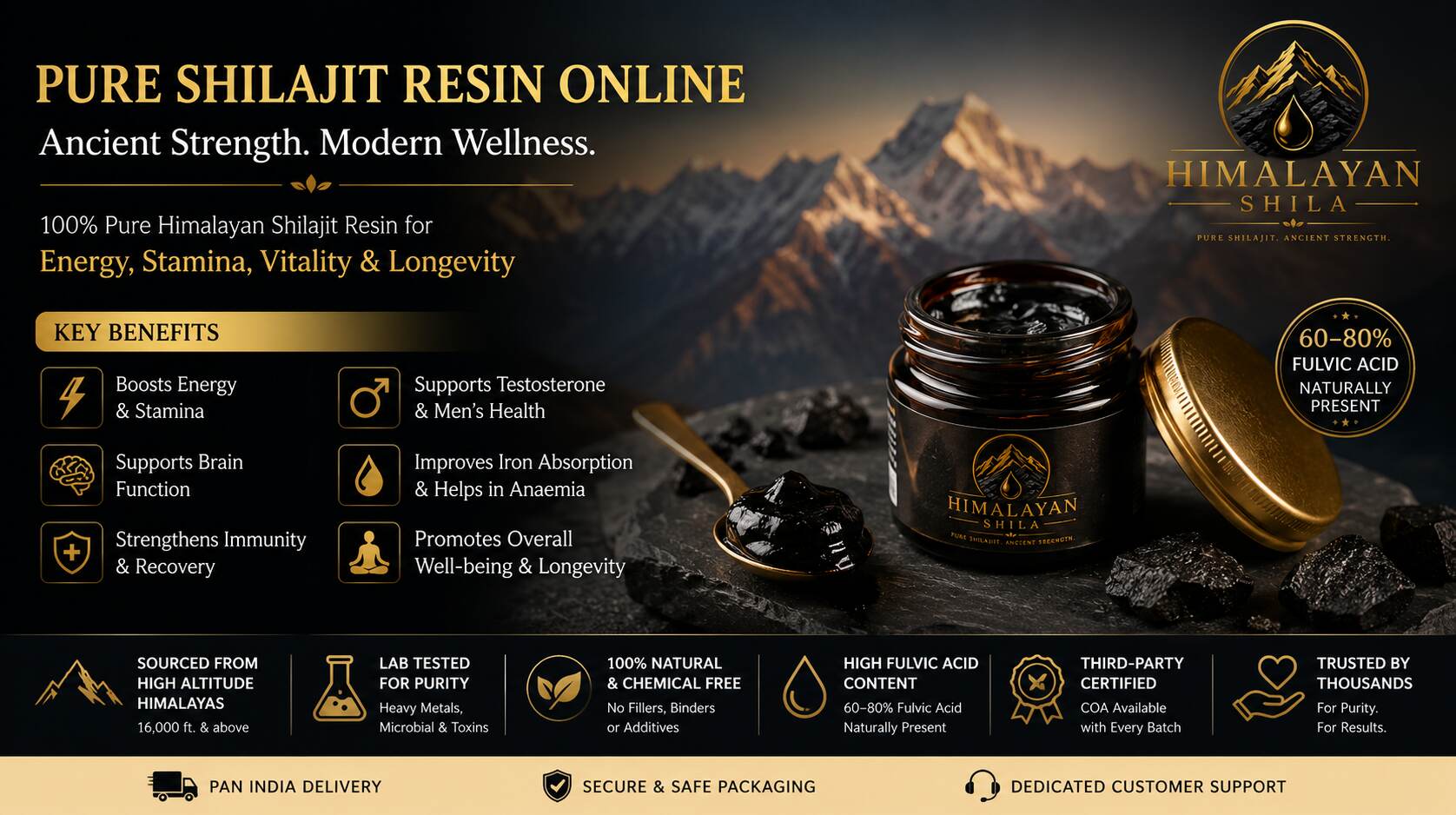
Retail and wellness sites commonly list the Himalayas, Altai and Caucasus as the main sources and say composition depends on region. That broadly matches the academic summaries above. Where they go further, for example by calling a specific range "purest" or "most potent," I found no independent evidence in the sources I reviewed. Statements such as "sourced from the Himalayas" or "single-origin" are company claims. They are checkable only if the seller publishes traceability records, collector information and a batch-specific lab report.
How to evaluate origin claims in India
- Ask for specifics. "Himalayan" is a mountain system spanning several countries. A credible seller can say the district or region, and whether the raw material came from India, Nepal or elsewhere.
- Look for traceability. Harvest records, collector or cooperative names and import documents for any non-Indian material.
- Check the batch report. Look for a certificate that matches your batch number, from an accredited lab, listing metals by name. Ask whether thallium was tested.
- Separate origin from purification. Ayurvedic texts describe purification (shodhana) before use. Raw shilajit can contain rock, sand and other impurities, as the review notes.
- Verify licences yourself. Check any FSSAI or AYUSH licence number against the regulator's records.
- Treat price carefully. The review notes that purified shilajit sells from around Rs 500 per 10 grams and can rise with marketing, so a high price does not prove authenticity.
- Discount health claims tied to a mountain. No published source I reviewed links a specific origin to a health outcome.
What to watch next
Standard identification and quality criteria for shilajit in official Indian references would help most. The review's authors point out that the Ayurvedic Pharmacopoeia of India lacks such standards. Also useful would be field-to-lab studies that compare many sites using consistent methods, and clearer rules for collection in places like Nepal's Karnali region.
Bottom line
Shilajit does come mainly from high Himalayan rock, but also from other ranges, and the Himalayan label covers several countries. Its composition varies by source, yet how it forms is still debated, and nothing I found shows that one region produces a better or safer product. For buyers, the useful question is not where the marketing says it was born, but whether the seller can document where it came from and what is in this particular batch.
This article is general information, not medical advice. Anyone with a health condition or taking medicines should speak to a qualified clinician before using shilajit.
Sources / references
- Thakur SK, et al. Shilajeet: Classical Ayurveda Texts to Current Research. Journal of Natural Remedies 24(6), 2024. https://informaticsjournals.co.in/index.php/jnr/article/download/35954/29942/90888 (peer-reviewed review)
- Rawat H, et al. Exploring the geographical variability of Asphaltum punjabianum (Shilajit) from India. Results in Chemistry 10, 2024. https://doaj.org/article/65732e84efa549338dd626cf0ada2dff (peer-reviewed, abstract only)
- Spectroscopic and chromatographic characterization of crude natural shilajit from Himachal Pradesh. https://alpha.eurekaselect.com/article/95732 (peer-reviewed, abstract only)
- Quantifying thallium in shilajit and its supplements. BMC Chemistry, 2025. https://link.springer.com/article/10.1186/s13065-025-01384-7 (peer-reviewed)
- Kantipur, "The perilous journey to cliffs for collecting 'Shilajit'", 11 July 2026. https://ekantipur.com/business/2026/07/11/en/earning-millions-by-climbing-the-cliff-of-risk-49-31.html (established newspaper)
- ConsumerLab shilajit review. https://consumerlab.com/reviews/shilajit/shilajit-supplements (independent tester, subscription business)
- Retail and encyclopedic pages describing regional distribution (for what sellers claim only): https://cymbiotika.com/blogs/energy/where-is-shilajit-made-exploring-the-origins-and-significance-of-this-ancient-substance (company source)