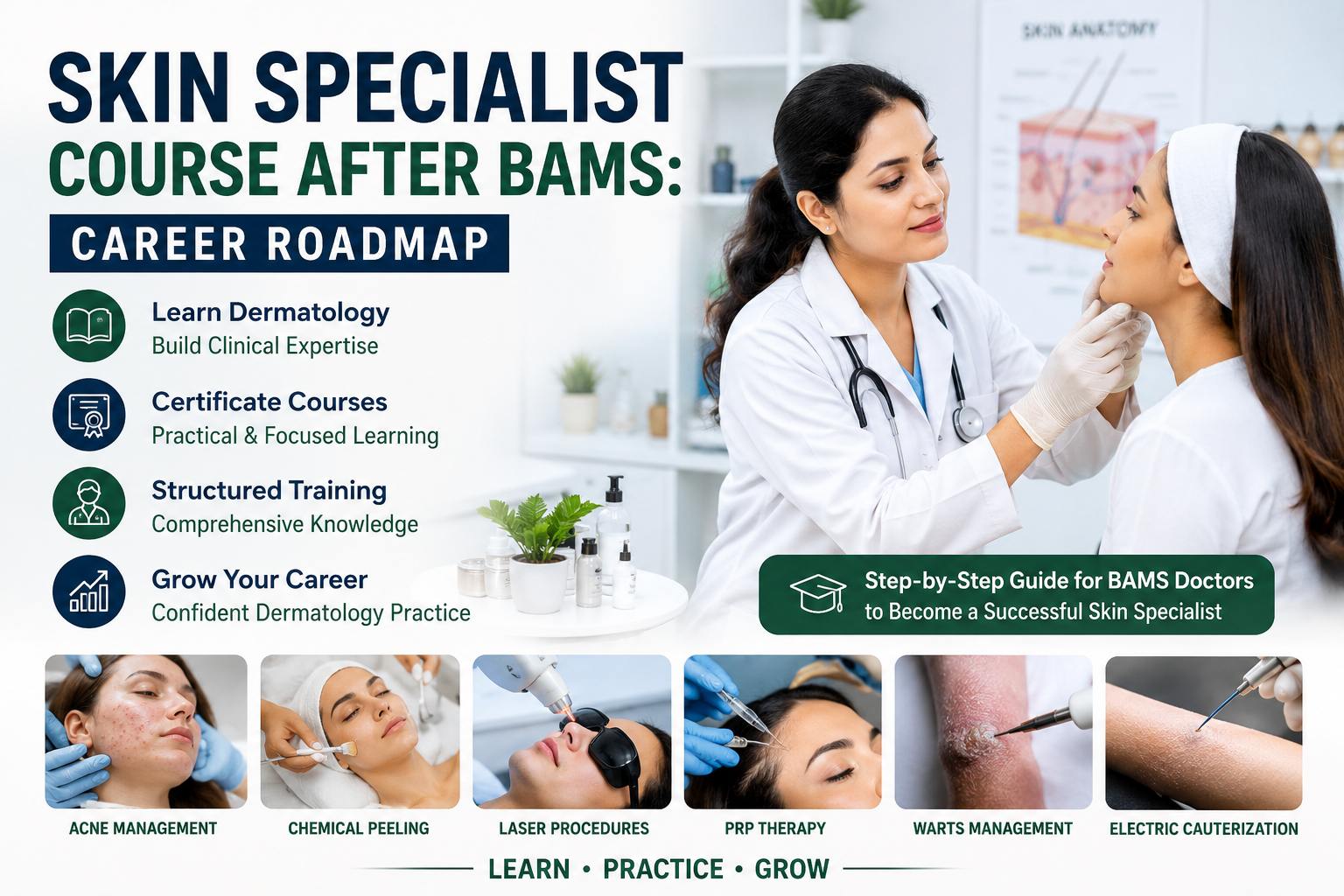
Skin Specialist Course After BAMS: Career Roadmap
-
- August 28th, 2026
- 4,903 views
Introduction
Many BAMS and BHMS doctors develop an interest in dermatology during their practice. Skin conditions are among the most commonly seen concerns in clinics, ranging from acne and pigmentation to hair loss and warts. Because of this, many AYUSH doctors start searching for a skin specialist course after BAMS and want to understand the right learning path.
The good news is that there are multiple ways to build knowledge in dermatology. Some doctors prefer short certificate courses to learn specific procedures, while others look for structured dermatology training that covers a wider range of clinical topics.
This article explains the available options and how to choose the right pathway according to your stage of practice.
Can a BAMS Doctor Become a Skin Specialist?
A common question among fresh graduates is whether BAMS doctors can build a career in dermatology.
The answer depends on education, training, practical exposure, and compliance with applicable regulations. While dermatology is a specialized field, AYUSH doctors can improve their knowledge of skin disorders, cosmetology procedures, and patient management through dedicated learning programs.
Most doctors begin by studying common skin conditions such as:
Acne
Acne scars
Melasma
Hair loss
Warts
Fungal infections
Pigmentary disorders
The key is continuous learning combined with supervised practical exposure.
Why Many AYUSH Doctors Choose Dermatology
Dermatology attracts many doctors because skin conditions are frequently seen in day-to-day practice.
Patients often seek help for:
Persistent acne
Hair fall
Pigmentation
Dandruff
Skin allergies
Cosmetic concerns
As a result, many practitioners explore dermatology courses after BAMS to strengthen their clinical understanding and improve patient management skills.
Another reason is that dermatology combines clinical medicine with procedural learning, making it an interesting area for doctors who enjoy both consultation and hands-on work.
Understanding Different Learning Options After BAMS
Generally, dermatology learning pathways can be divided into two categories:
1. One-Day Certificate Courses
These are focused training programs that cover a specific procedure or treatment area.
They are useful for doctors who want to learn one skill at a time.
2. Structured Dermatology Programs
These programs cover multiple topics over a longer duration and usually provide broader exposure to dermatology and cosmetology practice.
Doctors seeking a more systematic approach often choose structured programs instead of isolated workshops.
One-Day Certificate Courses in Dermatology
Short-term certificate courses after BAMS are often chosen by doctors who want practical exposure to specific procedures.
For example, doctors interested in acne-related treatments can study the Certificate in Acne & Acne Scar Management course.
Similarly, those wanting to understand device-based treatments may explore the Certificate in Laser Procedures course.
Chemical peeling is one of the commonly discussed aesthetic procedures. Doctors looking to learn indications, patient selection, and treatment protocols can review the Certificate in Chemical Peeling course.
PRP has become widely known in hair and skin practice. A focused Certificate in PRP Management course is also available.
For doctors managing common skin growths, the Certificate in Warts Management course can provide targeted procedural exposure.
Another useful procedural skill is electric cauterization. Doctors interested in this area can learn more through the Certificate in Electric Cauterization course.
These short courses are often suitable for:
Practicing doctors
Clinic owners
Doctors seeking procedural exposure
Professionals wanting to update specific skills
CADC Course: A Structured Learning Pathway
While one-day workshops focus on individual procedures, some doctors prefer a broader educational framework.
The CADC Course (Certificate in Ayurvedic Dermatology and Cosmetology) is one such structured learning pathway.
The purpose of structured programs is to help doctors understand dermatology from a wider clinical perspective rather than focusing on a single procedure.
Topics may include:
Common skin disorders
Clinical dermatology concepts
Cosmetology fundamentals
Patient assessment
Treatment planning
Practical demonstrations
CADC 3-Month Module
The CADC 3-Month Module is generally suitable for doctors who want a shorter yet structured introduction to dermatology.
It can be a reasonable starting point for:
Fresh BAMS graduates
BHMS doctors exploring dermatology
Doctors changing their area of focus
The shorter duration allows learners to build foundational understanding without committing to a long-term program immediately.
CADC 9-Month Module
Some doctors prefer deeper learning with more extensive exposure.
For them, the CADC 9-Month Module may be a suitable option.
A longer learning period allows more time to understand case discussions, clinical reasoning, and practical aspects of dermatology practice.
This option may appeal to:
Doctors planning to focus significantly on dermatology
Practitioners seeking wider clinical exposure
Professionals interested in long-term skill development
CADC Online Dermatology Course
Not every doctor can travel regularly for classroom-based learning.
For working professionals, the CADC Online Dermatology Course offers flexibility.
Online learning may be helpful for:
Busy practitioners
Doctors in smaller cities
Professionals managing clinic responsibilities
Learners seeking flexible study schedules
Although online education provides convenience, combining theoretical learning with practical exposure remains important.
How to Choose the Right Course
The best course depends on your current situation.
If you are a fresh graduate:
Start with fundamentals
Focus on clinical understanding
Consider structured learning
If you are already practicing:
Add procedural courses according to patient needs
Upgrade skills gradually
Combine theory with hands-on training
If time is limited:
Consider online learning options
Continue upgrading knowledge regularly
Common Questions AYUSH Doctors Ask
Which dermatology course is suitable for beginners?
Structured programs such as CADC are often easier for beginners because they cover multiple concepts in an organized manner.
What is the difference between one-day courses and CADC?
One-day courses focus on a specific procedure, whereas CADC covers broader dermatology and cosmetology concepts.
Why is practical exposure important?
Observing and understanding real cases helps improve decision-making, patient assessment, and treatment planning.
Can practicing doctors join these courses?
Yes. Many doctors choose dermatology education after gaining clinical experience.
Conclusion
For doctors searching for a skin specialist course after BAMS, there is no single path that fits everyone. Some practitioners prefer focused certificate courses, while others benefit from structured dermatology education such as CADC.
The most important factor is consistent learning. Dermatology is a practical field where theoretical knowledge and clinical exposure go hand in hand. Choosing a course that matches your experience level, learning goals, and available time can help build confidence and improve your understanding of skin-related conditions.