Slip Disc – Surgery vs Non-Surgical Treatment: What to Expect
-
- Published Updated
- 4,778 views
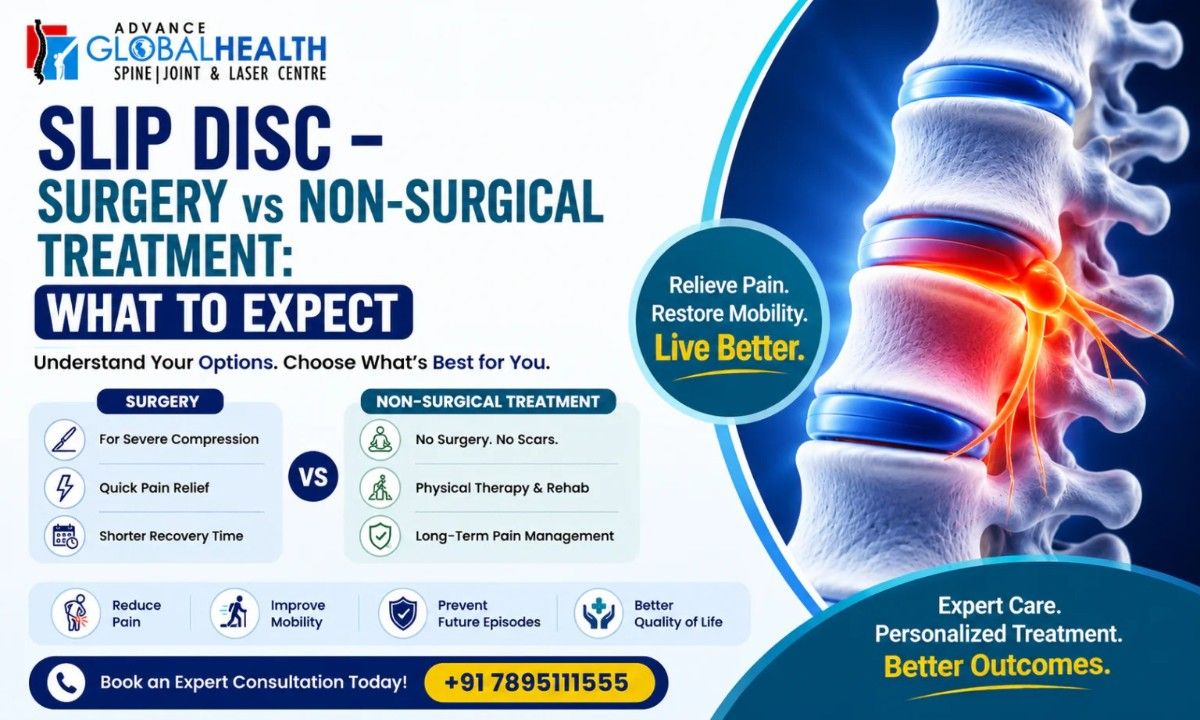
A slip disc, commonly referred to as a herniated, prolapsed, or bulging disc, can cause anything from mild lower-back discomfort to severe pain, sciatica, numbness, or weakness in the leg. One of the most common questions patients ask after receiving an MRI diagnosis is: “Do I need surgery, or can my slip disc be treated without surgery?”
The answer depends on the severity of the condition, neurological symptoms, duration of pain, and whether the affected disc is actually compressing a nerve.
The good news is that most people with a herniated disc do not automatically need surgery. Conservative treatment often helps symptoms improve over days or weeks, although recovery varies between individuals.
At Advance Global Health, the approach is to evaluate the patient’s symptoms and underlying spinal condition before recommending an appropriate treatment pathway.
People Also Like to read this: AVN Stage 3/4 Treatment Options Without Surgery: Is Hip Replacement the Only Choice?
What Is a Slip Disc?
The spine contains flexible discs between the vertebrae that act as cushions and help the spine move. A slip disc occurs when the inner material of a disc pushes through a weakened or damaged outer layer.
If the disc irritates or compresses a nearby nerve, it may cause:
- Lower-back pain
- Sciatica or pain travelling down the leg
- Tingling or pins and needles
- Numbness
- Leg or foot weakness
Difficulty sitting, standing, or walking
Importantly, an abnormal disc on an MRI does not always mean that it is the cause of your symptoms. Clinical symptoms and examination findings need to be considered alongside imaging.
Slip Disc Treatment Without Surgery
For many patients, slip disc treatment without surgery is an appropriate first approach, particularly when there is no serious or progressive neurological problem.
1. Physiotherapy and Rehabilitation
A structured rehabilitation program can help improve mobility, strengthen the core and supporting muscles, and help patients return to normal activities.
Exercises should be selected according to the individual’s symptoms rather than following a generic online exercise routine.
2. Activity Modification
Prolonged bed rest is generally not recommended for uncomplicated disc problems. Instead, patients are usually encouraged to remain gently active while temporarily avoiding activities that significantly aggravate symptoms.
Heavy lifting, repeated bending, and twisting may need to be modified during the painful phase.
3. Pain Management
Depending on the patient’s health and diagnosis, a doctor may recommend appropriate medications to control pain and inflammation. In selected cases, injections may also be considered.
4. Spinal Decompression and Other Non-Surgical Approaches
Some spine-care programs may incorporate controlled traction or decompression approaches for selected patients. These should be considered as part of an individualized treatment plan rather than promoted as a guaranteed cure for every slipped disc.
5. Lifestyle and Rehabilitation
Long-term management may also include:
- Improving posture and movement patterns
- Maintaining an appropriate body weight
- Strengthening the core
- Gradually increasing physical activity
- Learning safer lifting techniques
- Improving workplace ergonomics
The aim is not simply to reduce pain temporarily but to improve overall spinal function and help prevent recurrent problems.
When Is Surgery Considered?
Surgery is not the first option for every slip disc. It may be considered when symptoms remain severe or disabling despite appropriate non-surgical treatment, or when there is significant neurological impairment.
According to Mayo Clinic, surgery may be recommended in situations involving persistent serious symptoms, significant numbness or weakness, difficulty walking or standing, or loss of bladder/bowel control.
A common operation is a discectomy, in which the surgeon removes the portion of the disc that is pressing on the nerve. In appropriately selected patients, this can relieve nerve-related leg pain.
Surgery should therefore be considered based on the whole clinical picture, not simply because an MRI report says “disc protrusion” or “disc herniation.”
Surgery vs Non-Surgical Treatment: A Simple Comparison
| Factor | Non-Surgical Treatment | Surgery |
|---|---|---|
| Main goal | Reduce symptoms and improve function | Directly relieve significant nerve compression |
| Typical approach | Rehabilitation, exercise, activity modification, medication and selected procedures | Discectomy or another appropriate spinal procedure |
| Invasive? | Generally non-invasive/minimally invasive depending on treatment | Yes |
| Suitable for | Many uncomplicated cases | Selected patients with persistent/severe symptoms or neurological problems |
| Recovery | Usually gradual | Requires postoperative recovery and rehabilitation |
| Surgery always required? | No | Only when clinically indicated |
Evidence and clinical experience support starting with non-operative care for many patients, while surgery can be effective when appropriately selected patients do not improve or develop significant neurological problems.
What Treatment Can You Expect at Advance Global Health?
At Advance Global Health, the focus is on identifying the cause of back and leg symptoms before deciding whether surgery is necessary.
Depending on the patient’s condition, the treatment plan may include:
- Slip disc treatment without surgery
- Personalized physiotherapy and rehabilitation
- Core strengthening and mobility exercises
- Posture and ergonomic guidance
- Non-surgical spine-care approaches
- Spinal decompression/traction where clinically appropriate
- Pain-management strategies
- Appropriate image-guided interventions for selected patients
- Surgical evaluation when medically necessary
The objective is to reduce pain, improve mobility, restore function, and avoid unnecessary surgery whenever it is clinically appropriate.
However, it is important to be realistic: not every slip disc can or should be treated without surgery. Severe nerve compression, progressive weakness, or emergency neurological symptoms require prompt specialist assessment.
When Should You Seek Urgent Medical Attention?
Don’t wait for routine treatment if back pain is accompanied by:
- New loss of bladder or bowel control
- Numbness around the groin or saddle region
- Rapidly worsening weakness in the legs
- Severe difficulty walking
These symptoms can indicate serious nerve compression and require urgent medical evaluation.
Final Takeaway
A diagnosis of a slip disc does not automatically mean surgery. For many patients, an individualized non-surgical treatment program involving rehabilitation, exercise, activity modification, and appropriate medical care can provide significant improvement.
The key is to determine what is causing the symptoms, whether a nerve is actually being compressed, and how severe the problem is.
If you have been diagnosed with a slipped or herniated disc and are considering slip disc treatment without surgery, an evaluation by an experienced spine-care team can help you understand your options.
Learn more about spine and joint treatment at Advance Global Health.
Disclaimer: This article is for educational purposes only and should not replace an in-person medical evaluation. Treatment decisions should be based on clinical examination, symptoms, imaging, medical history, and individual circumstances.